
• -20%

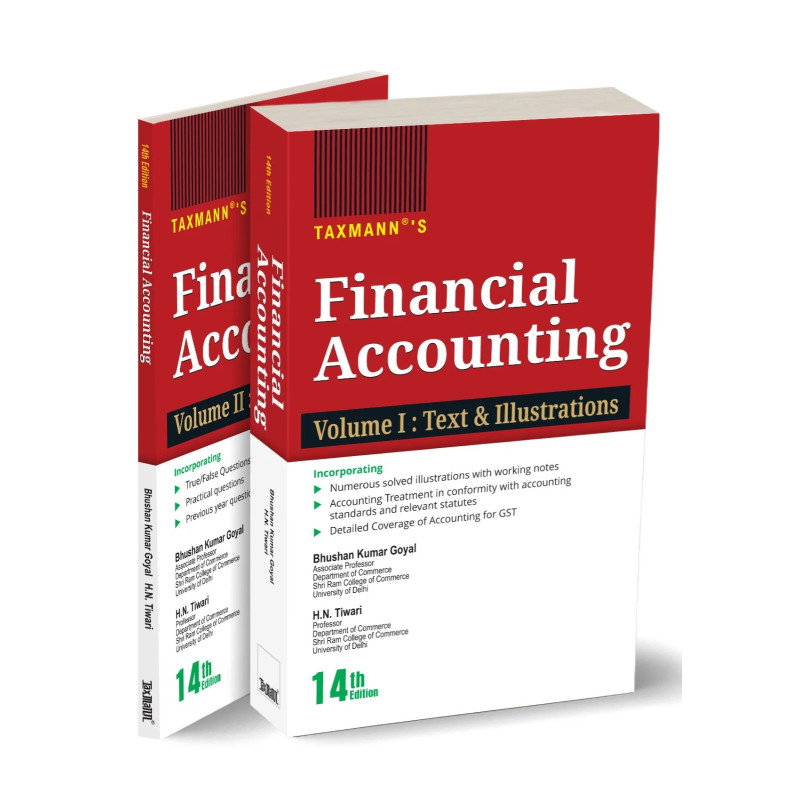
Taxmann Financial Accounting By Bhushan Kumar Goyal H.N Tiwari 14th Edition June 2026

₹1,145.00
₹916.00 Save 20%
Tax excluded
Quantity

Taxmann Financial Accounting Bhushan Kumar14th Edition June 2026

Taxmann Financial Accounting Bhushan Kumar14th Edition June 2026

Description

  • Financial Accounting is a comprehensive, authentic two-volume textbook that brings the theory, procedure, and practice of accounting together in a single, integrated treatment. It is written for undergraduate commerce students and is fully aligned with the Undergraduate Curriculum Framework (UGCF) prescribed under the National Education Policy (NEP), making it suitable for B.Com. and B.Com. (Hons.) programmes at universities throughout India.The book is deliberately student-oriented. Concepts are explained in simple language and developed in a systematic, building-block sequence, with particular care taken over the points students typically find difficult. Theory is anchored throughout to an extensive body of solved illustrations with working notes, and the major standards-based topics are presented under the relevant Accounting Standard (AS) and, where applicable, set against their Ind AS counterparts—so that students see the current Indian position alongside its IFRS-converged form.The work is delivered across two complementary volumes—Volume I (Text & Illustrations) carrying the conceptual and worked-example content, and Volume II (Assignments) carrying the practice apparatus of objective questions, practical problems, and previous-year question papers—keeping study and self-assessment structurally distinct yet fully coordinated.This book is intended for the following audience:
    • Undergraduate Commerce Students Pursuing B.Com. and B.Com. (Hons.) under the NEP/UGCF framework at universities across India
    • Candidates of Other Undergraduate and Postgraduate Programmes in which financial accounting is a core paper
    • Students of Management Courses requiring a rigorous grounding in financial accounting theory and practice
    • Aspirants to Professional Accountancy Qualifications who need a standards-aligned, first-principles foundation in financial accounting
    • Students of the School of Open Learning (SOL) and the Non-Collegiate Women’s Education Board (NCWEB), University of Delhi

    The Present Publication is the 14th Edition, authored by Bhushan Kumar Goyal and Dr H.N. Tiwari, and includes several noteworthy features:

    • [Solved Illustrations with Working Notes] A large number of fully solved illustrations, each supported by detailed working notes, so that students can follow the complete reasoning behind every solution
    • [Graded Problem Progression] Graded illustrations that progress from the elementary to the advanced, allowing students to build competence before attempting examination-standard problems
    • [AS-versus-Ind AS Comparisons] Dedicated AS-versus-Ind AS comparisons at the relevant topics—AS 4 with Ind AS 10; AS 5 with Ind AS 8; AS 29 with Ind AS 37; AS 26 with Ind AS 38; AS 2 with Ind AS 2; and AS 19 with Ind AS 17—with Ind AS 115 (Revenue from Contracts with Customers) additionally introduced by way of an overview
    • [Standards-Compliant Treatment] Accounting treatment given throughout in conformity with the Accounting Standards and the relevant statutes
    • [Accounting for GST] Detailed, worked coverage of accounting for Goods and Services Tax (GST), including its integration into the final accounts
    • [Latest Examination Questions] Most of the questions set in the December 2025 examination of the University of Delhi are reproduced and solved as illustrations, in addition to fresh illustrations added in this edition
    • [Student-Friendly Exposition] Simple language and a systematic, step-by-step build-up, with special emphasis on the points students generally find difficult
    • [Dedicated Assignment Volume] A dedicated assignment volume (Volume II) carrying True/False questions with reasoned answers, practical questions, and previous-year question papers for structured self-assessment
    • [Revised for the UGCF/NEP Syllabus] Thoroughly revised for this Edition in line with the UGCF syllabus under NEP, incorporating valuable suggestions received from the faculty of the University of Delhi

    The book provides end-to-end coverage of the financial accounting syllabus, spanning:

    • The Conceptual Framework of Accounting
      • Accounting as an information system; the users of accounting information and their information needs; the qualitative characteristics of financial statements; the functions, advantages, limitations and branches of accounting; and the cash and accrual bases—together with an overview of Artificial Intelligence and Data Analytics in accounting
    • Capital and Revenue Items
      • The distinction between capital and revenue expenditure, deferred revenue expenditure, the difference between expense and expenditure, and capital versus revenue receipts
    • Events Occurring After the Balance Sheet Date
      • Their meaning and types, with AS 4 set against Ind AS 10 (Events after the Reporting Period)
    • Net Profit or Loss, Extraordinary and Prior-Period Items
      • Ordinary activities, the components of net profit or loss, extraordinary and prior-period items, accounting estimates, accounting policies and fair value, with AS 5 set against Ind AS 8
    • Provisions, Contingent Liabilities and Contingent Assets
      • Recognition, measurement and disclosure, with AS 29 set against Ind AS 37
    • Generally Accepted Accounting Principles (GAAP)
      • The nature of accounting principles, accounting concepts, the fundamental accounting assumptions and accounting conventions
    • Accounting Standards and Ind AS
      • The meaning, objectives, benefits and limitations of standards; compliance; the role of the Accounting Standards Board and the National Financial Reporting Authority (NFRA); the procedure for issuing AS and Ind AS; applicability to companies and non-company entities; IFRS; the distinction between IFRS adoption and convergence; the benefits of Ind AS; the corporate roadmap for implementation; and the list of notified Ind AS
    • The Complete Accounting Process
      • The accounting equation and accounting cycle; the traditional and modern (accounting-equation-based) classification of accounts and their rules of debit and credit; recording in the journal; posting, balancing and the opening entry in the ledger; the full range of subsidiary books (cash book, purchases and sales books, purchases- and sales-returns books, bills receivable and bills payable books, and the journal proper); and the preparation of the trial balance
    • Accounting for Goods and Services Tax (GST)
      • The defects of the earlier indirect-tax structure; the objectives, advantages and characteristics of GST; the treatment of alcoholic liquor, tobacco and petroleum products; the categories of GST and the meanings of goods, services and supply; intra-state versus inter-state supply; the composition scheme; the levy and charging of GST; the accounting treatment; and the manner and order of set-off of input tax credit
    • Measurement of Business Income and Revenue Recognition
      • The concepts of revenue and business income; the relevance of the accounting period, the continuity doctrine and the matching concept; the economic concept of income; the salient features of AS 9 and the special situations it covers; and an overview of Ind AS 115 (Revenue from Contracts with Customers)
    • Property, Plant and Equipment And Depreciation
      • Recognition of an item of PPE; the causes of and factors determining depreciation; the methods of computing depreciation and the distinction between the straight-line and diminishing-balance methods; the accounting treatment of disposal, the exchange of a used asset, abnormal loss and the rectification of errors; changes in residual value, useful life and method of depreciation under AS 10 (Revised); and the impact of depreciation on the measurement of business income
    • Intangible Assets Under AS 26
      • Definition, recognition and initial measurement of acquired and internally generated intangibles; subsequent expenditure and measurement; amortisation and its review; impairment losses; retirement and disposal; disclosure and transitional provisions; application to computer software and websites; with AS 26 set against Ind AS 38
    • Inventory Valuation
      • The cost of inventories; periodic and perpetual record systems; the FIFO, LIFO and Weighted Average methods and the choice between them; the lower-of-cost-or-market rule; and AS 2 set against Ind AS 2, including the impact of the method chosen on the measurement of business income
    • Financial Statements of Non-Corporate Business Entities
      • The trading account, profit and loss account, manufacturing account and balance sheet; adjustments and the worksheet; the integration of GST into the final accounts; and the limitations of financial statements
    • Financial Statements of Not-for-Profit Organisations
      • The receipts and payments account, the income and expenditure account and the balance sheet; the treatment of peculiar items; and their preparation from, and reconstruction into, complete and incomplete records
    • Accounting for Inland Branches
      • The concept of dependent branches and the distinction from independent branches; the Debtors System, with goods sent to the branch both at cost and at a price above cost; and the Stock and Debtors System
    • Departmental Accounting
      • Its objectives and advantages; the distinction from branch accounting; types of departments; the allocation and apportionment of expenses; and inter-departmental transfers
    • Lease Accounting Under AS 19
      • The definition and classification of leases; the distinction between finance and operating leases; their accounting treatment; sale-and-leaseback transactions; and a comparison with Ind AS 17
    • Computerised Accounting Systems
      • Manual versus computerised accounting; the grouping and codification of accounts; the criteria for selecting accounting software; and working with Tally-Prime, from company, group and ledger creation through to the preparation of final accounts

    The work is delivered across two coordinated volumes.

    • Volume I — Text & Illustrations carries the full conceptual and worked-example treatment across twenty chapters, organised into five thematic blocks that follow the UGCF unit structure:
      • Theoretical Framework & the Accounting Process (Chapters 1–10) — The accounting system; capital and revenue expenditures and receipts; events after the balance sheet date; extraordinary items, prior-period items, estimates, policies and fair value; provisions and contingencies; financial accounting principles; Accounting Standards and Ind AS; the journal and ledger; subsidiary books, ledger and trial balance; and accounting for GST
      • Business Income, Assets & Inventory (Chapters 11–14) — Measurement of business income and revenue recognition; property, plant, equipment and depreciation; intangible assets; and inventory valuation
      • Financial Statements (Chapters 15–16) — Financial statements of non-corporate business entities and of not-for-profit organisations
      • Branch, Departmental & Lease Accounting (Chapters 17–19) — Accounting for inland branches; departmental accounting; and lease accounting
      • Computerised Accounting (Chapter 20) — Computerised accounting systems
    • Volume II — Assignments mirrors the text across twelve chapters of practice material—opening with objective (True/False) questions with answers, then practical questions arranged chapter-wise across the accounting process, PPE and depreciation, intangible assets, inventory, the financial statements of non-corporate and not-for-profit entities, branches, departments, leases and computerised accounting—and closing with a dedicated section of seven previous-year question papers of the University of Delhi (B.Com. and B.Com. (Hons.), UGCF) spanning March 2023 through December 2025
    • Uniform Chapter Architecture — Within Volume I, each chapter follows a consistent pedagogical scaffold:
      • It opens with a clearly stated set of Learning Objectives
      • The relevant theory is developed in simple language and in a logical, building-block sequence
      • For the relevant standards-based topics, the AS treatment is presented alongside a comparison with the corresponding Ind AS
      • The exposition is reinforced by numerous solved (and, where provided, graded) illustrations, each accompanied by detailed working notes, with entries and treatments in conformity with the applicable AS/Ind AS and statutory requirements

About the Author

Bhushan Kumar Goyal is an Associate Professor of Shri Ram College of Commerce, University of Delhi, Delhi. He did his B.Com (H) and M.Com from Shri Ram College of Commerce. Thereafter, he completed LL.B from University of Delhi.

He has been teaching Accounting for more than 39 years in Shri Ram College of Commerce. He has been visiting faculty at the Institute of Chartered Accountants of India and Institute of Company Secretaries of India.
Harendra Nath Tiwari is an Associate Professor at the Commerce Department, Shri Ram College of Commerce (SRCC), University of Delhi. He is an alumnus of the Department of Commerce, the University of Delhi, where he obtained his post-gradua
Taxmann
49 Items

Specific References