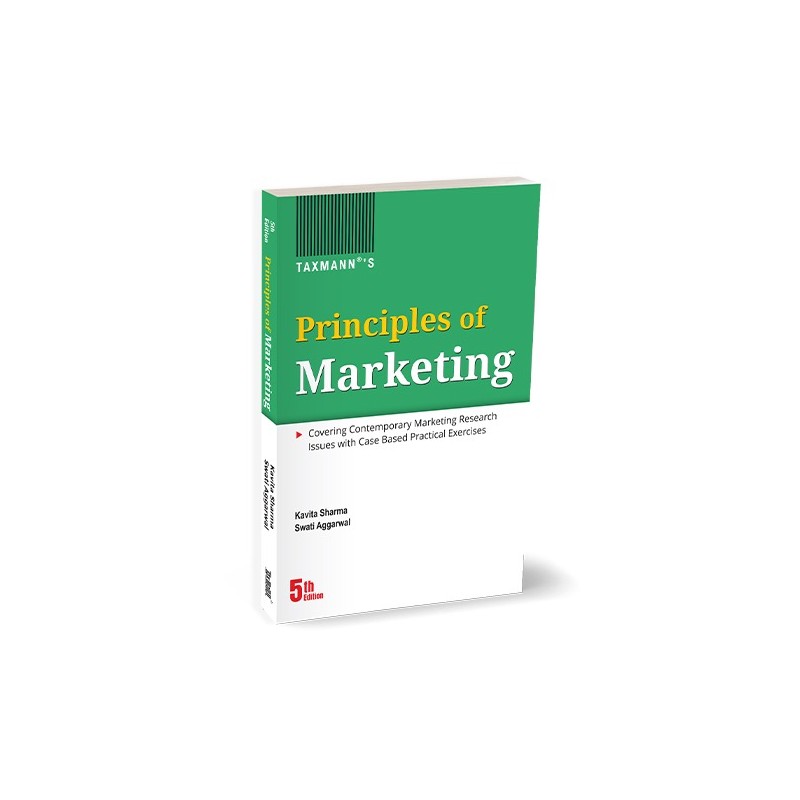
Principles of Marketing is a complete, lucid, and classroom-ready textbook that introduces students to the full landscape of modern marketing—from the foundational concepts of what marketing is and why it matters, right through to the contemporary research issues shaping the discipline today. Written by two senior faculty members from the University of Delhi, the book distils decades of teaching and research experience into a single, accessible volume designed specifically for Indian graduate and postgraduate learners.
What sets this Edition apart is its deliberate balance of theory and practice. Every core concept is anchored in extant marketing literature, then brought to life through richly illustrated examples, product advertisements, figures, flow charts, and—crucially—real business cases drawn from the Indian context. The book moves beyond rote learning by embedding case-based practical exercises aligned with the National Education Policy (NEP), encouraging students to critically analyse, apply, and debate the ideas they encounter rather than simply memorise them.
This Edition reflects the evolving norms of the field, giving prominence to sustainable marketing, holistic marketing, digital and social-media marketing, and the research questions confronting marketers in a fast-changing, technology-driven business environment. The result is a text that reads as an experience—comprehensive enough to serve as a primary course book, yet practical enough for those already working in the field.
The book is written to meet the learning needs of undergraduate and postgraduate commerce and management courses, including:
- B.Com (Hons.) and B.Com Students
- BBA and MBA Students
- Learners Across Other Commerce and Management Programmes where marketing is taught as a core or elective paper
Because its cases and exercises follow the NEP framework—and reflect curriculum structures such as the LOCF and UGCF—it is well suited to universities that have adopted outcome-based, application-oriented syllabi. Beyond the classroom, practising marketers, management trainees, and teachers will also find the case-based exercises and Indian-context illustrations valuable references for connecting principles to practice.
The Present Publication is the 5th Edition, authored by Sr. Prof. (Dr) Kavita Sharma and Dr Swati Aggarwal, with the following noteworthy features:
- [Comprehensive Yet Lucid] A single, self-contained text that caters to the full learning needs of a graduate-level marketing course
- [Visually Engaging] Chapter discussion is supported throughout by relevant product advertisements, figures, tables, and flow charts, making the reading itself an experience
- [Discussion Questions] Each chapter closes with a set of review questions to consolidate and test the concepts covered
- [Real-World Case Studies] Carefully compiled from secondary sources, these cases help students practise the critical analysis of concepts, using recognisable brands and companies
- [NEP-aligned Case-based Exercises] Practical, application-oriented exercises incorporated at the chapter end in line with the National Education Policy, deepening conceptual understanding
- [Contemporary and Research-forward] Comprehensive coverage of modern marketing research issues, real business challenges, and consumer-behaviour insights in both the Indian and global context
- [Written by Indian Authors] Deliberately addresses the dearth of graduate-level marketing texts by Indian authors, with all cases and examples set in the Indian context
The book offers end-to-end coverage of the marketing discipline, organised so that students build understanding progressively—from fundamentals, to market selection, to each element of the marketing mix, and finally to emerging developments and research frontiers:
- Foundations of Marketing
- The meaning, nature, scope, and importance of marketing; core concepts and marketing philosophies; the selling-versus-marketing distinction; the components of the marketing mix; and an introduction to services marketing
- The Marketing Environment
- The micro and macro environmental forces that shape and constrain marketers' decisions
- Consumer Behaviour
- The consumer buying process and the psychological, personal, social, and cultural factors that influence buying decisions
- Market Selection (STP)
- Segmentation, targeting, and positioning, including bases of segmentation, targeting choices, positioning and repositioning, and differentiation strategy
- Product Decisions
- Levels of product, product classification, product-mix decisions, branding and brand building, packaging, labelling, and support services; plus the new product development process and the product life cycle
- Pricing Decisions
- Pricing objectives, factors affecting price, major pricing methods, policies and strategies, price-adjustment strategies, and ethical issues in pricing
- Distribution and Retailing
- The meaning and importance of channels, channel types and choice, distribution logistics, and an overview of retailing (store-based and non-store) and the changing retail scenario in India
- Promotion Decisions
- The communication process; the promotion mix; advertising, personal selling, sales promotion, public relations and publicity, direct marketing, and integrated marketing communication (IMC)
- Relationship Marketing
- Transactional versus relationship marketing, dimensions and scope of customer relationships, and a collaborative approach to retaining customers
- Developments in Marketing
- Ethics in marketing (including deceptive and unfair use of promotion and possible courses of action), green and sustainable marketing, rural marketing, social marketing, and digital marketing
- Research Issues in Marketing
- Modern marketing practices, contemporary issues, and the open research questions facing marketers today
- Indian-context Case Studies
- Concepts are reinforced with a strong roster of case studies featuring companies and brands such as Britannia, Apollo Hospitals, Nestlé, Gillette, Airtel, Patanjali, Toyota, Starbucks, Pepsi, BPCL, and Maggi
The book is organised into five units and thirteen chapters, progressing from the fundamentals of marketing through market selection and the elements of the marketing mix to emerging developments and research issues. Within this framework, every chapter is authored to follow the same consistent flow, so students always know what to expect:
- Concept Discussion — The chapter opens by developing its core concepts in clear, lucid prose, supported throughout by visuals—product advertisements, figures, tables, and flow charts—that make the ideas easy to follow and the reading an experience
- Discussion Questions — A set of review questions then allows students to revisit, consolidate, and test their understanding of the concepts covered in the chapter
- Case Study (or Studies) —One or more real, Indian-context case studies—compiled from secondary sources—follow, prompting students to apply the concepts and practise their critical analysis
- Case-based Practical Exercise — Each chapter closes with an NEP-aligned, application-oriented exercise that deepens conceptual understanding and builds hands-on problem-solving skills
- Predictable Design — Concept → discussion questions → case studies → case-based exercise—repeats across all thirteen chapters, giving the book a uniform, easy-to-navigate learning structure