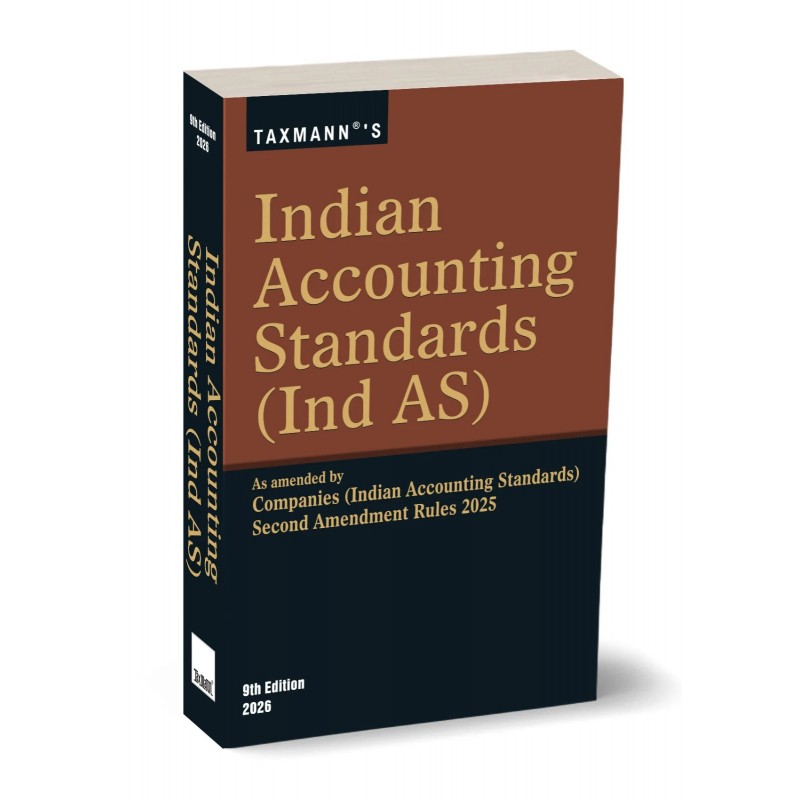
Indian Accounting Standards (Ind AS) is a comprehensive, single-volume compendium that reproduces the complete, authenticated text of every Indian Accounting Standard notified under the Companies Act 2013, together with the Companies (Indian Accounting Standards) Rules 2015, the Schedule to those Rules, and an extensive, practitioner-oriented Guide to Indian Accounting Standards that decodes the entire framework in plain, application-ready language.
What distinguishes this volume from an ordinary bare-text compilation is its annotation. The text is threaded with 489 numbered amendment footnotes that record precisely how each paragraph reached its present form—noting whether it was inserted, substituted, or omitted, by which amendment rules, and with effect from which date. These annotations trace the full amendment lineage from the Companies (Indian Accounting Standards) (Amendment) Rules 2016 right through to the Amendment and Second Amendment Rules 2025. For a professional taking a technical position, drafting an audit file note, or defending a treatment before a regulator, this amendment trail is the difference between a book you read and a book you rely on.
This Edition (2026) has been fully updated to reflect the law as amended by the Companies (Indian Accounting Standards) Second Amendment Rules 2025, with the law stated as updated till 1st July 2026—making it current, authoritative, and ready for the 2026 reporting cycle.
India adopted a ‘convergence’ approach rather than full adoption of IFRS, and the book takes that distinction seriously: it devotes dedicated sections to the carve-ins and carve-outs that make Ind AS contextually appropriate to the Indian economy, legal environment, and commercial practice—and every standard closes with an ‘Appendix 1’ setting out where and why Ind AS departs from its international counterpart. There are 40 such appendices in the volume.
This book serves anyone who prepares, audits, advises on, teaches, or studies financial statements under the Ind AS framework:
- Chartered Accountants (CAs), Company Secretaries (CSs) and Cost & Management Accountants (CMAs)—in practice and in industry
- Statutory, Internal and Forensic Auditors, who need the authenticated text plus the amendment history to evidence which version of a paragraph applied in a given reporting period
- CFOs, Financial Controllers, and Finance & Accounts Teams of Companies reporting under Ind AS
- Preparers of Standalone and Consolidated Financial Statements, navigating first-time adoption, business combinations, financial instruments, leases, revenue, and impairment
- Insurers and their Advisers, for whom the retained text of Ind AS 104 in the Schedule remains directly relevant
- Students and Faculty in CA/CS/CMA and University Accounting and Finance Programmes—the bare text, the Guide, and the comparison tables together form a complete study companion
- Legal, Compliance and Secretarial Professionals, and Regulators, Consultants and Advisers requiring an authoritative, current reference on Indian accounting law
The Present Publication is the 9th Edition, updated till 1st July 2026, edited by Taxmann’s Editorial Board, with the following noteworthy features:
- [Complete & Authenticated Text] Every notified Indian Accounting Standard is reproduced in full and in the officially notified sequence, preserving the statutory convention that paragraphs set in bold type and in plain type have equal authority, with bold type indicating the main principles
- [489 Numbered Amendment Footnotes] The volume’s single most valuable feature. Each records the exact change (‘Inserted by…’, ‘Substituted for…’, ‘Omitted by…’) together with the notifying rules and the effective date, spanning the 2016, 2017, 2018, 2019, 2020, 2021, 2022, 2023, 2024 and 2025 amendment rules. Substitutions and insertions dominate, and many footnotes reproduce the superseded wording verbatim (‘Prior to its omission, paragraph D9A read as under’). Amendment history is not summarised; it is embedded paragraph by paragraph
- [Fully Updated for 2026] Incorporates the Companies (Indian Accounting Standards) Amendment Rules 2025 and the Second Amendment Rules 2025, with the law stated till 1st July 2026
- [A 9-Part ‘Guide to Indian Accounting Standards’] A substantial guide opening the volume, covering the framework, the phased applicability roadmap, first-time adoption, the conceptual framework, an Ind AS vs. AS comparison, MAPI FAQs, and a two-part treatment of Ind AS vs. IFRS
- [40 IFRS/IAS Comparison Appendices] An ‘Appendix 1’ at the end of every standard highlights the major differences between it and its international counterpart—40 such appendices in total (17 measured against IFRS, 23 against IAS), covering all 39 live standards plus Ind AS 104 in the Schedule. Each carries the express caveat that the appendix ‘is not a part of’ the standard. (Ind AS 101’s is headed ‘Major differences between Ind AS 101 and IFRS 1’; the remainder read ‘Comparison with IFRS/IAS …’)
- [Complete Appendix Architecture Preserved] For each standard: Defined terms, Application guidance, References to matters contained in other Indian Accounting Standards, Effective date and transition, and the erstwhile interpretations now folded in as appendices (e.g., Service Concession Arrangements; Changes in Existing Decommissioning, Restoration and Similar Liabilities)
- [Omitted Standards Retained as Annotated Placeholders] Ind AS 11 (Construction Contracts), Ind AS 17 (Leases) and Ind AS 18 (Revenue) are not silently dropped: each appears in its proper place with a bracketed note recording its omission and its prior amendment history, so historical positions remain traceable
- [The Full Ind AS 104 Story, Told Accurately] Ind AS 104 (Insurance Contracts) was omitted from the Annexure by the Amendment Rules 2024, w.e.f. 12-8-2024—and then reinstated in full as the Schedule by the Third Amendment Rules 2024, w.e.f. 28-9-2024. The book carries both: the annotated placeholder in the main body, and the complete retained text in the Schedule, for insurers still entitled to apply it alongside the arrival of Ind AS 117
- [15 Detailed MAPI FAQs] Fifteen FAQs on Material Accounting Policy Information, addressing the amendment to Ind AS 1 and clarifying the shift from disclosing ‘significant accounting policies’ to disclosing ‘material accounting policy information’
- [Reader-friendly Navigation] A detailed contents map with page references against each standard, plus running heads carrying the standard name and paragraph/appendix reference on every page, enabling fast and precise look-ups
The volume brings together the three layers of the Ind AS framework—the interpretive guide, the enabling rules, and the standards themselves—plus the Schedule.
- Guide to Indian Accounting Standards (9 Sections)
- Introduction—the competing reporting frameworks (IFRS, US GAAP, AS, Ind AS); why harmonisation matters; India’s decision to adopt a convergence rather than full adoption approach
- Effective dates and applicability—the MCA roadmap announced in February 2015:
- Voluntary adoption for periods beginning on or after 1st April 2015
- Phase 1 (mandatory, from 1st April 2016): listed/to-be-listed companies with net worth ≥ ₹500 crore; other companies with net worth ≥ ₹500 crore; and their holding, subsidiary, joint venture and associate companies
- Phase 2 (mandatory, from 1st April 2017): listed/to-be-listed companies with net worth < ₹500 crore; unlisted companies with net worth ≥ ₹250 crore but < ₹500 crore; and their group companies
- Plus the critical practical rules—adoption is irreversible; group companies are pulled in automatically; thresholds are tested on standalone financials as at 31st March 2014; SME-exchange-listed companies are exempt (though they may adopt voluntarily); and banks, NBFCs and insurers follow a separately announced roadmap
- First-Time Adoption of Ind AS and tts Challenges—the transition date concept (with worked illustration); principles for preparing the opening Ind AS Balance Sheet; the mandatory exceptions and optional exemptions under Ind AS 101; the requirement for at least three Balance Sheets, two Statements of Profit and Loss, two Statements of Cash Flows and two Statements of Changes in Equity; and the reconciliations explaining the transition from previous GAAP
- Format and Framework of Ind AS Financial Statements—Ind AS prescribes no format; Division II of Schedule III to the Companies Act 2013 supplies the framework and minimum requirements
- Conceptual Framework for Financial Reporting under Ind AS—objectives and limitations of general purpose financial reporting; relevance, materiality and comparability; the cost constraint; the elements of financial statements; recognition, measurement, derecognition, presentation and disclosure; capital maintenance
- Differences Between Ind AS and Accounting Standards (as Notified in the Companies (Accounting Standards) Rules 2021)—an itemised treatment covering other comprehensive income and the statement of changes in equity; MAPI; the removal of extraordinary items; retrospective correction of prior period errors; the third balance sheet; the balance sheet vs. income statement approach to deferred tax; past service cost and actuarial gains/losses; functional vs. presentation currency; useful life of intangibles; irreversibility of goodwill impairment; constructive obligations; fair value in business combinations; the control model for consolidation; financial instruments; fair value measurement; and lessee right-of-use accounting.
- Frequently Asked Questions on Material Accounting Policy Information (MAPI)—15 FAQs unpacking the MCA notification amending Ind AS 1 (including the newly inserted Para 139V) and the imported Ind AS 8 definition of ‘accounting policies’ (principles, bases, conventions, rules and practices)
- Comparison Between Ind ASs and IFRSs—the carve-outs and carve-ins, explained with reasons: the deemed-cost option for PPE and intangibles on transition; long-term foreign currency monetary items; common-control business combinations (Appendix C to Ind AS 103); bargain purchase gain routed to OCI and capital reserve rather than profit or loss; EPS disclosure relief; and Ind AS 40’s cost-model-only requirement for investment property
- Tabular Comparison of Ind AS with Corresponding IFRS—a clean, at-a-glance mapping table of every Ind AS against its IFRS/IAS counterpart
- Companies (Indian Accounting Standards) Rules 2015
- Rules 1–5 in full—short title and commencement; definitions; applicability of accounting standards; obligation to comply with Ind AS; and exemptions—followed by the Annexure (General Instructions, and the standards themselves), each carrying its own amendment footnotes
- The Complete Text of All Notified Indian Accounting Standards
- Ind AS 101–117
- Ind AS 1–41
- The Schedule
- The concluding Schedule reproduces the complete text of Ind AS 104, Insurance Contracts, retained for insurers entitled to continue applying it. Inserted by the Companies (Indian Accounting Standards) Third Amendment Rules 2024, w.e.f. 28th September 2024, it carries its own objective, scope, appendices and comparison notes against IFRS 4
The volume follows a deliberate three-movement progression—context → law → application — with a fourth, specialist coda.
- Guide — Before a reader meets a single paragraph of bare text, the nine-part Guide establishes why Ind AS exists, who must apply it, when, how an entity transitions to it, and where it departs from both the old Accounting Standards and IFRS. Standards are therefore approached with the conceptual scaffolding already in place
- Rules — The Companies (Indian Accounting Standards) Rules 2015 establish applicability, the obligation to comply, and exemptions. This is the legal foundation on which every subsequent standard rests, and it is itself subject to amendment.
- Standards Appear in Notified Sequence — The full text of each Ind AS follows in official order—Ind AS 101 through 117, then Ind AS 1 through 41—mirroring the arrangement in the notified Rules rather than renumbering them for convenience
- Schedule — It closes the volume, carrying the retained text of Ind AS 104
- Navigation is supported by a detailed front-of-book contents map with page references against every standard, and by running heads on each page that carry the standard’s name alongside the paragraph or appendix reference—so a reader chasing ‘Ind AS 12, Para 22’ or ‘Ind AS 105, Appendix C’ can land on it directly.
Taxmann’s Research & Editorial Board includes Chartered Accountants, Company Secretaries, and Lawyers working under the editorial direction of Editor-In-Chief Mr Rakesh Bhargava. The team operates at the junction of legal expertise and editorial rigour, producing content that meets the high standards of India’s professional knowledge community. All content is sourced solely from authorised statutory repositories and is continuously updated to reflect the latest judicial pronouncements and legislative changes. Analysis is based on primary references—sections, rules, circulars, notifications, and rulings—ensuring that every insight is traceable, defensible, and practice-ready.