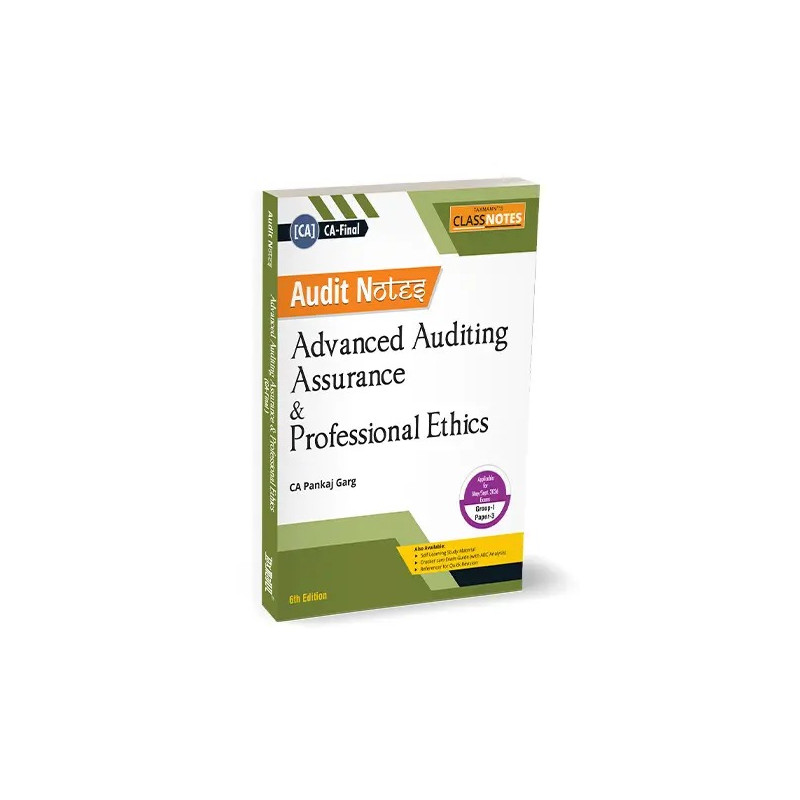
The Present Publication is the 6th Edition, authored by Pankaj Garg, with the following noteworthy features:
[Concise—To-the-point Presentation] Each concept is expressed in short, exam-ready sentences without unnecessary text
[Tabular & Visual Learning] Every topic is summarised through charts, tables, and flow diagrams for instant comprehension
[Amendments Incorporated] Updated with the latest ICAI pronouncements and CARO 2020 clarifications
[Colour-coded Highlights] Core principles, examples, and exceptions marked distinctly for faster scanning.
[Practical Illustrations] Includes audit templates
[Comprehensive Professional Ethics Coverage] All Clauses, ceilings, indebtedness limits, and UDIN rules explained
[Smart Revision Tool] Perfect for last-day brushing of standards and ethics
The book is organised into 19 chapters that collectively cover the entire CA Final Paper 3 syllabus:
Part A — Auditing Standards & Core Concepts (Chapters 1–7)
Chapter 1 — Quality Control (QC) | Covers SQC 1 (quality control for firms) and SA 220 (quality control for individual audit engagements), including leadership responsibilities, ethical requirements, acceptance and continuance of engagements, human resources, engagement performance (consultation, EQCR, differences of opinion), documentation, and monitoring
Chapter 2 — General Auditing Principles & Auditor Responsibilities | Deals with fraud and error (SA 240), laws and regulations (SA 250), communication with TCWG (SA 260), communication of deficiencies in internal control (SA 265), and related standards on auditor responsibilities
Chapter 3 — Audit Planning, Strategy and Execution | Covers overall audit strategy, audit plan (SA 300), terms of engagement (SA 210), use of internal auditors (SA 610), use of auditor’s expert (SA 620), related party transactions (SA 550), opening balances (SA 510), and more
Chapter 4 — Materiality, Risk Assessment and Internal Control | Comprehensive treatment of materiality (SA 320), risk assessment procedures (SA 315), auditor’s response to assessed risks (SA 330), and evaluation of internal controls
Chapter 5 — Audit Evidence | Covers SA 500 (audit evidence), SA 501 (specific items), SA 505 (external confirmations), SA 520 (analytical procedures), SA 530 (audit sampling), SA 540 (accounting estimates), and SA 550 (related parties)
Chapter 6 — Completion and Review | Deals with subsequent events (SA 560), going concern (SA 570), written representations (SA 580), and procedures for completion of the audit
Chapter 7 — Reporting | Extensive coverage of forming an opinion (SA 700), modified opinions (SA 705), emphasis of matter and other matter paragraphs (SA 706), Key Audit Matters (SA 701), comparative information (SA 710), other information (SA 720), and CARO 2020 reporting requirements
Part B — Specialised Areas & Related Services (Chapters 8–11)
Chapter 8 — Specialised Areas | Audit of SMEs, audits in an automated environment, summary financial statements, and other specialised engagement areas
Chapter 9 — Related Services | Compilation engagements (SRS 4410), agreed-upon procedures (SRS 4400), and the framework for assurance engagements
Chapter 10 — Review of Financial Information | Review engagements including SRE 2400 (review of historical financial statements) and SRE 2410 (review of interim financial information)
Chapter 11 — Prospective Financial Information and Other Assurance Services | Examination of prospective financial information (SAE 3400) and other assurance services
Part C — Digital Auditing & Group Audit (Chapters 12–13)
Chapter 12 — Digital Auditing and Assurance | Covers IT dependencies in auditing (automated controls, reports, calculations, security, interfaces), General IT Controls, CAATs, data analytics in audit, emerging technologies (AI, blockchain, cloud computing), and cybersecurity considerations
Chapter 13 — Group Audit | Detailed coverage of SA 600 (special considerations for group audits), including the role of the group auditor, component auditors, communication requirements, and consolidation procedures
Part D — Industry-Specific Audits (Chapters 14A–16)
Chapter 14A — Audit of Banks | RBI framework, statutory central auditor scope, Long Form Audit Report (LFAR), concurrent audit, NPA classification, income recognition, asset classification and provisioning, capital adequacy, treasury operations, and related certifications
Chapter 14B — Audit of NBFCs | RBI guidelines for NBFCs, prudential norms, asset classification, provisioning requirements, and specific audit considerations for non-banking financial companies
Chapter 15 — Audit of Public Sector Undertakings (PSUs) | CAG framework, government audit standards, performance audit, compliance audit, and special features of PSU auditing
Chapter 16 — Internal Audit | Internal audit standards, risk-based internal audit, internal audit in different environments, and the relationship between internal and external audit
Part E — Investigation, Assurance & Ethics (Chapters 17–19)
Chapter 17 — Investigation, Due Diligence and Forensic Accounting | Types of investigations, due diligence procedures, fraud detection frameworks (fraud diamond), indicators of fraud, forensic accounting techniques, and the auditor’s role in fraud detection
Chapter 18 — SDG and ESG Assurance | Sustainable Development Goals, Environmental/Social/Governance reporting, ESG assurance frameworks, BRSR (Business Responsibility and Sustainability Reporting), and the auditor’s role in sustainability assurance
Chapter 19 — Professional Ethics & Liabilities of Auditors | Comprehensive coverage of the Chartered Accountants Act 1949, Code of Ethics, independence requirements, fee-related provisions, professional misconduct (First and Second Schedules), tax audit assignment limits, liabilities under the Companies Act 2013, and disciplinary proceedings
About the author
Pankaj Garg is a Chartered Accountant, Company Secretary and Cost Accountant. He is an All India Toppe