CS Executive CMSL Cracker N.S. Zad Dec 26 & June 27
CS Executive CMSL Cracker N.S. Zad Dec 26 & June 27
Description
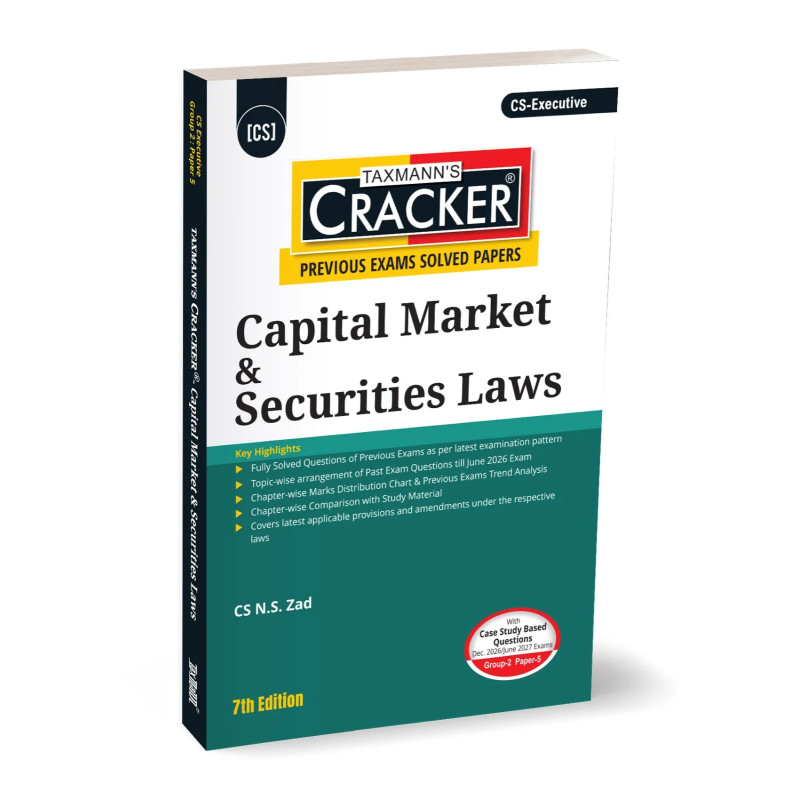
Capital Market & Securities Laws – CRACKER is the exam-oriented companion to the CS-Executive (Group 2 | Paper 5) paper. It compiles the previous examination questions set by the Institute of Company Secretaries of India (ICSI), rearranges them topic by topic, and answers each one in full, written strictly to the latest examination pattern of the paper, including the case-study-based questions that now carry a fixed weight in every sitting.
The method is deliberately practical: rather than studying the law in the abstract, the candidate works through the exact questions ICSI has asked, sees the depth and structure expected of a model answer, and learns to apply the securities laws to descriptive, problem-based and scenario-based situations alike. Across the book the answers are anchored in authority—exact section, regulation and SEBI-circular references, supported by tribunal and judicial precedent—so that solutions read the way the examiner expects them to. This Edition is applicable for the December 2026 and June 2027 examinations.
The Present Publication is the 7th Edition | June 2026, authored by CS N.S. Zad, with the following noteworthy features:
[Fully Solved Past-Exam Questions] Answered to the latest examination pattern; every question is worked out in full, showing the expected depth, structure and statutory referencing of a model answer
[Topic-wise Arrangement] Past questions up to and including the June 2026 examination are regrouped under the relevant topic, so everything ICSI has asked on a point sits together for focused revision
[Worked Practical & Numerical Problems] Net-asset-value and return computations with portfolio-valuation tables for mutual funds, plus dedicated problem sets on capital-market instruments and derivatives, each solved step by step
[Answers Referenced to Source] Solutions cite the precise section, regulation and, where relevant, the exact SEBI circular by number and date, training the candidate to anchor every answer in authority
[Grounded in Decided Matters] Answers draw on tribunal and judicial precedent (SAT, High Courts and the Supreme Court) and on SEBI informal-guidance and order matters, which is how the application-type and case-study questions are expected to be answered
[Comparison Tables] ‘Distinguish between’ topics are laid out point-by-point for quick recall and clean reproduction in the exam
[Chapter-wise Marks-Distribution Chart] Covering the recent sittings from 2021 to June 2026, with a per-chapter average to guide where revision time should go
[Previous-Exams Trend Analysis] For the most recent sittings (December 2023 to June 2026), classifying each question by chapter, marks and category (descriptive vs practical) to reveal the recurring and high-yield areas
[Comparison with the ICSI Study Material] A mapping of every chapter to its corresponding Study Material chapter, so the two can be used together without gaps
[Updated with the Latest Law] The latest applicable provisions and amendments are integrated (including recent 2023–2025 changes to the regulatory framework), so answers reflect the position as it stands for the upcoming sittings
[Dedicated Case-Study Chapter] Six fully solved, multi-part case studies, mirroring the application component that has consistently carried 20 marks in recent sittings
[Solved June 2026 Paper] The complete question paper across Part I and Part II, reproduced with suggested answers for a full-length, current-pattern mock
The book is divided into two integrated parts, covering the full breadth of the Paper 5 syllabus:
Capital Market
Basics of the Capital Market — The organisational structure of the financial system and the role and functions of the securities market, together with the instruments and investor classes that populate it: alternative investment funds, private equity, high-net-worth individuals, pension funds, and foreign-currency convertible and exchangeable bonds
Secondary Market in India — Stock markets and stock exchanges, book closure and record date, and quantitative practice on capital-market instruments and on derivatives
Securities Contracts (Regulation) Act 1956 — Its objects, applicability and defined terms
Securities and Exchange Board of India — Its objectives, duties and functions
Depositories & Depository Participants — The depository system and the Depositories Act 1996, covering the dematerialised holding of securities and the role of depository participants
Securities-Market Intermediaries — Merchant bankers, custodians of securities, investment advisers, research analysts and foreign portfolio investors
International Financial Services Centres Authority (IFSCA) — The importance, necessity, tax position and benefits of an IFSC, and the listing and trading of securities within it
Securities Laws
Issue of Capital & Disclosure Requirements — Basic concepts of a securities issue, book-building, initial public offers, lock-in of securities, issuance conditions and procedure, the exit opportunity for dissenting shareholders, fast-track issues, preferential issues and bonus issues
Share-Based Employee Benefits & Sweat Equity — It includes the related provisions of the Companies Act 2013
Issue & Listing of Non-Convertible Securities — Along with the listing of privately placed debt
Listing Obligations & Disclosure Requirements — Applicability and disclosures, the various board committees and policies, related-party transactions, continuing obligations, and a set of questions framed around specific SEBI circulars
Substantial Acquisition of Shares & Takeovers — Applicability and objectives, the obligations under the Takeover Regulations, and the open-offer framework
Prohibition of Insider Trading — Restrictions on communication and trading by insiders, disclosure of trading, and the codes of fair disclosure and conduct
Prohibition of Fraudulent & Unfair Trade Practices — Relating to the securities market
Delisting of Equity Shares — Including compulsory delisting
Buy-Back of Securities — Its objectives and conditions, the tender-offer route, and the attendant obligations and exemptions
Mutual Funds — Basic concepts, their advantages and limitations, the SEBI (Mutual Fund) Regulations, and the computation of net asset value and returns
Collective Investment Schemes — Along with the SEBI provisions that govern them
Case Study Based Questions — A dedicated set of application-based case studies drawn from real SEBI guidance, regulatory orders and judicial matters
The book follows two parts that mirror the two limbs of the syllabus, followed by a dedicated case-study segment and the current solved paper:
Part I | Capital Market (Chapters 1–7) — Basics of the capital market, the secondary market, the Securities Contracts (Regulation) Act, SEBI, depositories and depository participants, securities-market intermediaries, and the IFSCA
Part II | Securities Laws (Chapters 8–18) — Issue of capital and disclosure requirements, share-based employee benefits and sweat equity, issue and listing of non-convertible securities, listing obligations and disclosure requirements, takeovers, insider trading, prohibition of fraudulent and unfair trade practices, delisting, buy-back, mutual funds and collective investment schemes
Case Study Based Questions (Chapter 19) — Six standalone, multi-part case studies, fully solved, that test the securities-laws topics against extended, realistic fact patterns
Solved Paper | June 2026 — The complete question paper across Part I and Part II, reproduced with suggested answers
Within each chapter, the internal architecture is uniform:
Topic-wise Grouping — Past exam questions are arranged under topic headings, so all questions on a given concept appear together
Exam Tagging — Every question is tagged with the sitting(s) and marks in which it appeared (month, year and mark value), with repeat questions showing each appearance
Fully Worked Answers — Each question is followed by a complete solution setting out the governing provisions, regulation numbers and circular references, supported by distinguishing tables and step-by-step reasoning where useful
Theory and Problems Together — Descriptive theory questions sit alongside practical and problem-based questions, with dedicated problem-and-solution groupings where the subject is quantitative (capital-market instruments, derivatives and net-asset-value computations) and, in the listing chapter, a separate set of circular-based questions
Analytical Front Matter and Closing Paper — The chapters are preceded by the analytical preliminary pages (the marks chart, the trend analysis and the Study Material comparison) and are closed by the June 2026 solved paper.
About the Author-
N.S. Zad obtained his Commerce degree from Shivaji University, Kolhapur, and cleared the CS Final Exam in June 2005, conducted by the Institute of Company Secretaries of India. He has been teaching for the last ten years and has extensive teaching experience in various professional courses, including CA, CS, and CWA, at the IPCC/Executive and Final Levels. He has practical experience working with medium and large-sized organisations and firms of practising company secretaries.