CS Executive Setting Up Business Industrial & Labour Laws Cracker N.S. Zad Dec 26 & June 27
CS Executive Setting Up Business Industrial & Labour Laws Cracker N.S. Zad Dec 26 & June 27
Description
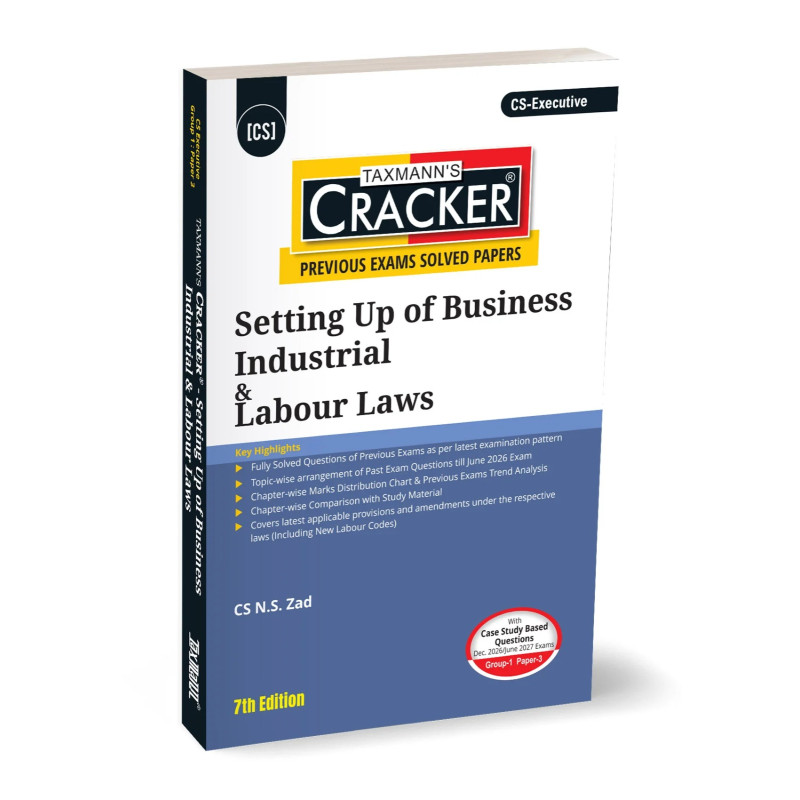
Setting Up of Business, Industrial & Labour Laws – CRACKER is a comprehensive, examination-focused question bank prepared strictly in accordance with the latest ICSI examination pattern. Part of Taxmann’s established CRACKER series, it is built to do one job exceptionally well—to convert a student’s conceptual understanding into examination-ready answers. Every question it carries is fully solved, arranged topic-wise under the relevant chapter, and written in the manner the examiner expects, so that practice, self-assessment, and last-mile revision can all happen within a single resource.
The book is calibrated to the most significant recent development in this paper—the shift towards application-led, case-study-based assessment, which the book’s own Chapter-wise Marks Distribution chart identifies as the single highest-weighted area. Through a dedicated chapter of cross-syllabus case studies and a complete, solved June 2026 question paper, it trains students to read a factual situation, locate the governing provision (including under the new Labour Codes), apply settled judicial principles, and present a precise, reasoned answer rather than reproduce theory.
The Present Publication is the 7th Edition, authored by CS N.S. Zad, with the following noteworthy features:
[Fully Solved Previous Exam Questions] Questions of previous examinations solved as per the latest examination pattern—so students absorb both the substance of the answer and its expected structure
[Topic-wise Question Arrangement] Past-examination questions up to the June 2026 exam grouped under the relevant chapter for sequential, syllabus-aligned practice
[Questions Recast under Current Law] Long-standing, repeatedly-tested questions combined with the most recent papers, where earlier questions are re-framed and answered under the law as it now stands—for instance, erstwhile gratuity and maternity-benefit problems solved under the Code on Social Security 2020
[Chapter-wise Marks Distribution] A marks-distribution chart paired with a trend analysis, so students can see the relative weightage of each chapter and the type of question it tends to attract
[Previous Exams Trend Analysis] A question-by-question analysis classifying each question as Practical, Descriptive or Distinction, helping students anticipate the kind of answer demanded before they attempt it
[ICSI Study Material Mapping] A chapter-wise comparison mapping each chapter of this book to the corresponding chapter of the ICSI Study Material for seamless cross-referencing
[Updated Legal Position] Coverage of the latest applicable provisions and amendments under the respective laws, including the new Labour Codes
[Exam-oriented Answer Drafting] Answers supported by relevant judicial precedents where the point of law calls for it, anchored to specific sections of the governing Act or Code, with comparative tables for distinction-type questions—training students to write authoritative, well-cited answers
[Variety of Question Formats] A genuine mix of practical/problem-based questions, ‘distinguish between’ questions, short notes, and explain/discuss/comment questions—so preparation is not limited to a single style of answering
[Dedicated Case Study Chapter] A separate chapter of realistic, multi-paragraph business scenarios followed by linked sub-questions that cut across the whole syllabus—mirroring the highest-weighted component shown in the marks-distribution chart
[Full Solved June 2026 Paper] A complete, solved June 2026 examination paper (Suggested Answers), giving students a current model of how the paper is set and answered
[Consolidated Repeated Questions] A question that appears across several attempts is shown once, with all its examination references—removing duplication and saving revision time
The book covers the complete syllabus of the paper, organised into two parts and twenty-four chapters:
Part I – Setting Up of Business
Selection of Business Organisation—comparing the available forms of business and the factors that govern the choice of the right vehicle
Corporate Entities – Companies—types of companies and their formation, features and suitability under the Companies Act 2013
Limited Liability Partnership—nature, formation and key features of an LLP under the LLP Act 2008
Startups & its Registration—eligibility, recognition and benefits under the Startup India framework
Micro, Small & Medium Enterprises—classification, registration and incentives under the MSME regime
Conversion of Business Entities—converting one form of entity into another and the procedure involved
Non-Corporate Entities—sole proprietorship, partnership, HUF and other unincorporated forms
Financial Services Organisations—NBFCs, banks and other financial-sector entities and their set-up and regulation
Business Collaborations—joint ventures, foreign collaborations and strategic business arrangements
Setting-up of Branch Office/Liaison Office/Wholly Owned Subsidiary by Foreign Company—the entry routes available to foreign companies in India
Setting-up of Business Outside India and Issue Relating thereto—establishing business overseas and the issues that attend it
Identifying Laws Applicable to Various Industries and their Initial Compliances—industry-specific laws and the first-stage compliances they require
Various Initial Registrations & Licenses—the registrations and licences needed to commence business.
Part II – Industrial & Labour Law
Constitution and Labour Laws—the constitutional foundations of labour law and the relevant Articles and principles
Evaluation of Labour Legislation & Need of Labour Code—the rationale for consolidating India’s labour laws into the Codes
Occupational Safety, Health & Working Conditions Code 2020—workplace safety, health and working-condition standards
Child & Adolescent Labour (Prohibition & Regulation) Act 1986—prohibition and regulation of child and adolescent labour.
Industrial Relations Code 2020—trade unions, standing orders and the resolution of industrial disputes
Code on Wages 2019—wages, bonus and related payment obligations
Code on Social Security 2020—provident fund, ESI, gratuity, maternity and other social-security benefits
Apprentices Act, 1961—the engagement and regulation of apprentices
Labour Laws (Simplification of Procedure for Furnishing Returns & Maintaining Registers by Certain Establishments) Act 1988—simplified returns and registers for certain establishments
Sexual Harassment of Women at Workplace (Prevention, Prohibition & Redressal) Act 2013—prevention, prohibition and redressal of workplace sexual harassment.
Case Study Based Questions—integrated, cross-syllabus scenarios that mirror the application-led examination pattern
Part I addresses the choice and constitution of business vehicles and the registrations, licences and compliances that attend the setting up of a business in India and abroad.
Part II is built around the consolidation of India’s labour legislation into the four Labour Codes—the Code on Wages 2019; the Industrial Relations Code 2020; the Code on Social Security 2020; and the Occupational Safety, Health & Working Conditions Code 2020—while retaining the standalone enactments that continue to be examined, and opens with the constitutional foundations of labour law (the relevant Articles and the judicial principles that flow from them).
The book is built around a plan-practise-revise workflow:
Analytical Tools — It opens with three aids—the Chapter-wise Marks Distribution, the question-by-question Previous Exams Trend Analysis (with each question tagged as Practical, Descriptive, or Distinction), and the Chapter-wise Comparison with the ICSI Study Material—which together help a student plan their preparation before turning to the questions
Syllabus-aligned Chapter Flow — The content then follows the syllabus across its two parts and twenty-four chapters
Topic-wise Question-and-Answer Layout — Within each chapter, past-examination questions are arranged topic-wise in a consistent question-and-answer format: each question carries its examination reference and marks; questions repeated across attempts are merged under a single answer; and the solutions are written point-wise or in comparative tables, cite the governing section of the relevant Act or Code, and bring in judicial precedents where the point requires
Application-style Finish — The work closes with the Case Study Based Questions chapter—long-form scenarios followed by integrated sub-questions spanning multiple chapters—and a fully solved June 2026 paper (Suggested Answers) running to thirty-one pages, so that preparation finishes on complete, current, application-style assessments.
About the Author –
N.S. Zad obtained his Commerce degree from Shivaji University, Kolhapur, and cleared the CS Final Exam in June 2005, conducted by the Institute of Company Secretaries of India. He has been teaching for the last ten years and has extensive teaching experience in various professional courses, including CA, CS, and CWA, at the IPCC/Executive and Final Levels. He has practical experience working with medium and large-sized organisations and firms of practising company secretaries.