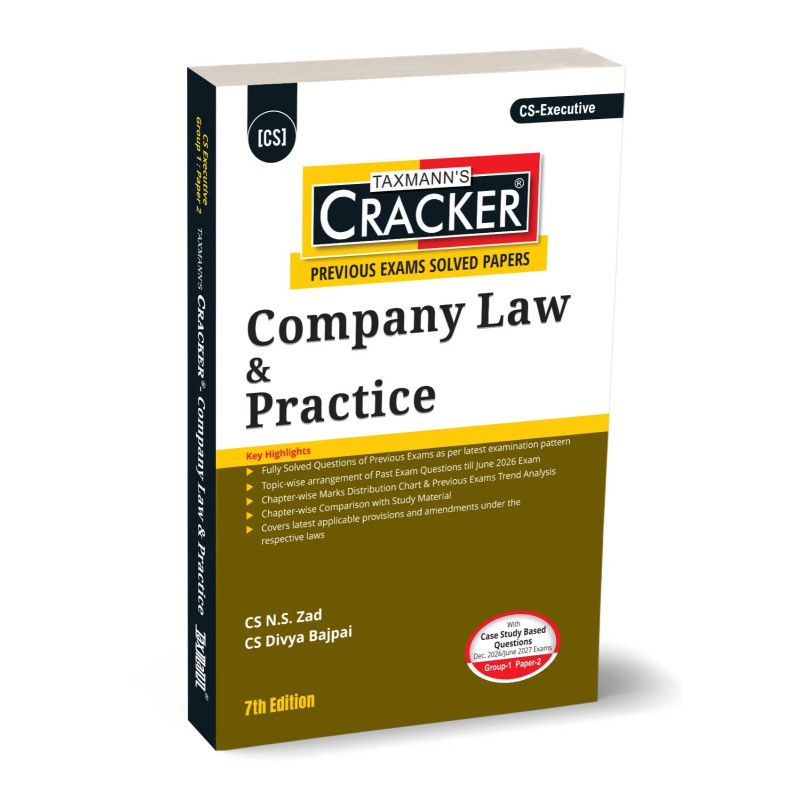
CS Executive Company Law & Practice Cracker By N.S. Zad Dec 26 & June 27
CS Executive Company Law & Practice Cracker By N.S. Zad Dec 26 & June 27
Company Law & Practice – CRACKER is a rigorously exam-oriented question-and-answer companion engineered to convert a candidate’s reading of the Companies Act 2013 into the ability to write complete, authority-backed, marks-fetching answers under timed conditions.
The book’s working method is application rather than instruction. It assembles several hundred previous examination questions from this paper—reaching back over roughly two decades and current up to and including June 2026—arranges them topic-wise within each chapter, and answers each one in the ICSI suggested-answer style.
Crucially, the solutions are not abstract: they are pinned to the specific governing sections of the Companies Act 2013 and the relevant Rules, reinforced with leading judicial precedents, and—reflecting the genuinely practical character of this paper—they reference the actual MCA e-Forms and reproduce specimen drafting (notices, minutes, and board/special resolutions) wherever the question calls for it. As the title signals, the book is built around case-study-based questions—the integrated, scenario-driven problems that now carry the single largest block of marks—supported by a dedicated chapter of such questions and by the most recent June 2026 solved paper.
This Edition has been revised to reflect the latest applicable provisions and amendments, making it current for candidates appearing in the December 2026 and June 2027 attempts.
The Present Publication is the 7th Edition | June 2026, authored by CS N.S. Zad & CS Divya Bajpai, with the following noteworthy features:
[Hundreds of Solved Past-Exam Questions] Several hundred fully solved previous-exam questions, aligned to the latest examination pattern; every answer models the structured, provision-and-precedent presentation the ICSI examiner rewards, teaching not just what to write but how to write it
[Topic-wise Arrangement (till June 2026)] Questions are grouped by concept rather than merely by year, with each tagged by its exam session and marks; questions that have recurred across sittings are consolidated (with an ‘Or’) and all their appearances are listed, so candidates instantly see how a theme has been tested over time
[Answers Anchored to the Statute] Solutions are anchored to the specific governing provisions of the Companies Act 2013 and the relevant Rules, drawing on well over 150 distinct sections across the syllabus, so students learn to quote the exact authority rather than answer in generalities
[Reinforced with Leading Case Law] The answers cite a broad body of landmark decisions, including Salomon v. Salomon & Co. Ltd., Foss v. Harbottle, Ashbury Railway Carriage & Iron Co. Ltd. v. Riche, Royal British Bank v. Turquand, Daimler Co. v. Continental Tyre & Rubber Co., and Gilford Motor Co. v. Horne, among many others
[Strong Practical & Procedural Orientation] Solutions reference the actual MCA e-Forms (for example SH-4, AOC-4, MGT-7, MGT-14, DIR-3, ADT-1, CHG-1, DPT-3, BEN-1, INC-22) and reproduce specimen drafting—notices, minutes, and board/special resolutions—mirroring the compliance and drafting demands of the paper
[Chapter-wise Marks Distribution Chart] A consolidated table mapping marks awarded to each chapter across the June and December sittings from June 2021 to June 2026, with per-chapter averages, enabling sharp prioritisation of high-yield areas
[Previous Exams Trend Analysis] A question-by-question breakdown of recent papers (chapter, marks, and whether the question was Practical or Descriptive), exposing the examiner’s pronounced shift toward application-based and case-study problems
[Chapter-wise Comparison with the ICSI Study Material] An explicit mapping of each Cracker chapter to the corresponding ICSI study-material chapter, so the book slots cleanly alongside the official reading without leaving gaps
[Strong Case-Study Orientation] Built around the integrated, scenario-based questions that dominate the current paper, with a dedicated chapter devoted to them
[Latest June 2026 Solved Paper] The most recent solved paper with suggested answers, giving candidates an accurate read of present-day difficulty and question framing
[Fully Updated & Amended] Updated for the latest applicable provisions and amendments under the Companies Act 2013 and the relevant Rules
The book covers the full substantive and procedural sweep of the paper, including:
Foundational Doctrines and Corporate Personality
The nature of a company, illegal associations, the doctrines of ultra vires, indoor management, constructive notice and alter ego, the circumstances for lifting the corporate veil, and the nationality, residence and citizenship of a company
Classification of Companies
Private, public, small, associate, holding and subsidiary, Section 8 (non-profit), government and foreign companies, and companies limited by shares, by guarantee, and unlimited; service of documents
Constitutional Documents
The memorandum (situation/registered-office, object, liability and capital clauses) and the articles of association, their alteration, and pre-incorporation contracts
Share Capital and Securities
Issue of shares at premium and at discount, sweat equity, shares with differential voting rights, rights issue, preferential allotment, bonus issue, employee stock options, and underwriting; reduction of capital and buy-back; the prospectus regime (shelf, red-herring and abridged prospectus); allotment, share certificates, calls, forfeiture, transfer and transmission, and the depository system
Membership
Members versus shareholders, cessation and expulsion, registers and index of members and debenture-holders, members’ rights and variation of rights, nomination, beneficial interest and significant beneficial owners, and borrowing powers (intra vires/ultra vires)
Debt Funding and Deposits
Issue and redemption of debentures, and the deposits framework (definition, applicability, ceilings, interest, and procedural compliance)
Charges
Creation, registration and the consequences of non-registration, modification and satisfaction, and the register of charges
Profits and Dividends
Declaration of dividend (including out of reserves and the question of dividend out of capital profits), the Investor Education and Protection Fund, and penalties for default
Accounts and Audit
Financial statements, re-opening and voluntary revision, the National Financial Reporting Authority and accounting standards, filing with the Registrar, appointment, removal, and resignation of auditors, eligibility, qualification, and disqualification, powers and duties of auditors and auditing standards, cost audit, internal audit, the audit committee, and secretarial audit
Restructuring
Compromises, arrangements and amalgamations, including mergers with foreign companies, acquisition of dissenting shareholders’ shares, Central Government powers, preservation of records, valuation by registered valuers, majority rule and minority rights, and class actions
Dormant Companies
General Meetings
The AGM and EGM, ordinary and special business, notice, quorum, chairman, proxies, voting and poll, postal ballot, ordinary and special resolutions, representation of the President/Governors/corporations, minutes, and the report on the AGM
Directors
Appointment and the various categories (first, additional, alternate, nominee, resident, independent, and small-shareholders’ director), Director Identification Number, casual vacancies, disqualifications, duties, vacation of office, resignation and removal, the register of directors and KMP, and limits on the number of directorships
The Board
Composition and defects in appointment, the nomination & remuneration and stakeholders’ relationship committees, powers and restrictions on the Board, political/charitable/defence contributions, disclosure of interest, loans to directors, inter-corporate loans and investments, investments held in the company’s own name, and non-cash transactions involving directors
Board and Committee Meetings
Frequency and quorum, resolutions by circulation, and minutes
Corporate Social Responsibility
Annual Report and Disclosures
The annual return, the corporate governance report, and ACTIVE (Active Company Tagging Identities and Verification)
Key Managerial Personnel
Appointment of the managing/whole-time director and manager, contracts of employment, managerial remuneration and compensation for loss of office, appointment of KMP, and the appointment and functions of the company secretary
E-Governance and the MCA-21 Framework
Integrated Application
Multi-issue, scenario-based case studies cutting across the above.
The material is organised into two Parts spanning twenty chapters, followed by the latest solved paper:
Part I | Company Law: Principles & Concepts (Chapters 1–11) — The foundational doctrines and core substantive provisions, running from introduction to company law through to dormant companies
Part II | Company Administration & Meetings (Chapters 12–20) — Company administration, governance, and the conduct of meetings, culminating in a dedicated Case Study Based Questions chapter of integrated, multi-part scenarios
Closing Section — Solved Paper: June 2026 (Suggested Answers): the most recent examination, fully solved and presented in its actual Part I/Part II form (including an integrated case study), for end-stage benchmarking
Each chapter follows a uniform internal architecture:
It opens with topic-wise sub-headings that cluster questions by concept (for example, within share capital: issue at premium/discount, sweat equity, rights, bonus and preferential issues, buy-back, the prospectus types, allotment, forfeiture, transfer and transmission)
Under each sub-heading, past examination questions are arranged topic-wise, every question tagged by its exam session and marks; recurring questions are consolidated (with an ‘Or’) and all appearances listed
Each question is immediately followed by a fully worked suggested answer—grounded in the specific sections of the Companies Act 2013 and the relevant Rules, reinforced with case-law citations, and, where the question demands, illustrated with the relevant e-Form references and specimen drafting (notices, minutes, resolutions)
Both descriptive and practical (application-based) questions are included, mirroring the actual paper
The dedicated case-study chapter presents integrated, multi-part scenarios with sub-questions carrying individual marks and complete provision-based solutions.
About the Author –
N.S. Zad obtained his Commerce degree from Shivaji University, Kolhapur, and cleared the CS Final Exam in June 2005, conducted by the Institute of Company Secretaries of India. He has been teaching for the last ten years and has extensive teaching experience in various professional courses, including CA, CS, and CWA, at the IPCC/Executive and Final Levels. He has practical experience working with medium and large-sized organisations and firms of practising company secretaries.
CS Divya Bajpai is a distinguished Practising Company Secretary with a Commerce degree from Banaras Hindu University (BHU), Varanasi. She successfully cleared the CS Final Exam in June 2016, administered by the Institute of Company Secretaries of India (ICSI). In 2019, she was an active member of the Women Empowerment Committee of the Northern India Regional Council of ICSI.