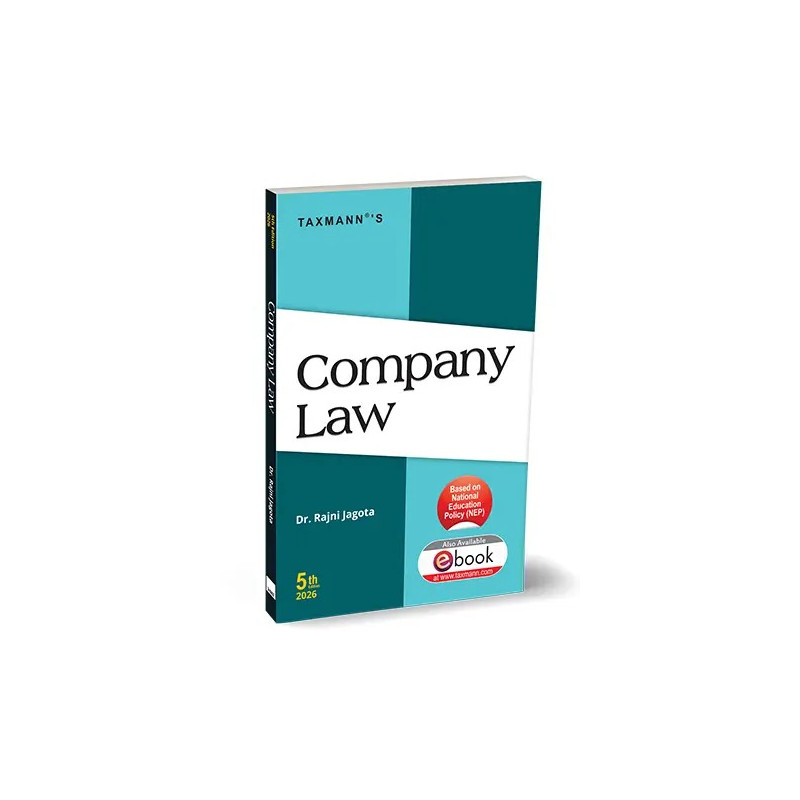
Company Law By Rajni Jagota 5th Edition January 26
Company Law By Rajni Jagota 5th Edition January 26
The Present Publication is the 5th Edition | 2026 (based on the National Education Policy [NEP]), authored by Dr Rajni Jagota, with the following noteworthy features:
- [NEP-aligned, Outcome-Based Learning Architecture]
- [Integrated Treatment of Statute, Rules, and Regulatory Practice]
- [Updated for Contemporary Corporate Governance (2025–26)]
- [Strong Procedural and Compliance Orientation]
- [Pedagogical Enrichment and Learning Aids]
The book is divided into five logically sequenced units, covering the entire lifecycle of a company:
- Unit I – Introduction | Establishes foundational understanding through:
- Nature and characteristics of a company
- Evolution and administration of company law
- Doctrine of corporate personality and lifting of the corporate veil,
- Classification of companies (private, public, government, foreign, OPC, small, dormant, producer, etc.)
- Associations not for not-for-profit and illegal associations
- This unit lays the conceptual groundwork essential for advanced study
- Unit II – Formation and Incorporation Documents | Provides a detailed exposition of:
- Promoters and pre-incorporation contracts
- Online incorporation process through SPICe+
- Memorandum and Articles of Association and their alteration
- Doctrines of ultra vires, constructive notice, and indoor management
- The unit is robust in explaining digital incorporation workflows, statutory documentation, and compliance checkpoints, making it highly relevant to modern corporate practice
- Unit III – Share Capital | Covers capital-raising mechanisms and securities law interfaces, including:
- Prospectus and types of prospectus
- Misstatement and liabilities
- Book-building process
- Issue, allotment, calls, forfeiture, transfer and transmission of shares,
- ESOPs, bonus issues, buy-back, and dematerialisation
- This unit integrates statutory provisions with practical capital market processes
- Unit IV – Management and Meetings | Addresses corporate governance and decision-making through:
- Directors and their legal position, duties, and liabilities
- DIN and KMP framework
- Board meetings and shareholders’ meetings (AGM/EGM)
- Resolutions, postal ballot, e-voting, and virtual meeting mechanisms
- The unit reflects evolving governance norms and technological integration
- Unit V – Dividends, Audit and Winding Up | Explains:
- Declaration and payment of dividends
- Statutory and secretarial audit
- Auditor appointment, rotation, and removal
- Winding up under the Companies Act
- Interface with the Insolvency and Bankruptcy Code 2016, including MSME-specific mechanisms
- This unit completes the lifecycle approach, linking corporate closure with insolvency law