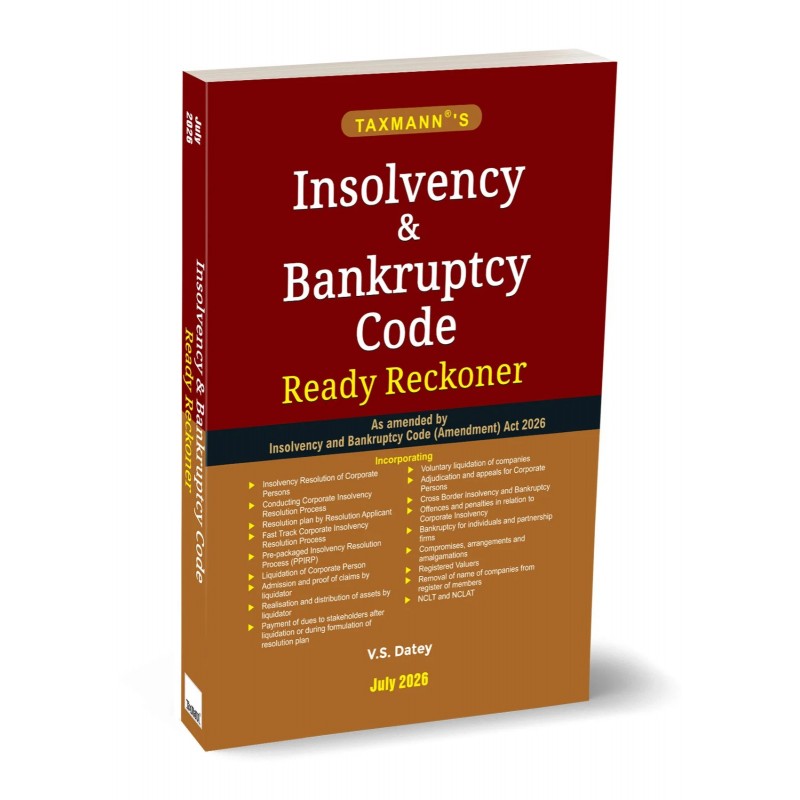
Insolvency and Bankruptcy Code Ready Reckoner V.S. Datey Edition July 2026
Insolvency and Bankruptcy Code Ready Reckoner V.S. Datey Edition July 2026
Description
Insolvency & Bankruptcy Code Ready Reckoner is a comprehensive, topic-wise commentary that maps the entire framework of India’s Insolvency and Bankruptcy Code, 2016 into a single, practice-oriented volume. The book follows the complete life cycle of financial distress—from the first warning signs of a ‘declining organisation,’ through corporate insolvency resolution, the various special and alternative resolution routes, liquidation and distribution of assets, and finally the insolvency and bankruptcy of individuals and partnership firms—so that a professional can reach a reliable, well-supported answer without wading through the bare Act.
What sets this book apart from a mere reproduction of the statute is its depth of explanation and its heavy grounding in case law. The Author (V.S. Datey) explains each concept in plain language, states the relevant statutory provision, and then illustrates it with a dense body of judicial authority—Supreme Court, NCLAT, NCLT, and High Court decisions cited with full parallel citations—right up to the latest 2025 and 2026 judgments (for example, the Supreme Court’s three-judge bench ruling in Kalyani Transco v. Bhushan Power & Steel Ltd. dated 26-9-2025, and the 2026 NCLAT decision in Purusottam Behera v. State Bank of India).
This Edition has been comprehensively revised to incorporate the sweeping Insolvency and Bankruptcy Code (Amendment) Act 2026—which the author himself describes as ‘not a minor repair… a complete overhaul’ and ‘a game changer’—with the law stated as amended up to 20th June 2026, including the amended IBBI Regulations (1st and 8th June 2026) and the newly prescribed Forms. It is, therefore, one of the most current and authoritative treatments of the subject available.
The Ready Reckoner is an everyday desk reference for everyone who works with, advises on, litigates, or studies insolvency law, including:
- Insolvency Professionals (IPs), Insolvency Professional Agencies (IPAs), and Insolvency Professional Entities (IPEs)
- Chartered Accountants, Company Secretaries, and Cost & Management Accountants in practice or in industry
- Advocates and Insolvency Litigators appearing before the NCLT, NCLAT, DRT, and appellate forums
- Bankers, Lenders, ARCs, NBFCs, and Members of the Committee of Creditors (CoC)
- Directors, Promoters, CFOs, and Management of Stressed Companies—including MSMEs navigating the pre-packaged and creditor-initiated routes
- Registered Valuers and Other Professionals in the insolvency ecosystem
- Academics and Students of professional (CA/CS/CMA), law, and management programmes seeking a clear, up-to-date, and case-law-rich treatment of the Code
The Present Publication is the July 2026 Edition, updated till 20th June 2026. It is authored by V.S. Datey with the following noteworthy features:
- [Fully Updated to the 2026 Amendment Act] The entire commentary has been restated in light of the largest overhaul of the Code since 2016. Crucially, the book distinguishes provisions that are already effective (w.e.f. 26-5-2026) from those enacted but ‘yet to be notified,’ so readers know exactly what law is currently in force
- [The New Creditor-Initiated Insolvency Resolution Process (CIIRP)] Deep coverage of the out-of-court, creditor-driven route (Chapter IV-A, Sections 58A–58K—enacted by the 2026 Amendment, to be notified), introduced while the earlier Fast Track process (Sections 55–58) is abolished (omitted w.e.f. 26-5-2026). The book walks through eligibility, the financial creditor’s 51%-approval procedure, the corporate debtor’s objection rights, the moratorium, the 150-day completion timeline (extendable by 45 days on a 66% CoC vote), and conversion of CIIRP into a regular CIRP
- [Pre-Packaged Insolvency Resolution Process (PPIRP) for MSMEs] Detailed treatment across four dedicated chapters (Sections 54A–54P): its ‘best of both worlds’ hybrid philosophy, the ₹10-lakh minimum-default threshold, the base resolution plan, the ‘Swiss challenge’ mechanism with tick-size bidding, and the compressed 120-day timeline
- [Group Insolvency, Cross-Border Insolvency & the Electronic Portal] Dedicated coverage of the emerging frameworks: Group Insolvency (Section 59A) and Cross-Border Insolvency (Section 240C), together with the new electronic portal for insolvency procedures (Section 240B)
- [Exceptionally Case-Law-Rich] Hundreds of judgments are woven into the analysis with full parallel citations, current through 2025–2026—making the book as useful for framing an argument as for understanding the black-letter law
- [Interplay with Allied Laws] Practical, cross-referenced discussion of how the Code interacts with the Companies Act 2013 (Sections 326/327/529A on workmen’s dues), SARFAESI, the RDBA/DRT regime, GST (Section 82 of the CGST Act), income-tax, the Provident Fund and ESIC Acts, the Employees’ Compensation Act, the Indian Trust Act, and the Limitation Act, along with the constitutional basis (Entry 9, List III of the Seventh Schedule)
- [Worked Examples & Clear Distinctions] Numerical illustrations (e.g., computing a secured creditor’s ‘workmen’s portion’) and crisp conceptual distinctions (workmen vs. employees; pari passu charge; trust money vs. liquidation estate) make difficult provisions concrete
- [Powerful Navigation Aids] A detailed Section Index maps individual sections (and sub-sections) to the exact paragraph where they are discussed, supported by Chapter-heads, a granular Contents list, an Acronyms table, and a comprehensive Subject Index—the hallmarks of a true ‘ready reckoner’
- [A Candid Practitioner’s Voice] Datey does not merely restate the law; he flags drafting ambiguities, notes where provisions ‘need improvement,’ and offers frank views on policy and practical workability—insights that come from decades of professional experience
The book covers the Code end-to-end and can be read as a continuous account of how an insolvency actually unfolds:
- The Distress Stage and Institutional Architecture
- The opening chapter sets the scene—why organisations decline, the ‘vision of the Code,’ its overriding effect (Section 238), and the roles of the IBBI, the Adjudicating Authority, Information Utilities, and the Insolvency and Bankruptcy Fund. It also lays out the complete structural map of the Code (Parts, Chapters, and section ranges) and, importantly, a clear account of the 2026 Amendment Act—what changed, what took effect on 26-5-2026, and what awaits notification. This is followed by a chapter on the Insolvency Professional, IPAs, and IPEs.
- Corporate Insolvency Resolution (CIRP)
- The heart of the book examines who may trigger insolvency (financial creditors, operational creditors, and the corporate applicant), special provisions for real-estate projects and personal/corporate guarantors, appointment of the interim resolution professional, the moratorium and public announcement, constitution and powers of the Committee of Creditors, the duties and protections of the resolution professional, and special provisions for large NBFCs
- The Resolution Plan
- A full chapter addresses the resolution applicant and the plan—ineligibility under Section 29A, the invitation for expressions of interest, submission and evaluation, insolvency resolution process costs, CoC approval, submission to and approval by the Adjudicating Authority, appeals, and the immunities that attach once a plan is approved
- Alternative and Special Routes
- Separate chapters cover the new CIIRP, the PPIRP (across initiation, post-admission procedure, and plan approval, including the Swiss-challenge method), and group insolvency
- Liquidation and Distribution
- Where resolution fails, the book explains initiation of liquidation, appointment and powers of the liquidator (now recommended by the IBBI, with the RP who ran the CIRP barred from becoming liquidator, and CoC supervision of the process under the 2026 amendments), the liquidation estate, admission and proof of claims, avoidance of preferential, undervalued, and extortionate transactions and fraudulent/wrongful trading, realisation and distribution of assets, and dissolution. A standout chapter dissects the Section 53 distribution ‘waterfall’ in depth—covering the priority of trust money; the treatment of provident-fund, pension, and gratuity dues (which fall outside the liquidation estate); the pari passu protection of workmen’s dues for the 24 months preceding liquidation; and the hotly litigated question of tax dues vs. secured creditors (Rainbow Papers and the line of cases refining it). Voluntary liquidation of solvent companies is covered separately
- Adjudication, Cross-border, and Offences
- Dedicated chapters deal with adjudication and appeals for corporate persons (NCLT, NCLAT, and appeals to the Supreme Court), cross-border insolvency, and the offences and penalties arising in corporate insolvency—including the new penalties (up to ₹2 crore) for frivolous or vexatious proceedings
- Individuals and Partnership Firms
- Part III of the Code is covered in full—bankruptcy of individuals and partnership firms; the fresh-start process; insolvency resolution of individuals and firms (including personal guarantors to corporate debtors); bankruptcy orders; the bankruptcy trustee; and settlement of claims against a bankrupt
- Supporting Pillars
- The closing chapters address Registered Valuers (qualification, methods of valuation, the Valuation Report Identification Number, and their liability as ‘experts’) and the constitution, powers, and procedure of the NCLT and NCLAT
The structure of the book is as follows:
- 22 Chapters with Expanded Sub-Chapters — The book is organised into 22 chapters, with the corporate-resolution material expanded through sub-chapters 6A–6D (PPIRP, its post-admission procedure, plan approval, and group insolvency)
- Logical, Life-cycle Sequence — The chapters are arranged in the order an insolvency actually plays out—distress, resolution, liquidation, and finally individual/partnership bankruptcy and the supporting institutions
- Short, Numbered Topics — Within each chapter, the material is broken into short, numbered topics; many chapters open with a plain-language ‘Background’ section before moving into the statutory analysis, the supporting case law, and the author’s practical comments.
- A Consistent Explain–Cite–Comment Rhythm — Each topic broadly follows the same pattern—explain the concept, cite the section, cite the judgments, then comment—allowing a reader either to study a process from first principles or to jump straight to a specific point
- Navigation Aids — The volume opens with Chapter-heads, a detailed Contents list, an Acronyms table, and a section-by-section Section Index that points each provision to the exact paragraph discussing it
- Comprehensive Subject Index — It closes with a detailed Subject Index for fast topic-based research—the hallmark of a true reckoner
About the Author
Mr V.S. Datey, based out of Pune (Maharashtra), has worked for close to 27 years in the corporate field at senior levels in leading listed companies, including Kirloskar Tractors and Taparia Tools, as Company Secretary and General Manager (Finance) from 1966 to 1993. He began his career as an author of books on indirect taxes in 1993. Presently, he is writing books on indirect taxes and corporate laws. Taxmann published all his books. His books have been prescribed for professional examinations such as CA, CS, and ICMA, and are widely preferred by professionals and departmental officers. Mr Datey conducts various training programmes on indirect tax-related topics.