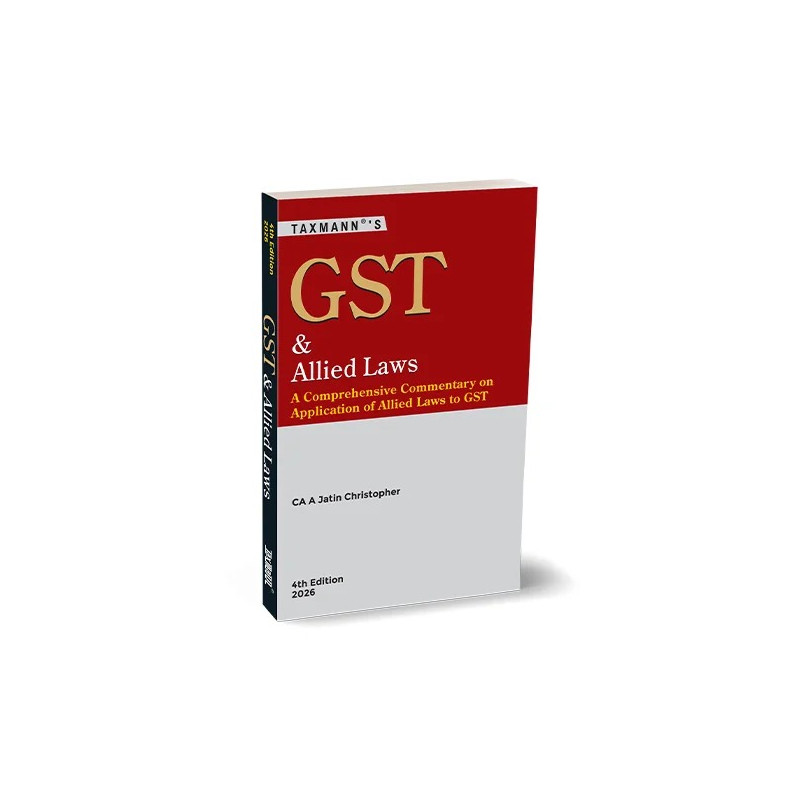
GST & Allied Laws By A Jatin Christopher 4th Edition 2026
GST & Allied Laws By A Jatin Christopher 4th Edition 2026
Description
The Present Publication is the 4th Edition, updated through February 2026. It is authored by CA. A Jatin Christopher, with the following noteworthy features:
- [First-principles Methodology] The work starts with a ‘Background’ chapter that sets out interpretative principles—examining the role of facts, legal fiction, judicial notice, statutory interpretation, evidentiary standards, and the constitutional requirement that no tax be imposed without lawful authority. It warns against mechanical reliance on disclosures or mismatches and stresses the importance of reconstructing GST issues through legally defensible reasoning
- [Allied Laws as Interpretative Frameworks] Allied statutes are regarded not as mere references but as interpretative frameworks for GST. The book systematically shows how principles from:
- Contract law
- Property law
- Corporate law
- Income-tax law
- Insolvency law
- Securities regulation
- SEZ and Customs law
- Intellectual property law
- Banking and insurance regulation
- Education and medical regulation
- Digital and internet intermediary frameworks
- Gaming and criminal law
- directly impact GST liability, valuation, classification, exemption, credit eligibility, recovery, and procedural aspects
- [Fact-Discipline and Evidentiary Sensitivity] A key aspect of this work is its emphasis on the integrity of factual assertions. It examines how statements made to one regulator may influence GST exposure with respect to another—while carefully differentiating between comparable and non-comparable statutory contexts. This makes the book particularly relevant in multi-regulatory environments
- [Integration of Recent Legal Developments] The 2026 Edition includes recent developments such as:
- Amendments affecting insolvency resolution processes and how government dues are handled
- Evolving jurisprudence on valuation, legal fictions, and the principles of substance over form
- Sector-specific regulatory developments influencing GST classification
- Contemporary issues related to virtual digital assets and modern digital business models
- [Sector-specific Analytical Depth] Few GST commentaries attempt the level of sectoral granularity presented here. The book covers:
- Real estate and RERA implications
- Special Economic Zones and zero-rated structures
- Corporate restructuring, mergers, and insolvency waterfalls
- Securities transactions and the boundaries of GST exclusion
- Intellectual property assignments, goodwill, and virtual assets
- Healthcare exemptions and medicament classification
- Education services and edtech models
- Internet intermediaries and e-commerce operator liability
- Banking, FEMA, merchanting trade, wallets, and loyalty programmes
- Insurance sector peculiarities
- Online gaming models and Rule 31A controversies
- Criminal procedure, burden of proof, and investigative exposure under GST
- This breadth makes it a practical tool for addressing real-world commercial complexity.
The architecture of the book reflects deliberate progression:
- Foundational Framework
- Background principles of interpretation
- Legal fiction and statutory construction
- Evidentiary value of documents and disclosures
- Core Private Law Foundations
- Indian Contract Act
- Sale of Goods Act
- Transfer of Property Act
- Registration Act
- Easements Act
- Limitation Act
- These chapters define the legal aspects of supply, enforceable rights, the transfer of title, immovable property interests, the validity of documentation, and restrictions on exposure—essential to GST characterisation
- Tax and Corporate Interface
- Income-tax Act (legal fictions, PE concepts, valuation implications)
- Customs Act and SEZ Act (border tax interplay, zero-rating, debonding)
- Companies Act and Securities Contracts Act (corporate personality, restructuring, securities exclusion)
- Insolvency and Bankruptcy Code (moratorium, waterfall, extinguishment of dues)
- Sectoral and Regulatory Laws
- Real Estate Regulation
- Carrier and Motor Vehicle laws
- Competition law
- Intellectual Property laws
- Medical and healthcare regulation
- Education law
- Internet intermediaries and digital platforms
- Insurance and banking laws
- FEMA and cross-border trade
- Gaming regulation
- Criminal law implications
- General Clauses Act
- Each chapter isolates the ‘Relevance to GST,’ establishes doctrinal essentials under that statute, and then analyses applied GST implications
About the author
A Jatin Christopher is a seasoned professional with a diverse background as a Chartered Accountant, Cost Accountant, and Law graduate. Since qualifying as a Chartered Accountant in 1996, he has been in practice since 2000, specializing in indirect tax advisory and litigation for Central and State tax legislation.
Jatin is a sought-after resource for the Institute of Chartered Accountants of India (ICAI) and the government, particularly in Customs, Foreign Trade Policy, and GST. His insights and contributions are widely published in numerous respected forums. He practices at a full-service firm based in Bangalore, providing comprehensive tax and legal services.