- -30%
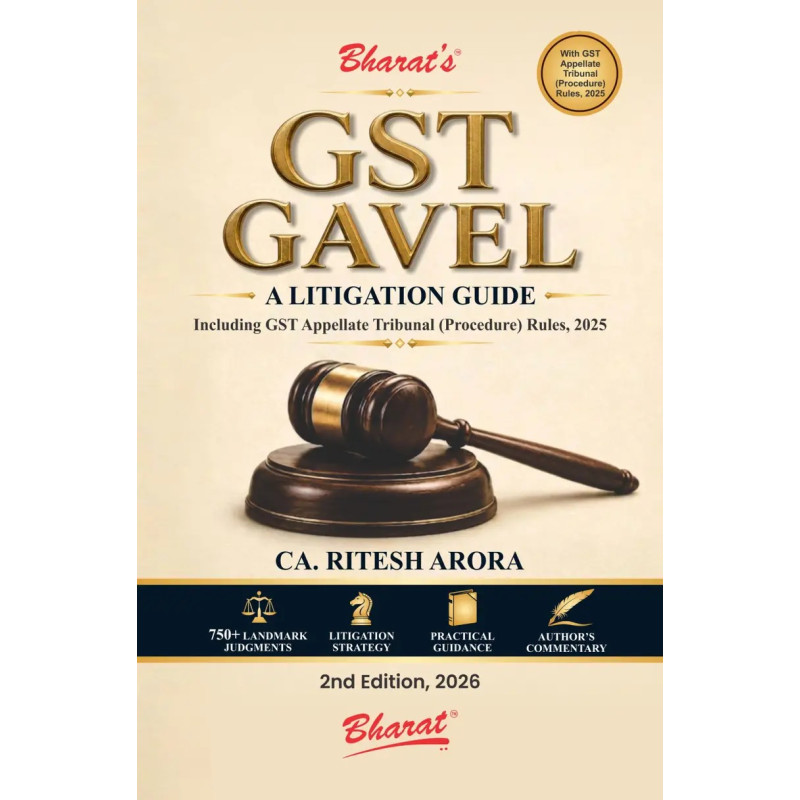
GST Gavel A Litigation Guide Ritesh Arora 2nd Edition June 2026
GST has now moved well past its initial years of transition. What was introduced as a simplified tax system has, in practice, unfolded into a framework where interpretation, procedure and litigation dominate its application. The expectation of certainty has steadily given way to continuous dispute, and with each passing year, the gap between what the law states and how it is enforced has only widened.This second edition is a response to that reality.
GST litigation does not begin with a show cause notice. It begins much earlier. It begins when a transaction is recorded, when a position is taken in returns, and more importantly, when the first response is given to the department. That first response is not a routine explanation. It is the foundation of the dispute that follows. Once facts are placed on record, they rarely change. The law only tests what has already been committed.
One of the most persistent misconceptions under GST is the belief that innocence needs to be demonstrated at every stage. Experience shows otherwise. Proceedings are not designed to discover truth. They are designed to test positions. A notice sets out an allegation. A reply is not a plea for understanding. It is a stand. Whether to accept or dispute is a decision that determines everything that follows. Once that choice is made, the course of litigation is largely set.
Over the last year, GST has seen significant shifts. Amendments in law, increasing reliance on system generated notices, and an expanding body of judicial precedents have altered the manner in which disputes are initiated and pursued. At the same time, procedural lapses continue to be the single largest reason for failure of demands. Courts have consistently intervened where due process is ignored, where jurisdiction is assumed without authority, or where orders are passed without proper application of mind. Yet, the recurrence of such lapses indicates that these are not exceptions but patterns.
GST is often approached as a question of taxability. In reality, most disputes are not about whether tax is payable. They are about whether the demand is sustainable. The distinction is critical. A legally correct position can still fail if it is poorly presented. Equally, a weak case can succeed if procedural safeguards are not followed. This is not a commentary on fairness. It is a reflection of how the system operates.
Chapter 1 Jurisdiction & Procedural Fairness under GST
Chapter 2 Demand & Recovery
Chapter 3 Input Tax Credit
Chapter 4 Cancellation & Revocation of Cancellation of Registration
Chapter 5 GST Refunds & Exemptions
Chapter 6 Inspection, Search, Seizure, Arrest & Summons
Chapter 7 Appeals
Chapter 8 Penalties during Transit
Chapter 9 Supply
Appendix 1 Goods and Services Tax Appellate Tribunal (Procedure) Rules, 2025
His specialisation spans across handling appellate proceedings, departmental audits, inspection & search cases, and legal strategy in GST matters, making him a go-to consultant for complex issues under the indirect tax regime. He is widely respected for his sharp legal acumen and practical understanding of GST jurisprudence.
Ritesh Arora is the author of the widely acclaimed publication “GST Gavel – A Litigation Guide”, which meticulously analyses landmark case laws with curated author’s commentary, serving as a practical handbook for professionals navigating GST litigation. He is also the co-author of “Reference Manual on Exports and Imports Provisions under Distinct Laws”, a comprehensive guide covering FTP 2023, the Customs Act, FEMA, and the IGST Act. His expert commentaries and insightful articles have been featured on leading professional platforms, and in monthly newsletters of various ICAI branches across India.