CA Inter Taxation Cracker K.M. Bansal 14th Edition Sept 26 & Jan 27 Exam
CA Inter Taxation Cracker K.M. Bansal 14th Edition Sept 26 & Jan 27 Exam
Description
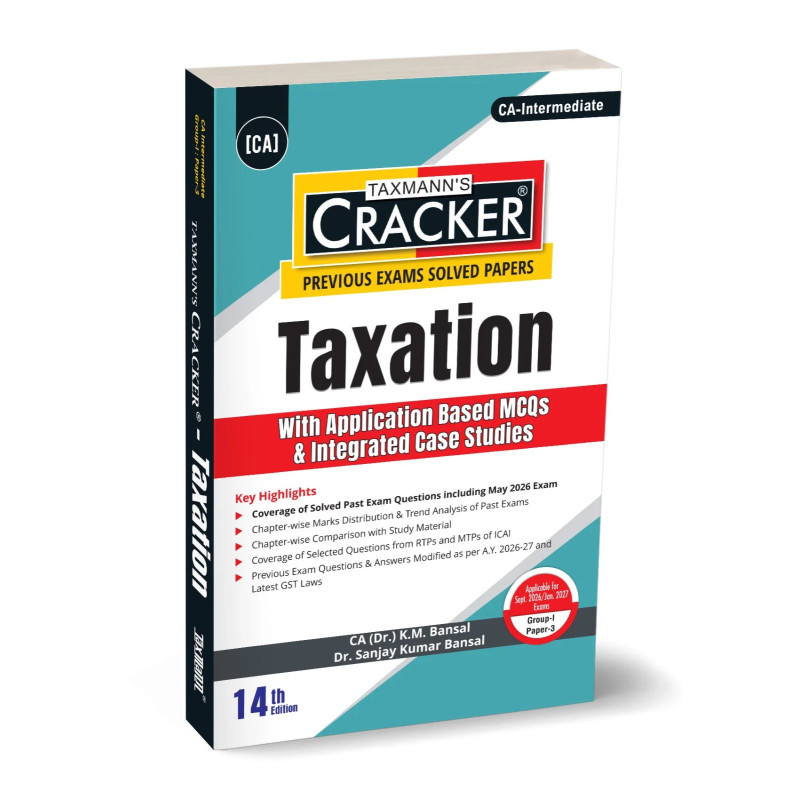
axation | CRACKER is an examination-focused practice and revision companion for CA-Intermediate Group I, Paper 3. It reduces the complete Taxation syllabus—Income-tax Law and Goods & Services Tax—to a single solved question bank that reproduces the paper’s own structure: descriptive theory and computational problems, standalone application-based MCQs, and integrated multi-part case studies, closing with the fully solved May 2026 paper. Questions are sourced from past attempts, ICAI Revision Test Papers and Mock Test Papers, with every solution restated to Assessment Year 2026-27 and the GST position currently in force, so the practice never runs against superseded law. It is built to be worked through in the final preparation phase as a self-testing and revision instrument rather than read as a first-principles text.
The Present Publication is the 14th Edition, authored by CA. (Dr) K.M. Bansal & Dr Sanjay Kumar Bansal, with the following noteworthy features:
- [Solved Past Exam Questions] Questions from past CA-Intermediate attempts, with the May 2026 paper reproduced and answered in full
- [Chapter-wise Marks Distribution] A table spanning the 2024 to 2026 attempts, with per-chapter averages that show concentration—Computation of Total Income & Tax Payable and Payment of Tax recur as the highest-weight areas
- [Previous Exams Trend Analysis] Every question listed by attempt, marks, compulsory status, and theory-versus-practical character, so revision can be prioritised by demonstrated weightage
- [Comparison with ICAI Study Material] A chapter-wise mapping of each chapter to its corresponding ICAI Study Material chapter
- [RTP & MTP Questions] Selected questions carried in from ICAI Revision Test Papers and Mock Test Papers alongside the examination questions
- [Updated to A.Y. 2026-27 & Latest GST Law] Earlier questions and answers rewritten to reflect current slab structures, the default regime, and revised special rates
- [MCQ & Integrated Case-Study Banks] Dedicated application-based MCQ banks and integrated case studies for both Income-tax and GST, each case scenario broken into linked sub-questions with answer keys
- [Examiner-Expected Answers] Computations laid out with working notes, and theory answers structured around the governing provisions
The coverage of the book is as follows:
- Income-tax Law
- Basic Concepts & Rate Structure
- The definition framework and the rate structure across the old regime, the default regime, and the special rates on capital gains, winnings, and unexplained credits
- Residential Status & Scope of Income
- Residential status, scope of total income, and incomes not forming part of total income
- The Five Heads of Income
- Salaries, house property, profits and gains of business or profession, capital gains, and other sources—taught through computational problems including gratuity, depreciation and block-of-assets treatment, slump sale, and property income
- Clubbing, Losses & Deductions
- Clubbing of income, set-off and carry-forward of losses, and deductions from gross total income
- Agricultural Income
- Agricultural and partly agricultural income
- Computation of Total Income & Tax
- The integrating, highest-weight area of the paper
- Tax Administration & Returns
- Advance tax, tax deducted and collected at source, and return filing with self-assessment, including return of loss and carry-forward conditions
- Goods & Services Tax
- GST Framework & Supply
- The constitutional and structural framework of GST and the meaning and scope of supply
- Charge, Place, Time & Value
- Charge of tax, threshold and composition eligibility, place of supply, time of supply, and value of supply
- Exemptions & Input Tax Credit
- Exemptions and input tax credit, including eligible-versus-blocked credit and reverse-charge treatment
- Registration, Invoicing & Documentation
- Registration and aggregate-turnover computation, tax invoices, credit and debit notes, e-invoicing, accounts and records, and the e-way bill, including validity and movement scenarios
- Payment, TDS/TCS & Returns
- Payment of tax and interest, tax deduction and collection at source under GST, and the return framework
The book is organised into four sequential parts, followed by the solved paper:
- Part One | Income-tax Law — The income-tax syllabus presented chapter-wise as solved descriptive and computational questions
- Part Two | Goods & Services Tax — The GST syllabus in the same chapter-wise solved treatment
- Part Three | MCQs & Integrated Case Studies (Income-tax Law) — A bank of standalone application-based MCQs followed by integrated case studies, each scenario resolved into a set of linked sub-questions with an answer key
- Part Four | MCQs & Integrated Case Studies (GST) — The same objective-and-case structure for the GST portion
- Solved Paper | May 2026 — The complete paper, covering both the case-scenario MCQs and the descriptive questions, with suggested answers
- Three Analytical Tables precede the chapters and run on a common logic—the marks-distribution table, the attempt-by-attempt trend analysis, and the Study-Material comparison—giving the student a weightage map and a cross-reference back to ICAI material before the practice begins. Within the subjective parts, each chapter opens directly into dated, solved questions arranged for sequential working
About the Author
CA. (Dr.) K.M. Bansal is an Associate Professor in the Department of Commerce, Dr B.R. Ambedkar College, University of Delhi. He is a Gold Medalist from Shri Ram College of Commerce and a University Rank Holder in M.Com. He has done M.Phil. (Accounting and Finance) from the Delhi School of Economics, University of Delhi. He has been a guide for M.Phil. students. He is also a member of the Institute of Chartered Accountants of India. Dr Bansal has more than two decades of professional teaching experience. He is also associated with the ICAI and ICSI as a visiting faculty member. He has been a speaker at various conferences, seminars and workshops organised by ICAI.
Dr Sanjay Kumar Bansal has devoted more than three decades to higher education since beginning his academic career in 1990. He is an Associate Professor at a constituent college of Chaudhary Charan Singh University, where he teaches and mentors students in finance and taxation. A prolific scholar, Dr Bansal has published twenty-four research papers in peer-reviewed journals and edited volumes. He is the author of Vyavasayik Evam Karyalaya Sanghthan and has contributed chapters to numerous books on Income Tax, Financial Management, E-Commerce, Security Analysis & Portfolio Management.