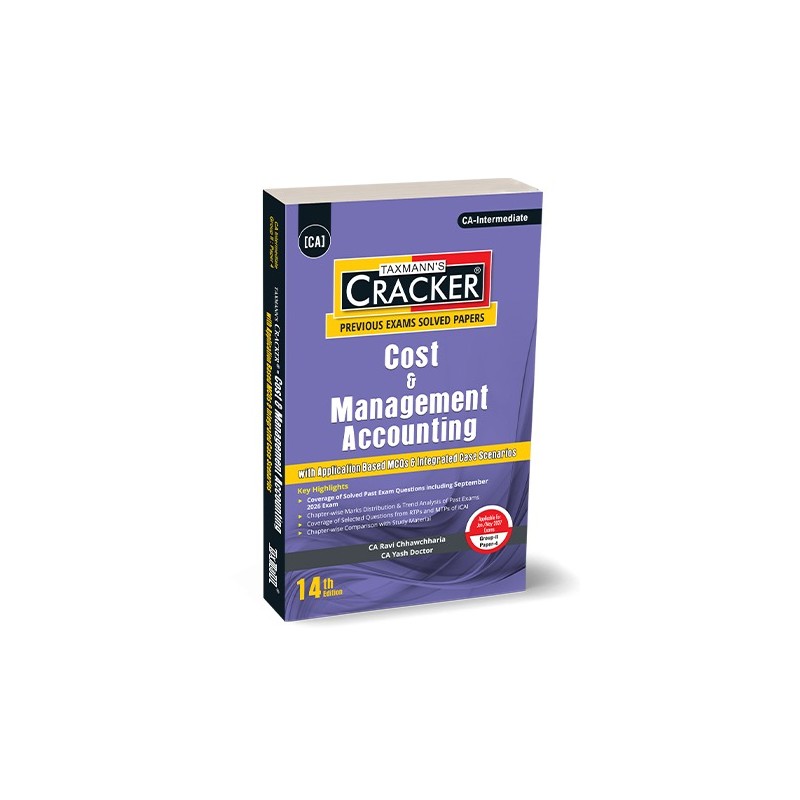
CA Inter Costing Cracker Ravi Chhawchharia ,Yash Doctor
Descriptions –
Cost & Management Accounting – CRACKER is a book of solved questions for the CA Intermediate exam. It is part of Taxmann's CRACKER series of previous exams solved papers. It brings together questions from past ICAI exams, arranged chapter by chapter, with detailed answers.
Inside are over 500 solved theory and practical questions across 15 chapters. A separate chapter covers MCQs and case scenarios, and the book ends with two full solved papers.
The Present Publication is the 14th Edition, for CA Intermediate, Group II, Paper 4. It is applicable for the Jan./May 2027 Exams. The book is authored by CA. Ravi Chhawchharia and CA. Yash Doctor, with the following noteworthy features:
[Solved Past Exam Questions, including September 2026 Exam] Questions from past exams, up to January 2026, are solved and arranged chapter-wise. They range from 2-mark theory questions to 10-mark practical problems. The May 2026 and September 2026 exams follow as full solved papers
[Solved Papers of May 2026 and September 2026] Both papers come with suggested answers. Part I has case scenarios and MCQs. Part II has descriptive questions, including the either/or question. The case scenarios cover process costing and machine hour rate (May 2026) and customer profitability and budgets (September 2026)
[Chapter-wise Marks Distribution] A table gives chapter-wise marks for every attempt from May 2023 to September 2026, with the average for each chapter. It shows at a glance how marks were spread across the 15 chapters
[Trend Analysis of Past Exams] A question-by-question table covers the descriptive part of each paper from September 2024 to September 2026. It lists the question number, chapter, marks, and whether each question was theory or practical. This shows how each recent paper was put together
[Selected Questions from RTPs and MTPs of ICAI] Selected questions from ICAI's Revision Test Papers and Mock Test Papers are placed across Chapters 2 to 15. Questions from the ICAI Module are included as well
[Chapter-wise Comparison with Study Material] A table matches Chapters 1 to 15 with their chapters in the ICAI Study Material. The book follows the same chapter order, so readers can move between the two, chapter by chapter.
[Application-based MCQs & Integrated Case Scenarios] Chapter 16 holds 10 case scenarios and 75 MCQs in all, grouped exam by exam. Each case scenario sets out a business situation with data, followed by five MCQs. The case scenarios cover topics such as activity based costing, budgets, inventory control, process costing, the cost sheet and marginal costing. The remaining MCQs stand alone
The coverage of the book is as follows:
Chapter-wise Marks Distribution
Previous Exams Trend Analysis
Chapter-wise Comparison with Study Material
Chapter 1
Introduction to Cost and Management Accounting, with theory questions on cost units and cost centres, responsibility centres, cost classification, methods of costing and installing a costing system
Chapter 2
Material Cost, with questions on valuation of material receipts, economic order quantity, inventory levels, inventory turnover ratio and pricing of material issues
Chapter 3
Employee Cost and Direct Expenses, with questions on employee cost with idle time, Rowan and Halsey incentive plans and labour turnover
Chapter 4
Overheads: Absorption Costing Method, with questions on methods of re-apportionment, comprehensive machine hour rate and under- or over-absorbed overheads
Chapter 5
Activity Based Costing, with questions on traditional versus activity based product costs, cost drivers, customer profitability and activity based budgeting
Chapter 6
Cost Sheet, with questions on preparing cost sheets and treating items in them
Chapter 7
Cost Accounting System, with questions on non-integrated accounts, integrated accounts and reconciliation of cost and financial accounts
Chapter 8
Unit and Batch Costing, with questions on economic batch quantity, batch costing and unit cost
Chapter 9
Job Costing, with questions on job costing, contract costing, and spoiled and defective work
Chapter 10
Process Costing, with questions on normal and abnormal loss, abnormal gain, equivalent production under FIFO and weighted average, and inter-process profits
Chapter 11
Joint Products & By Products, with questions on apportioning joint costs and treating by-products
Chapter 12
Service Costing, with questions on transport, hotels and lodges, hospitals, insurance companies, IT and educational institutions
Chapter 13
Standard Costing, with questions on material, labour and fixed overhead variances, and multiple variances
Chapter 14
Marginal Costing, with questions on P/V ratio, margin of safety, break-even point, and decisions such as product mix and choice of machines
Chapter 15
Budget and Budgetary Control, with questions on flexible, expense and functional budgets, and budget ratios
Chapter 16
Case Scenarios Based MCQs, from the September 2024 to January 2026 exams
Solved Paper
May 2026 (Suggested Answers)
Solved Paper
September 2026 (Suggested Answers)
The chapters and solved papers are laid out as follows:
Quick Review — Most chapters open with a Quick Review, a short recap of key formulas, formats and definitions
Theory Questions — Theory answers are mostly set out in points. Many comparison questions are answered in side-by-side tables
Practical Questions by Topic — Practical questions follow in Chapters 2 to 15. In most chapters, they are grouped under topic headings such as Economic Order Quantity (EOQ), Integrated Accounts and Material Cost Variances
Source Tags — Questions sit in shaded boxes, and nearly all carry a source tag in brackets. The tag lists the past attempts and marks, or shows that the question is from an RTP, MTP or the ICAI Module
Answers with Working Notes — Practical answers use the format the topic needs, such as a cost sheet, journal entries, ledger accounts or a reconciliation statement. Working notes support the figures, and notes explain treatments, assumptions and alternative methods
MCQs and Solved Papers — Each case scenario is followed by its MCQs. In the solved papers, marks are shown against each question. Every MCQ is answered, and most answers show the working