CSEET Business Communication Cracker
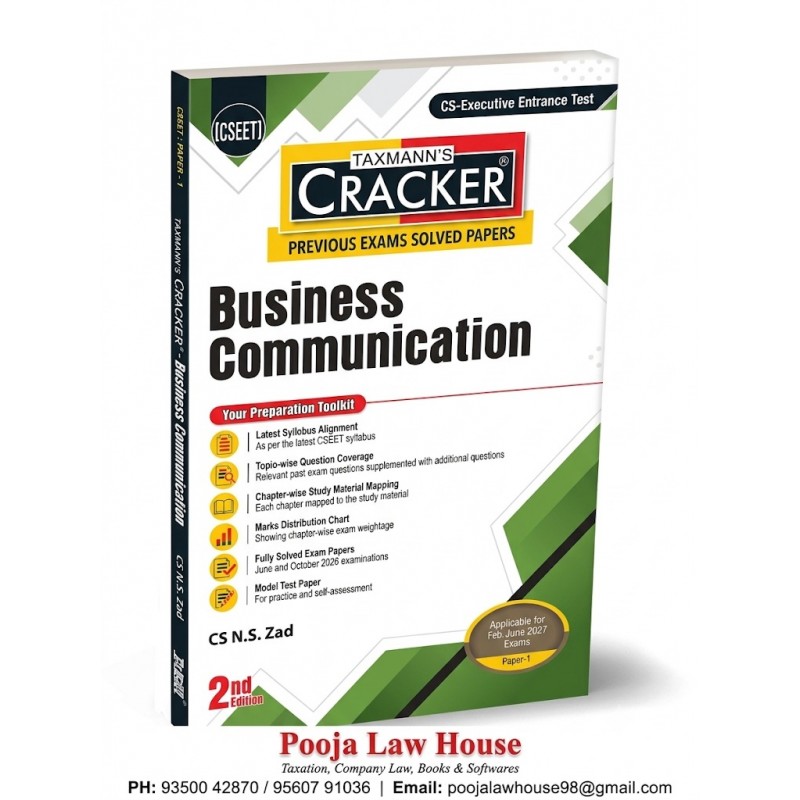
Business Communication – CRACKER is a book of solved questions for Paper 1 of the CS Executive Entrance Test (CSEET). It puts chapter-wise practice, a Model Test Paper and the two latest exam papers in one place. The book is built around four chapters:
- Essentials of Good English
- Communication
- Business Correspondence
- Common Business Terminologies
Each chapter is a bank of solved questions. Together, the four chapters hold 190 of them. They range from grammar, vocabulary and reading comprehension to communication theory, workplace cases, business terms and complete drafts of letters, notices and minutes.
After the chapters come the Model Test Paper and the fully solved papers of the June 2026 and October 2026 exams. Tables at the front link the chapters to the 2026 papers and to the study material.
The Present Publication is the 2nd Edition, published in October 2026. It is applicable for the Feb./June 2027 exams. It is authored by CS N.S. Zad and is part of Taxmann’s CRACKER series of solved previous exam papers, with the following noteworthy features:
- [Latest Syllabus Alignment] The book follows the latest CSEET syllabus. Each of its four chapters matches one of the four parts of the Paper 1 syllabus
- [Topic-wise Question Coverage] Questions are arranged chapter by chapter and, within a chapter, by topic. They include relevant past exam questions, supplemented with additional questions
- [Chapter-wise Study Material Mapping] A table at the front matches each chapter of the book to its chapter in the ICSI study material
- [Marks Distribution Chart] A chart shows the marks each chapter carried in the June 2026 and October 2026 exams, with the average of the two
- [Previous Exams Trend Analysis] A question-by-question table covers both 2026 papers. For each part of every question, it shows the chapter, the marks and the type of question
- [Fully Solved Exam Papers] The June 2026 and October 2026 papers are solved in full. Each question is printed with its marks and followed by its answer. Drafting questions get a complete draft. Case questions are answered on the facts given. In the NovoTecho case, for example, each employee complaint is matched to its barrier and to the steps that would remove it
- [Model Test Paper] A Model Test Paper is given for practice and self-assessment. Its questions come first, and the suggested answers follow in a separate section
- [Over 60 Model Drafts] Chapter 3 gives more than 60 drafts across business letters, office communications, notices, minutes and newspaper advertisements. Several come from company secretarial work, such as:
- a Board meeting notice and an AGM notice
- a newspaper notice for closing the register of members
- the minutes of a first Board meeting
- replies to shareholders’ complaints
- [Reasons, Not Just Answers] Many answers explain themselves. Comma questions say why a comma should be removed. Some sentence corrections state the grammar rule behind the fix. True-or-false answers correct or explain the false statements
- [Case-based Questions] Several questions are built on short workplace cases, such as:
- a team leader whose team is unclear about its tasks
- a support executive who keeps interrupting a customer
- a trainee whose emails confuse the design team, the finance team and the client
- a company whose late deliveries hurt its reputation
- an energy-saving trial that has to be written up as a business report
- Some answers point out exactly where the communication failed
The book is organised across four chapters, mirroring the chapter structure of the ICSI official study material for Paper 1:
- Chapter 1 — Essentials of Good English
- Grammar and usage: nouns, pronouns and adjectives, articles, tenses, conjunctions, interjections, active and passive voice, and sentence transformation
- Prefixes and punctuation, including capital letters, full stops, question marks, inverted commas, commas and the colon
- Vocabulary: choosing the right words, synonyms, antonyms, homophones, one-word substitutes, spellings, abbreviations, proverbs, and foreign words and phrases
- Arranging jumbled sentences and words in order, and spotting incorrect sentences
- Reading comprehension: six passages, each followed by multiple-choice questions
- Chapter 2 — Communication
- The importance and process of communication, its elements and its means
- Verbal communication, communication networks and digital communication
- Listening skills, barriers to listening and how to overcome them
- Barriers to communication and how to overcome them
- Workplace etiquette in a multicultural workplace, and business attire
- Public relations and social media communication
- The Information Technology (Intermediary Guidelines and Digital Media Ethics Code) Rules 2021 and other legal aspects of business communication
- High-tech communication tools and virtual meetings
- Chapter 3 — Business Correspondence
- Blocked and semi-blocked letter layouts, and the essentials of a good business letter
- Business reports and Management Information Systems (MIS)
- Email, intranet and extranet, and the agenda
- Business letters, office memoranda, office circulars, office orders and office notes
- Notices, minutes and newspaper advertisements
- Chapter 4 — Common Business Terminologies
- Business, legal and financial terms explained
- Terms to be named from their descriptions
- Full forms of common abbreviations
- One-word substitutes
- Model Test Paper (Suggested Answers)
- Solved Paper — June 2026 (Suggested Answers)
- Solved Paper — October 2026 (Suggested Answers)
Each chapter is built in a simple, consistent way:
- Chapter Opening — Each chapter opens with its number and title and goes straight into the questions. The first three chapters begin under a ‘Theoretical Questions’ banner
- Topic Headings — Chapters 1 and 3 group their questions under topic headings. Chapter 1 runs from grammar to vocabulary to comprehension. Chapter 3 runs from theory to letters, office memoranda, circulars, orders and notes, and then to notices, minutes and advertisements. Chapters 2 and 4 run as one continuous set of questions
- Question, Then Answer — Each question is numbered and printed in bold in a shaded band. Its answer follows straight after, under ‘Ans’
- Answer Layouts — Theory answers are set out in numbered points with bold lead words. Drafts are boxed and laid out like the real document. Synonyms, antonyms, proverbs, foreign words and phrases, and comparisons such as Internet versus Intranet are answered in tables