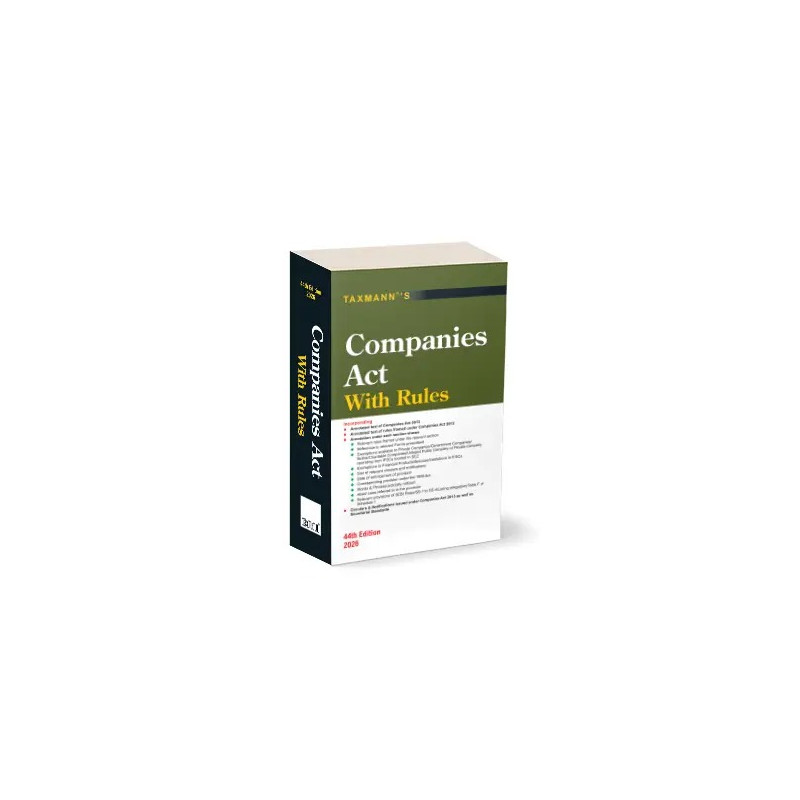
The Present Publication is the 44th Edition | 2026, updated upto 20th December 2025. This book is edited by Taxmann’s Editorial Board, with the following noteworthy features:
- [Comprehensive Annotated Text of the Companies Act 2013] The book presents the complete section-wise text of the Companies Act 2013, accompanied by concise annotations that explain applicability, scope, and compliance implications. Each section is cross-referenced with:
- Relevant Rules framed under the Act
- Prescribed Forms (e-Forms and Physical Forms)
- Date(s) of enforcement
- Corresponding provisions under the Companies Act 1956
- This structure ensures interpretative continuity and assists professionals dealing with legacy issues, transitional compliance, and litigation
- [Fully Integrated Rules and Forms Ecosystem] A defining strength of this publication is its Division-wise integration of Rules framed under the Companies Act, 2013, supported by a chapter-wise ‘Key to Prescribed Forms’. For every Chapter of the Act, the book identifies:
- Applicable Rules
- Form number and description
- Mode of filing (electronic or physical)
- Relevant section and rule references
- This framework covers, inter alia:
- Incorporation and Name Reservation (RUN, INC series)
- Accounts, Audit and CSR Compliance (AOC series, CSR-1, CSR-2, XBRL forms)
- Directors, KMPs and Secretarial Audit (DIR and MR series)
- Nidhis (NDH series)
- Foreign Companies (FC series)
- Compromises, Arrangements and Amalgamations (CAA series)
- NCLT and NCLAT procedures
- Winding-up and Liquidation (WIN series)
- The result is a compliance-executable statute, particularly valuable for practitioners and filing professionals
- [Exhaustive Coverage of Exemptions and Special Regimes] The book incorporates section-level exemptions and modifications, enabling immediate assessment of applicability for different categories of companies, including:
- Private Companies
- Government Companies
- Section 8 (Charitable) Companies
- Nidhi Companies
- Unlisted Public Companies
- Companies operating from IFSCs located in SEZs
- Financial Products, Services, and Institutions regulated within IFSCs
- IFSC-specific notifications, including regulatory substitutions (e.g., SEBI references replaced by IFSCA where notified), are embedded within the statutory framework rather than treated as appendices
- [Schedules Presented as Practical Compliance Tools] All Schedules to the Companies Act are included and mapped within the statutory flow, notably:
- Schedule I – MOA and AOA templates (Tables A to J, including Table F)
- Schedule II – Useful lives for depreciation
- Schedule III – Financial Statement formats (including Ind AS and NBFC divisions)
- Schedule IV – Code for Independent Directors
- These schedules are positioned as operational templates, supporting drafting, reporting, governance, and audit functions
- [Circulars, Notifications and Governance Standards] The publication includes a systematic listing and integration of MCA circulars and notifications, clarifying enforcement timelines, transitional provisions, and procedural guidance. It also incorporates Secretarial Standards (SS-1 to SS-4) and references to SEBI Regulations and Listing Obligations wherever relevant, ensuring alignment with the broader corporate governance framework
- [Interpretative Aids and Cross-Statute References] To support advisory and litigation work, the book provides:
- Appendix on Provisions of Other Acts referred to in the Companies Act 2013
- Words & Phrases Judicially Noticed, offering case-law backed interpretations of key statutory terms
- Cross-references to allied laws and regulatory instruments
The coverage of the book is as follows:
- Complete Companies Act 2013 (as amended)
- All Rules framed under the Act
- Chapter-wise prescribed Forms matrix
- Category-wise exemptions and special regimes
- IFSC and SEZ-specific statutory framework
- NCLT/NCLAT procedural architecture
- Winding-up, liquidation, and revival provisions
- Detailed Subject Index enabling topic-based navigation
- Despite its pocket format, the book spans over 1,800 pages, reflecting the full breadth of modern company law administration