MA Inter Taxation Cracker By Tarun Agarwal, K.M. Bansal Dec 26
CMA Inter Taxation Cracker By Tarun Agarwal, K.M. Bansal Dec 26
Description
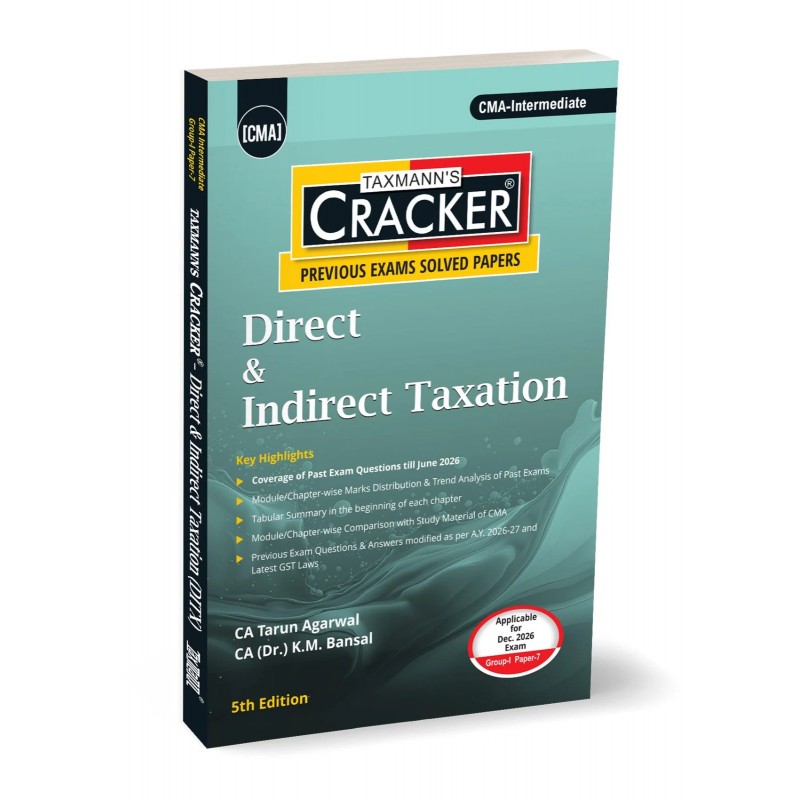
Direct & Indirect Taxation – CRACKER is a focused, exam-oriented question bank for Paper 7 – Direct & Indirect Taxation of the CMA Intermediate (Group I) course under Syllabus 2022. It is built around a single idea: the fastest way to score in a tax paper is to practise the questions the examiner actually sets, answering them exactly as they should be written in the exam hall.
The book is a chapter-wise solved question bank. It compiles a large body of ICMAI past exam questions—the inline question bank spans over a decade (questions are tagged from 2013 through 2025, drawn from both the current Syllabus 2022 and the erstwhile syllabus)—and presents each with a complete model solution. The answers are aligned to current law: practical sums are computed for Assessment Year 2026-27 (Direct Tax) and the latest amended GST and Customs provisions (Indirect Tax), with income-tax computations following the new/default tax regime under section 115BAC. Questions adapted for amended law carry a visible ‘Modified’ tag (used several hundred times across the book), so students can see at a glance that they are practising on current material rather than outdated answers.
Most chapters open with an ‘A Quick Review’ capsule—a tight summary of the charging sections, key provisions, rates, and deductions—before moving into the solved questions. The book then closes with the latest June 2026 paper solved in full, module-wise (Suggested Answers), giving students a clean, current-standard benchmark.
This Edition is one of the most up-to-date question banks available for the Dec. 2026 and June 2027 attempts, and is designed to sit alongside the ICMAI Study Material as the final-revision and self-practice companion.
The Present Publication is the 5th Edition | June 2026, authored by CA. Tarun Agarwal & CA. (Dr) K.M. Bansal, with the following noteworthy features:
- [Solved Past-exam Questions Including June 2026] A comprehensive, chapter-wise bank of previously asked ICMAI questions with complete, exam-ready answers, capped by the most recent paper solved in full at the end
- [Answers Aligned to Current Law] Practical problems are solved for A.Y. 2026-27 (Direct Tax, under the default/new regime u/s 115BAC) and the latest GST/Customs amendments; questions adapted for amended law are flagged ‘Modified’ (several hundred such tags appear across the book)
- [Every Question Is Tagged] Each carries its exam attempt and mark value (e.g. [Dec. 2022, Modified, 1 Mark], [June 2023, 1 Mark], [Dec. 2025, 2 Marks]), so students can gauge difficulty and weightage at a glance
- [‘A Quick Review’ Capsule Opening Most Chapters] Key sections, provisions, rates, and deductions captured in a concise summary for rapid recall and last-minute revision
- [Module/Chapter-wise Marks Distribution & Trend Analysis] A ready reckoner of how marks have been spread across topics over the latest seven sittings (June 2023 to June 2026), with averages, so students can prioritise high-weightage areas
- [Module/Chapter-wise Comparison with the ICMAI Study Material] Every chapter is mapped to the corresponding CMA (ICMAI) Study Material module, so the book dovetails with the official content
- [Module-wise Solved Paper: June 2026 (Suggested Answers)] The full latest paper solved at the end, organised module-by-module across both Direct and Indirect Tax
- [Fully Worked Solutions] Practical answers are presented as step-wise computations with Working Notes, modelling the structured, presentation-marks-friendly style examiners reward
- [All Question Types Covered] MCQs, True/False, Fill-in-the-Blanks, theory, and practical problems, reflecting the actual ICMAI paper pattern
The book covers the complete Paper 7 syllabus across two sections—Direct Taxation (Section A) and Indirect Taxation (Section B).
- Section A — Direct Taxation
- Module 1 — Basics of Income-tax Act
- Basic Concepts, Basis of Charge and Capital & Revenue Receipts
- Residential Status and Scope of Total Income
- Agricultural Income
- Income which does not form part of Total Income
- Module 2 — Heads of Income
- Income from Salaries
- Income from House Property
- Profits and Gains of Business or Profession
- Income from Capital Gains
- Income from Other Sources
- Module 3 — Total Income & Tax Liability of Individuals and HUF
- Clubbing of Income (income of other persons in the assessee’s total income)
- Set-off and Carry Forward of Losses
- Deductions, Rebate & Relief
- Taxation of Individual & HUF (covers AMT)
- Advance Tax
- Tax Deducted at Source (TDS) & Tax Collected at Source (TCS)
- Filing of Return of Income
- Permanent Account Number (PAN)
- Self-Assessment and Intimation
- Section B — Indirect Taxation
- Module 4 — Concept of Indirect Taxes
- Module 5 — GST Law
- Introduction to GST Law
- Levy and Collection of CGST and IGST
- Basic Concepts of Time, Place and Value of Supply
- Input Tax Credit
- Computation of GST Liability
- Registration under GST
- Tax Invoice and E-Way Bill
- Returns and Payment of Tax
- Module 6 — Customs Law
- Customs Act – Basic Concepts and Definitions
- Types of Duties
- Valuation Rules
- Computation of Assessable Value and Duties
- The book closes with a Module-wise Solved Paper: June 2026 (Suggested Answers) running across all six modules (Direct & Indirect), with full worked answers
The book is organised to move a student from strategy → revision → practice → benchmarking:
- Exam-planning Tools — It opens with three analytical aids
- A Module-wise Marks Distribution table (the latest seven sittings, June 2023 to June 2026, with averages)
- A Previous Exams Trend Analysis (Syllabus 2022) that maps every question of each recent paper to its topic, marks, and type (MCQ/True-False/Fill-in-the-Blanks/Theory/Practical)
- A Module-wise Comparison with the ICMAI Study Material
- Together, these tell a student where the marks are, what gets asked, and where each topic sits before they begin
- Section → Module → Chapter Hierarchy — Content is split into Section A (Direct Tax) and Section B (Indirect Tax), each divided into modules, and each module into chapters that mirror the official syllabus.
- Inside Each Chapter — Most chapters start with an ‘A Quick Review’ capsule of the relevant law (charging sections, computations, deductions), followed by past-exam questions arranged topic-wise, each tagged with its attempt and marks and answered in full. Practical questions are solved with Working Notes for A.Y. 2026-27 / the latest indirect-tax law; amended items are marked ‘Modified.’ (The lead chapter of each module generally opens straight into concepts or questions)
- Capstone Solved Paper — The book ends with the June 2026 question paper solved module-wise (Suggested Answers, ~21 pages), letting students attempt a full current-standard paper and self-assess against model answers
- This lets a student revise a concept, immediately attempt the questions actually asked on it, and finish by testing themselves on a complete recent paper—all in one volume.
About the Author
CA Tarun Ramgopal Agarwal is a distinguished All-India Rank Holder at all levels of the Chartered Accountancy exams, earning a Gold Medal in Financial Reporting in the CA Final. In 2010, he was honoured by the Chartered Accountants Association, Ahmedabad, as the best CA student in Gujarat for securing 1st Place in the CA Final in the state. He holds multiple qualifications, including B.Com., CS, LL.B., CFA (Level 2), and FRM.
CA (Dr) K.M. Bansal is a Professor in the Department of Commerce at Dr B.R. Ambedkar College, University of Delhi. A Gold Medalist from Shri Ram College of Commerce and a University Rank Holder in M.Com., Dr Bansal also holds an M.Phil. in Accounting and Finance from the Delhi School of Economics, University of Delhi, and is a member of the Institute of Chartered Accountants of India (ICAI). He has guided M.Phil. students and brings more than two decades of professional teaching experience to his role.