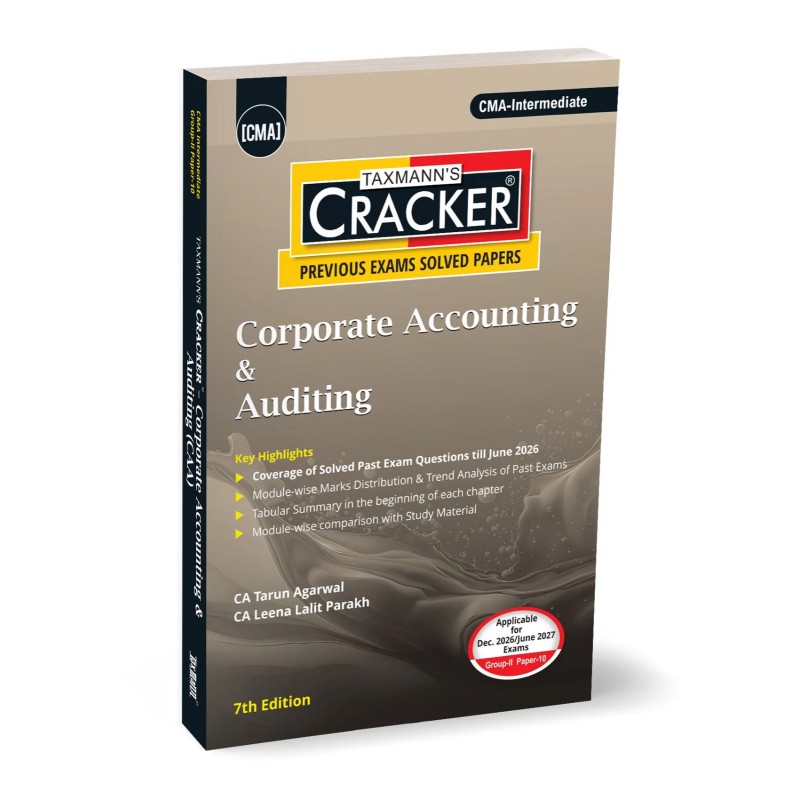
Corporate Accounting & Auditing – CRACKER(is a dedicated, exam-focused question bank for Paper 10 – Corporate Accounting & Auditing of the CMA Intermediate (Group II) course, prepared strictly as per the ICMAI Syllabus 2022. Part of Taxmann’s flagship CRACKER series, its purpose is singular and practical: to help students master the paper by working through actual past examination questions, fully solved, arranged in the exact sequence of the syllabus.
What sets this title apart is the depth and span of its question bank. Rather than a handful of recent papers, the book curates and solves questions drawn from more than a decade of CMA examinations—from June 2013 right through to June 2026—across the June, December and the transitional July 2023 sittings. Every question is tagged with the session and marks in which it appeared, and where the same or a substantially similar question has recurred across attempts, that repetition is flagged—a powerful signal of what examiners return to again and again.
The paper itself is a two-in-one subject, combining Corporate Accounting (a heavily practical, numerical discipline) with Auditing (a largely conceptual, provisions-driven one). This Edition treats both halves with equal rigour: practical accounting answers are laid out in full—journal entries, ledger accounts, Schedule III formats, cash flow statements and detailed working notes—while auditing answers are presented in the crisp, point-wise style that scores in the exam. This Edition (July 2026) is fully updated for the December 2026 and June 2027 attempts.
The Present Publication is the 7th Edition | July 2026, authored by CA. Tarun Agarwal and CA. Leena Lalit Parakh, with the following noteworthy features:
- [Decade-plus Solved Question Bank] Solved past-exam questions spanning June 2013 to June 2026—a deep, chapter-wise bank of previous CMA questions with full model answers, so practice mirrors the real paper across more than a decade of trends
- [Session & Marks Tagging with ‘Similar Question’ Flags] Every question is tagged with its exam session and marks, plus ‘similar question’ cross-references that flag when a question has recurred across attempts (e.g., ‘June 2019, 7 Marks; Similar Question in Dec. 2022, 8 Marks; Similar Question in July 2023, 4 Marks’)—helping students spot the perennial favourites
- [Objective & Descriptive Questions] Each chapter’s Past Examination Questions are split into Objective (MCQ/fill-in-the-blank, typically 1–2 marks) and Descriptive (theory and practical), all fully answered
- [Marks Distribution & Trend Analysis] Module-wise Marks Distribution plus a detailed, question-by-question Previous Exams Trend Analysis of recent papers (July 2023 through June 2026), classifying each part by module, marks and Theory vs. Practical; Section B (Auditing) additionally carries a chapter-wise marks distribution
- [Tabular ‘Quick Review’ Capsules] Concept-first theory recaps at the start of chapters (18 across the book), giving a fast refresher before the questions—with the theory-heavy auditing modules carrying several
- [Mapped to the ICMAI Study Material] A module-wise comparison mapping each of the book’s modules to the corresponding CMA study-material module, so students can toggle between concept and practice
- [Presentation-ready Solutions] Practical answers with journal entries, ledgers, Schedule III statements, cash flow statements and step-by-step working notes; theory answers in examiner-friendly point form
The book mirrors the paper’s two-part structure across 8 modules, with concrete sub-topics under each:
- Section A — Corporate Accounting
- Accounting for Shares and Debentures — Nature and types of companies; issue, forfeiture and re-issue of shares; securities premium; bonus shares; buy-back of shares; redemption of preference shares (capital redemption reserve); underwriting of issues; and issue and redemption of debentures
- Preparation of Statement of Profit & Loss and Balance Sheet — Preparation of the Statement of P&L and Balance Sheet in the Schedule III (Companies Act 2013) format, including the types of financial statements, profit determination and disclosures
- Cash Flow Statement (AS-3) — Classification into operating, investing and financing activities and preparation of the statement, with fully worked statements
- Accounts of Banking, Electricity and Insurance Companies — Special-entity accounting: banking company accounts (interest on doubtful debts, NPAs, rebate on bills discounted), insurance accounts (reserve for unexpired risk) and electricity undertakings
- Accounting Standards — Application of the Accounting Standards, covering areas such as disclosure of accounting policies, valuation of inventories, depreciation and fixed assets, accounting for investments, employee benefits and intangible assets—with presentation and inventories also framed under the corresponding Ind AS (Ind AS 1 and Ind AS 2)
- Section B — Auditing
- Basic Concepts of Auditing — Evolution and objectives of auditing; Standards on Auditing (SAs); audit engagement; audit risk; audit evidence and management assertions; audit sampling (SA-530); working papers and audit files; vouching; and auditing in an automated/CIS environment
- Provisions relating to Audit under the Companies Act 2013 — Statutory audit (auditor’s eligibility, qualification, appointment, rotation and removal); audit of government companies; cost audit; secretarial audit (Sec. 204); the audit report (including CARO and the ‘true and fair’ view); internal financial controls (Sec. 134(5)(e)); and the National Financial Reporting Authority (NFRA)
- Auditing of Different Types of Undertakings — Audit of educational institutions; hospitals and health-care organisations; hotels; cinemas; banks; co-operative societies; charitable trusts/institutions; and local self-government (municipalities and panchayats)
The book is built around a revision-first workflow:
- Analytics — Three planning tools sit before the chapters: the Module-wise Marks Distribution, a granular Previous Exams Trend Analysis (each question of recent papers mapped to module, marks and Theory/Practical), and the Module-wise Comparison with the ICMAI Study Material
- ‘Quick Review’ Capsules — Chapters are front-loaded with concise, tabular Quick Review theory recaps (18 in total across the book) covering core concepts, definitions, provisions and formats—heavily used in the accounting modules and the auditing-provisions chapters
- Past Examination Questions—Objective & Descriptive — The heart of each chapter is a set of past exam questions, grouped into Objective and Descriptive questions, each labelled with its exam session and marks and fully answered (‘Ans.’); practical answers include working notes and standard formats, theory answers are point-wise
- Two-section Flow — Section A (Corporate Accounting, Modules 1–5) and Section B (Auditing, Modules 6–8) are kept distinct, with Section B additionally carrying its own chapter-wise marks distribution.
CA Tarun Ramgopal Agarwal is a distinguished All-India Rank Holder at all levels of the Chartered Accountancy exams, earning a Gold Medal in Financial Reporting in the CA Final. In 2010, he was honoured by the Chartered Accountants Association, Ahmedabad, as the best CA student in Gujarat for securing 1st Place in the CA Final in the state. He holds multiple qualifications, including B.Com., CS, LL.B., CFA (Level 2), and FRM.
CA. Leena Lalit Parakh is a practising Chartered Accountant with over eleven years of academic experience, specialising in law, audit, strategic management, and economics. Renowned for her practical teaching approach, she has developed extensive educational resources and currently mentors CMA students at all levels in Surat. Her expert guidance has contributed to the success of numerous students, including over 25 All-India Rank holders.