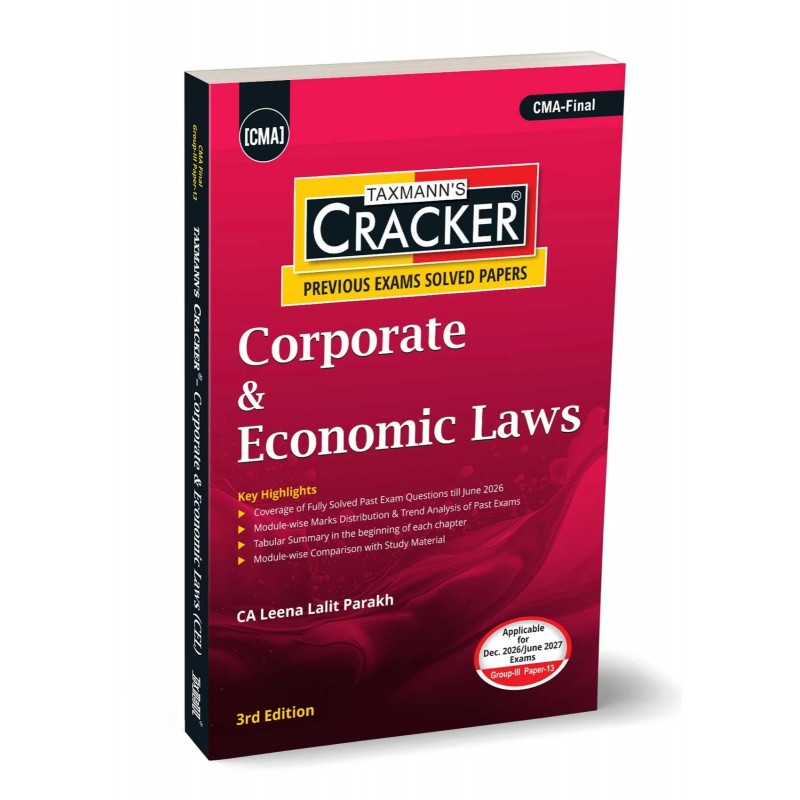
CMA Final Corporate & Economic Laws Cracker By CA Leena Lalit Parakh Dec 26 & June 27
CMA Final Corporate & Economic Laws Cracker By CA Leena Lalit Parakh Dec 26 & June 27
Corporate & Economic Laws – CRACKER is a focused, examination-oriented question bank for the CEL paper of the CMA-Final course under Syllabus 2022. Built on the CRACKER approach, it compiles past examination questions sitting-by-sitting and answers them with detailed, provision-anchored model solutions, training the student to reproduce in the examination hall exactly what the examiner rewards. It is not a textbook restatement of the law; it is a practice-and-revision instrument that pairs a concise recap of concepts with a graded set of solved questions—descriptive, numerical, and objective—so that conceptual understanding is converted into scoring ability. Every solution follows the disciplined ‘state the provision → apply it to the facts → conclude’ pattern, citing the governing section or rule, so the student internalises both the substance and the structure of a high-scoring answer
The Present Publication is the 3rd Edition | June 2026, authored by CA. Leena Lalit Parakh, with the following noteworthy features:
- [Fully Solved Past-Exam Questions (June 2015 – June 2026)] Compiled chapter-wise, with each question tagged by its examination session and marks, giving the student the full range and depth of the examiner’s past coverage in one place; close to six hundred chapter-wise solved questions
- [Every Question Format, Solved in Full] Theory and short-note questions; practical/numerical problems worked step by step; and objective/MCQ as well as integrated case-scenario questions that mirror the current pattern of the compulsory question
- [Module-wise Marks Distribution] The marks each chapter has carried across the recent June and December attempts (2023–2026), together with the average weightage assigned on the basis of Syllabus 2022, so effort can be allocated in proportion to scoring potential
- [Previous Exams Trend Analysis] Laying out, sitting by sitting for the most recent attempts (December 2023 to June 2026), the composition of each paper (question number, compulsory status, module, marks, and theory/practical classification), exposing the examiner’s recurring patterns
- [Chapter-opening ‘A Quick Review’] A concise summary at the start of every chapter (highlighted on the cover as the ‘Tabular Summary’) that condenses key definitions and governing provisions using bullet points, ready-reference tables and classification charts for rapid pre-examination revision
- [Module-wise Comparison with the Study Material] Mapping every chapter to its corresponding CMA study-material module number for seamless cross-referencing with the official material
- [Provision-anchored Model Answers] Consistently citing the relevant section or rule, applying it to the given facts, and arriving at a clear conclusion
The book spans the prescribed syllabus across two sections and eleven modules:
- Section A – Corporate Laws
- Module 1 | The Companies Act 2013 — Company formation & conversion; investments & loans; dividend; accounts & audit; board of directors & KMP; board meetings & procedure; inspection, inquiry & investigation; compromises, arrangements & amalgamations; prevention of oppression & mismanagement
- Module 2 | The Insolvency and Bankruptcy Code 2016 — Definitions; corporate insolvency resolution process; liquidation of a corporate person; personal insolvency
- Module 3 | Corporate Governance, Social Responsibility and Sustainability — Governance concepts & issues; governance practices in India; governance in family business; CSR—nature of activities and evaluation of CSR projects; sustainability management
- Section B – Economic Laws & Regulations
- Module 4 | SEBI Laws & Regulations — Raising finance from capital markets/IPO; insider trading; takeover code
- Module 5 | The Competition Act 2002 — Meaning, objectives, extent & applicability; Competition Commission of India
- Module 6 | Foreign Exchange Management Act 1999 — Salient features of FEMA; FDI—Master Directions; External Commercial Borrowings, trade credit & structured obligations; Liberalised Remittance Scheme
- Module 7 | Laws & Regulations relating to the Banking Sector — Banking Regulation Act 1949; role of the Reserve Bank of India; SARFAESI Act 2002
- Module 8 | Laws & Regulations relating to the Insurance Sector — Insurance Act 1938; IRDA Act 1999
- Module 9 | Specific Legal Provisions relating to the MSME Sector — Definition of MSME; rights and promotional measures under the MSMED Act 2006
- Module 10 | Laws & Regulations relating to Cyber Security & Data Privacy — Information Technology Act 2000 and rules; principles of data privacy and business intelligence; cybercrime/cyber frauds—meaning, remedies & penalties
- Module 11 | Laws & Regulations relating to Anti-Money Laundering — Prevention of Money Laundering Act 2002; PML (Maintenance of Records) Rules 2005
The structure of the book is as follows:
- Three-tier Hierarchy (Section → Module → Chapter) — The book is organised on a clean structure that maps directly onto the syllabus, moving from the two sections to their eleven modules and on to the constituent chapters
- Strategy-first — Before the questions begin, the book front-loads the planning apparatus: the Module-wise Marks Distribution, the Previous Exams Trend Analysis, and the Module-wise Comparison with the Study Material, so that strategy precedes practice
- A Uniform Chapter Rhythm — Each chapter opens with a Quick Review concept recap, after which the solved questions are presented in sequence, every question flagged with its examination session and marks, so the student can judge the expected length and depth of response
- Module-Wise Solved Papers — The book ends with a dedicated section, ‘Module-wise Solved Paper: December 2025 (Suggested Answers)’ and ‘Module-wise Solved Paper: June 2026 (Suggested Answers)’, in which the two most recent papers are reproduced in full and re-arranged module-wise, letting students work through complete papers grouped by topic and benchmark their readiness.
About the Author –
CA. Leena Lalit Parakh is a practising Chartered Accountant with over eleven years of academic experience, specialising in law, audit, strategic management, and economics. Renowned for her practical teaching approach, she has developed extensive educational resources and currently mentors CMA students at all levels in Surat. Her expert guidance has contributed to the success of numerous students, including over 25 All-India Rank holders.