CMA Final SFM Cracker by CA Tarun Agarwal For Dec 26 Exam
CMA Final SFM Cracker by CA Tarun Agarwal For Dec 26 Exam
Description
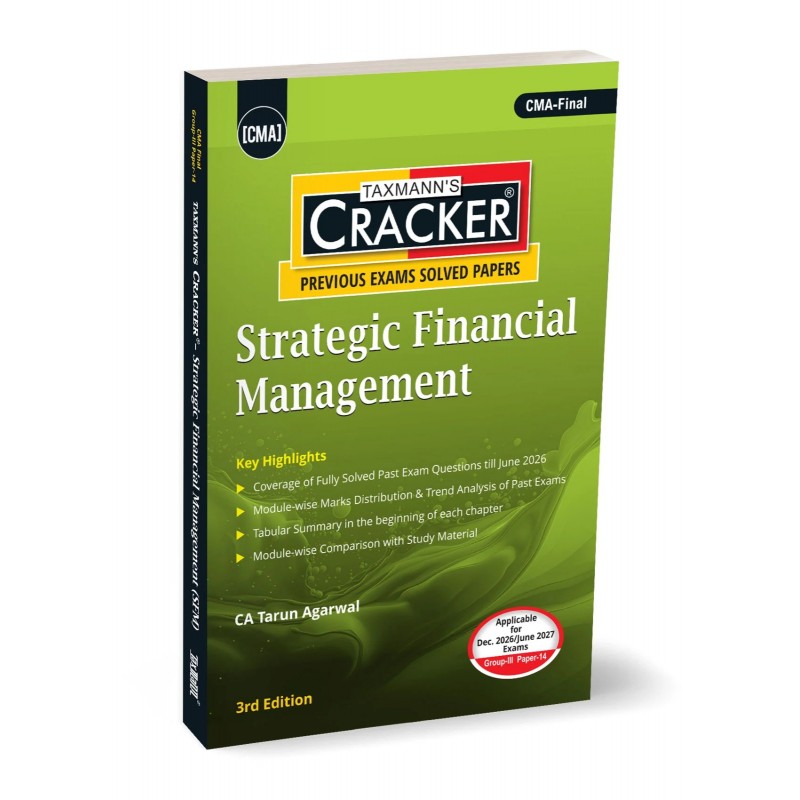
Strategic Financial Management – CRACKER is an exam-focused practice-and-revision companion written specifically for students appearing in Paper 14 (Group III) of the CMA Final examination conducted by the Institute of Cost Accountants of India (ICMAI). Part of Taxmann’s well-regarded CRACKER series, the book condenses the entire 2022 Syllabus into a disciplined, question-driven format engineered to help candidates convert conceptual understanding into exam marks.
Rather than functioning as a bulky first-read textbook, this CRACKER is built for the phase of preparation that actually determines results—practice, revision, and answer writing under exam conditions. Across roughly 490 pages, it organises the syllabus into 17 modules, opening each with a quick-review concept summary and following with past-examination questions that carry full, step-by-step model answers and working notes. In all, the modules hold close to 490 exam-tagged questions, and—with the two most recent papers solved in full at the end—the book runs to 500+ fully solved questions. Every question is tagged with the session it appeared in and the marks it carried, so revision doubles as pattern recognition. This Edition is updated with fully solved past exam questions through the June 2026 session, making it current for candidates targeting the December 2026 and June 2027 attempts.
The Present Publication is the 3rd Edition | June 2026, authored by CA. Tarun Agarwal, with the following noteworthy features:
- [Fully Solved Past-Exam Questions—through June 2026] A comprehensive bank of previous CMA questions, each reproduced with a complete, step-by-step suggested answer and working notes
- [Module-wise Marks Distribution] A front-of-book table mapping how marks have been allocated across all 17 modules over recent June and December sittings (2023–2026), with an average weightage per module, so students can see at a glance where the marks live
- [Previous Exams Trend Analysis] A question-by-question breakdown of recent papers showing the module tested, the marks carried, and whether each question was theory or practical in nature
- [Chapter-opening Quick Review (Tabular Summary)] Every module opens with a crisp recap of its important concepts, definitions and formulae before the questions begin—ideal for last-mile revision
- [Module-wise Comparison with the ICMAI Study Material] A front-matter table cross-references every module to the corresponding module number in the official ICMAI study material, so students can move seamlessly between the two resources
- [Exam-tagged Questions] Each question carries its originating session and marks (e.g., [June 2017, 2 Marks]), so candidates always know a question’s source and weight
- [Objective, Theory & Numerical Questions] Within each module, the past questions are organised into Objective Questions (including MCQs), followed by Theory Questions and Numerical Questions (as applicable), mirroring the actual paper
- [Two Most Recent Papers—Fully Solved & Re-sequenced Module-wise] The December 2025 and June 2026 papers are reproduced with complete suggested answers and rearranged module by module, so students see exactly how a live paper maps across the syllabus
The book covers all 17 modules of the Syllabus 2022, in the same sequence as the ICMAI study material. Module by module, the focus areas and the depth of practice in this edition are:
- Module 1 · Investment Decisions, Project Planning & Control
- Key Topics — Capital budgeting; Payback, payback reciprocal/profitability, ARR, NPV, IRR, PI, discounted payback, modified NPV/IRR, adjusted present value; capital rationing (divisible/indivisible)
- Practice Depth — ~50 solved questions across ~58 pages
- Module 2 · Evaluation of Risky Proposals for Investment Decisions
- Key Topics — Certainty-equivalent approach, risk-adjusted discount rate, sensitivity & scenario analysis, decision trees, simulation
- Practice Depth — ~26 solved questions across ~30 pages
- Module 3 · Leasing Decisions
- Key Topics — Lessor/lessee & sub-lease framework, finance vs operating leases, sale-and-lease-back, leveraged lease, lease rentals, lease evaluation (NPV/lease-vs-buy)
- Practice Depth — ~19 solved questions across ~26 pages
- Module 4 · Securitisation
- Key Topics — Special Purpose Vehicle (SPV) mechanism, asset-backed securities, process and benefits
- Practice Depth — ~12 solved questions across ~12 pages
- Module 5 · Introduction to Security Analysis & Portfolio Management
- Key Topics — Fundamental analysis (top-down: economy–industry–company) and technical analysis
- Practice Depth — ~6 solved questions across ~16 pages
- Module 6 · Equity & Bond Valuation & Evaluation of Performance
- Key Topics — Dividend-discount/DCF models, relative valuation (P/E, etc.), bond valuation, yields, zero-coupon
- Practice Depth — ~29 solved questions across ~20 pages
- Module 7 · Mutual Funds
- Key Topics — NAV computation, fund types, returns, loads/expense ratio, performance evaluation
- Practice Depth — ~40 solved questions across ~36 pages
- Module 8 · Portfolio Theory & Practice
- Key Topics — Expected return & risk, ex-ante vs ex-post, Markowitz diversification, correlation/covariance, beta
- Practice Depth — ~71 solved questions across ~44 pages
- Module 9 · Asset Pricing Theories
- Key Topics — CAPM, beta and the Security Market Line, Arbitrage Pricing Theory (APT)
- Practice Depth — ~36 solved questions across ~28 pages
- Module 10 · Portfolio Performance Evaluation & Revision
- Key Topics — Money- and time-weighted returns (MWROR/TWROR), Sharpe, Treynor, Jensen; portfolio revision
- Practice Depth — ~15 solved questions across ~12 pages
- Module 11 · Efficient Market Hypothesis
- Key Topics — Random-walk theory; weak, semi-strong and strong-form efficiency
- Practice Depth — ~4 solved questions across ~4 pages
- Module 12 · Risks in Financial Market
- Key Topics — Operational, market, credit and liquidity risk; risk classification and measurement
- Practice Depth — ~8 solved questions across ~8 pages
- Module 13 · Financial Derivatives – Instruments for Risk Management
- Key Topics — Forwards, futures, options and swaps; option pricing (binomial, Black–Scholes), hedging and risk-management strategies
- Practice Depth — ~97 solved questions across ~72 pages
- Module 14 · The International Financial Environment
- Key Topics — IMF, World Bank and international financial institutions; Bretton Woods; ADRs/GDRs
- Practice Depth — ~11 solved questions across ~14 pages
- Module 15 · Foreign Exchange Market
- Key Topics — Spot & forward quotes, bid/ask, cross rates, arbitrage, interest-rate and purchasing-power parity
- Practice Depth — ~31 solved questions across ~14 pages
- Module 16 · Foreign Exchange Risk Management
- Key Topics — Transaction, translation and economic exposure; hedging with forwards, netting and other tools
- Practice Depth — ~22 solved questions across ~26 pages
- Module 17 · Digital Finance
- Key Topics — Fintech, digital payments (UPI), blockchain and crypto assets, AI and emerging technologies in finance
- Practice Depth — ~12 solved questions across ~16 pages
The book follows a consistent, revision-friendly architecture from start to finish.
- Strategic Front Section — The Module-wise Marks Distribution, the Previous Exams Trend Analysis, and the Module-wise Comparison with the Study Material. Together, these give the student a data-backed map of the syllabus before a single question is attempted: which modules matter most, how they have been examined (theory vs practical), and where each sits in the official ICMAI material
- Same Internal Flow
- Quick Review — A concise, tabular-style recap of the module’s important concepts, definitions and formulae
- Past Examination Questions — Objective Questions (including MCQs), then Theory Questions and Numerical Questions (as applicable), all drawn from prior CMA exams
- Complete Suggested Answers — Every question is worked out in full, with working notes, and tagged with its exam session and marks
- Fully Solved December 2025 & June 2026 Papers — They are arranged module-wise, allowing candidates to benchmark their preparation against the two most recent live examinations.
About the Author
CA Tarun Ramgopal Agarwal is a distinguished All-India Rank Holder at all levels of the Chartered Accountancy exams, earning a Gold Medal in Financial Reporting in the CA Final. In 2010, he was honoured by the Chartered Accountants Association, Ahmedabad, as the best CA student in Gujarat for securing 1st Place in the CA Final in the state. He holds multiple qualifications, including B.Com., CS, LL.B., CFA (Level 2), and FRM.