CMA Final SPMBV Cracker Tarun Agarwal Dec 26 & June 27
CMA Final SPMBV Cracker Tarun Agarwal Dec 26 & June 27
Description
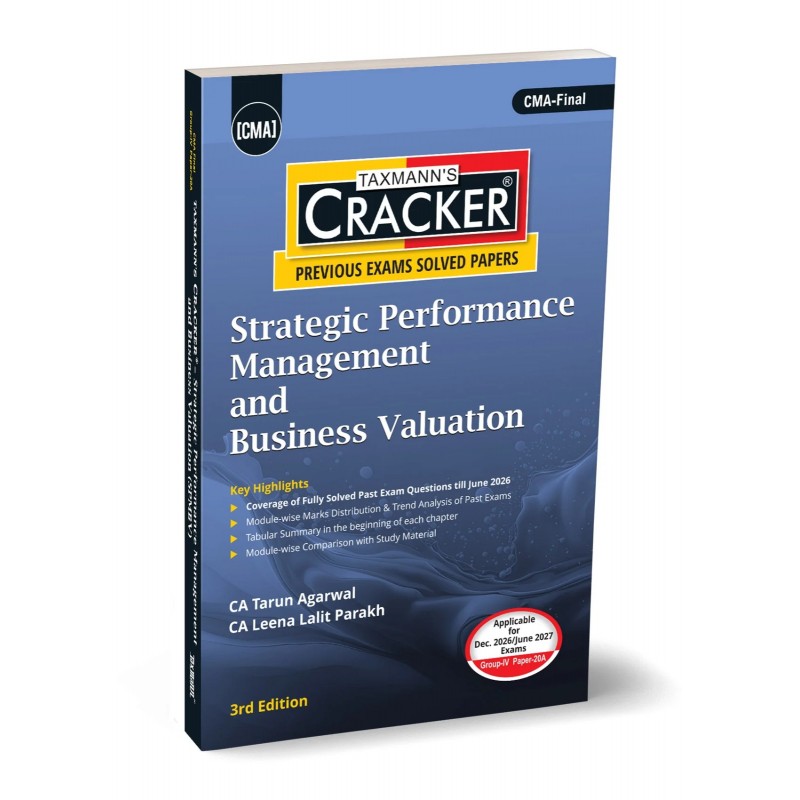
Strategic Performance Management and Business Valuation – CRACKER is an exam-focused, self-study question bank and revision companion built specifically for CMA Final Paper 20A. This book shifts the emphasis from reading theory to practising the exam—every module is taught through past examination questions, fully worked model answers, and quick-revision aids that mirror how the ICMAI examiner actually frames the paper.
The book is aligned with the ICMAI Syllabus 2022 and organises the entire paper into its nine prescribed modules across two sections—Strategic Performance Management (Section A) and Business Valuation (Section B)—each carrying equal 50% weightage under the syllabus. Within every chapter, students first get a crisp concept-and-formula recap (A Quick Review), then a graded bank of Past Examination Questions—objective questions and numerical problems, plus theory/short-note questions—each tagged with the exam session(s) and marks in which it appeared and solved in full with detailed Working Notes.
Its defining strength is currency and exam intelligence: solved questions are updated right up to the June 2026 attempt, and the front matter equips students with a module-wise marks distribution, a question-by-question trend analysis of recent papers, and a direct mapping to the ICMAI study material—so a student always knows what to study, how much it is worth, and where it sits in the official material. The book closes with the two latest papers (December 2025 and June 2026) presented as module-wise solved papers that re-sequence each real exam by topic and cross-reference answers back to the relevant chapter
The Present Publication is the 3rd Edition | June 2026, authored by CA. Tarun Agarwal & CA. Leena Lalit Parakh, with the following noteworthy features:
- [Fully Solved Past-exam Questions till June 2026] A deep, current bank of previous CMA Final questions with complete, model-style suggested answers. The bank reaches back to 2015 (over a decade of papers), incorporating earlier-syllabus questions remapped to the current modules
- [Questions Tagged by Session & Marks] Every question carries its exam attempt(s) and mark value (e.g., [June 2017, Dec. 2023, 2 Marks]), and repeats are flagged (‘Similar Question in…’), so high-frequency and favourite topics are instantly visible
- [Module-wise Marks Distribution & Trend Analysis] A statistical view of how marks have fallen across modules over recent attempts (2023–2026, with averages), making it easy to prioritise high-yield areas
- [Question-by-question Previous-exam Trend Analysis] A paper-wise breakdown identifying the compulsory question, the chapter tested, the marks, and whether the question was theory or practical
- [‘A Quick Review’ at the Start of Every Chapter] The chapter-opening quick-revision summary (marketed as the chapter’s tabular summary) captures key concepts, frameworks and formula sheets (e.g., Enterprise Value, operating/financial leverage, Gordon growth, FCFF/FCFE, CAPM/WACC, Altman Z-score, and merger exchange-ratio/synergy formulae)
- [Worked Numerical Problems with Working Notes] Practical questions are solved step-by-step with supporting computations, not just final figures
- [Module-wise Comparison with the ICMAI Study Material] Every module and chapter is mapped to its corresponding CMA study material module, removing any guesswork about coverage
- [Module-wise Solved Papers (Dec. 2025 & June 2026)] The two latest papers, re-arranged module-wise with suggested answers and cross-referenced to the relevant chapter/page for context-rich practice
The book covers the complete Paper 20A syllabus across two sections and nine modules:
- Section A — Strategic Performance Management (50% Weightage)
- Module 1 – Introduction to Performance Management (8 Chapters)
- Performance, productivity and efficiency; financial performance analysis; procurement-to-pay and vendor relationship management; supply chain management; reverse mapping of business strategies using data analytics; order-to-cash and customer relationship management (CRM); customer profitability analysis; improvement of corporate credit rating score
- Module 2 – Performance Management, Evaluation and Improvement Tools (10 Chapters)
- Balanced Scorecard; Du-Pont analysis and the RONA model; benchmarking and bench trending; Six Sigma and Lean Management; Statistical Quality Control (SQC); Plan-Do-Check-Action (PDCA); MIS in a digital environment; Total Productive Maintenance; Total Quality Management; and Data Environment Analysis (the book’s title for the Data Envelopment Analysis / DEA technique). (The single highest-weighted module in the paper—roughly a 24-mark average across recent attempts)
- Module 3 – Economic Efficiency of the Firm (Performance Analysis) (3 Chapters)
- Economic performance indicators; profit optimisation under different market structures; market factors affecting pricing decisions
- Module 4 – Enterprise Risk Management (3 Chapters)
- Risk management; corporate risk management; corporate failure (including Altman Z-score/discriminant analysis).
- Section B — Business Valuation (50% Weightage)
- Module 5 – Fundamentals of Business Valuation
- Valuation concepts (CFA Institute view), Enterprise Value, leverages, dividend/Gordon growth models, cost of equity (CAPM) and WACC
- Module 6 – Laws and Compliance in Business Valuation
- Insolvency and Bankruptcy Code, 2016, fair-value and orderly-transaction concepts, and the regulatory framework (fully covered, though it carries no marks in the recent attempts tracked in the book’s distribution)
- Module 7 – Business Valuation Methods and Approaches
- DCF, FCFF/FCFE, relative valuation, beta and equity valuation
- Module 8 – Valuation of Assets and Liabilities
- Net asset value, intangibles, EVA/MVA, and security/bond valuation
- Module 9 – Valuation in Mergers and Acquisitions
- Exchange ratio, EPS impact, synergy, purchase consideration, free-float market capitalisation and merger types (the highest-weighted module within Business Valuation—roughly a 21-mark average—and heavily practical)
- Each module blends theory and practical (numerical) questions in the proportion the paper is actually examined, with full solutions throughout
The book is engineered for a logical study-to-revision flow:
- Strategic Front Matter First — It opens with the Module-wise Marks Distribution, the Previous Exams Trend Analysis, and the Module-wise Comparison with Study Material, giving students a planning map before they begin
- Section- and Module-wise Organisation — Content follows the official syllabus order: Section A (Strategic Performance Management) and Section B (Business Valuation), broken into the nine modules and their chapters.
- Consistent chapter anatomy—each chapter follows the same dependable rhythm:
- A Quick Review — Concept, framework and formula recap
- Past Examination Questions — Objective Questions (MCQs and fill-in-the-blank type) and Numerical Problems, alongside theory/short-note questions, each tagged with exam session and marks
- Model Answers with Working Notes — Complete, step-by-step solutions
- Module-wise Solved Papers at the End — The December 2025 and June 2026 papers are reproduced with suggested answers but re-sequenced module-wise (rather than in original question order) and cross-referenced to the relevant chapter/page, enabling topic-anchored, full-length revision.
About the Author
CA Tarun Ramgopal Agarwal is a distinguished All-India Rank Holder at all levels of the Chartered Accountancy exams, earning a Gold Medal in Financial Reporting in the CA Final. In 2010, he was honoured by the Chartered Accountants Association, Ahmedabad, as the best CA student in Gujarat for securing 1st Place in the CA Final in the state. He holds multiple qualifications, including B.Com., CS, LL.B., CFA (Level 2), and FRM.
CA. Leena Lalit Parakh is a practising Chartered Accountant with over eleven years of academic experience, specialising in law, audit, strategic management, and economics. Renowned for her practical teaching approach, she has developed extensive educational resources and currently mentors CMA students at all levels in Surat. Her expert guidance has contributed to the success of numerous students, including over 25 All-India Rank holders.