Drafting Pleadings & Appearances Cracker Ankush Bansal Dec 26 & June 27
Drafting Pleadings & Appearances Cracker Ankush Bansal Dec 26 & June 27
Description
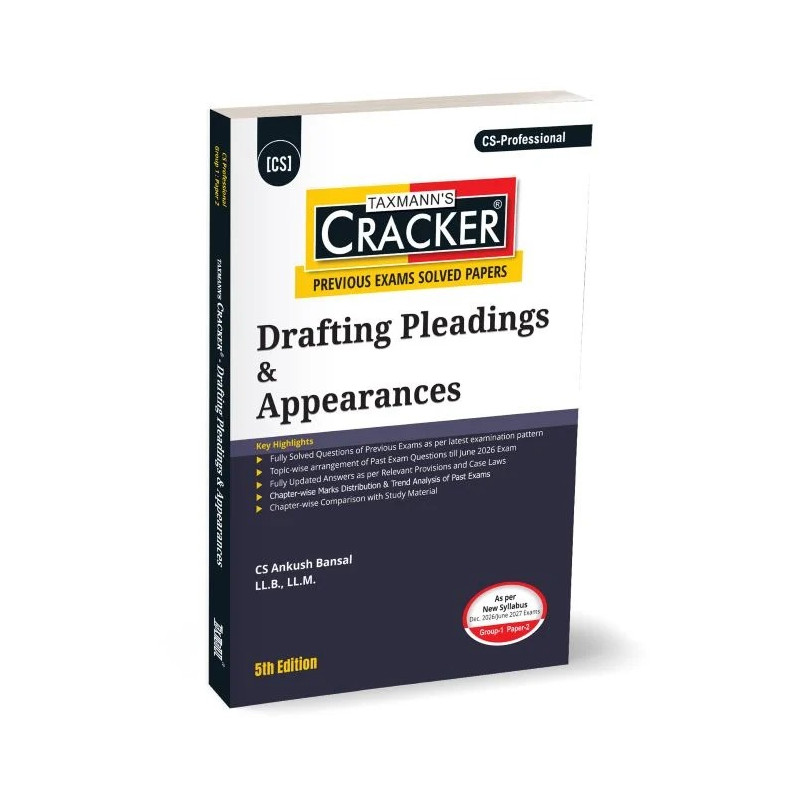
Drafting Pleadings & Appearances – CRACKER is a question-bank-led revision and practice volume for CS-Professional | Group 1 – Paper 2. It is built on a single working method: learn the paper the way it is examined. Instead of restating theory, the book reproduces the questions ICSI has actually set, groups them topic-by-topic, and answers each one in full—backed by the governing provisions, leading case law, and, where the paper demands it, a complete specimen draft the student can reproduce under exam conditions. The result is a self-contained companion that takes a candidate from ‘I have read the syllabus’ to ‘I can write a scoring answer,’ and doubles as the primary revision tool in the weeks before the exam.
The Present Publication is the 5th Edition June 2026, authored by CS Ankush Bansal, with the following noteworthy features:
- [Complete Solved Question Bank] Over 470 questions across all 14 chapters, answered in line with the latest examination pattern
- [Two Decades of Past Papers] The great majority are previous-exam questions, each tagged with the sitting(s) and marks in which it appeared, spanning from the mid-2000s up to and including June 2026
- [Probability-Graded Tagging] Questions are also flagged as Scoring Questions (high-recurrence areas) and Expected Questions (anticipated topics), so revision time follows the marks
- [Specimen Drafts & Ready Formats] More than 25 specimen drafts embedded in the answers, covering the practical, reproduce-under-pressure component this paper specifically rewards
- [Anchored in Case Law] Model answers cite leading precedents such as Mohiri Bibi v. Dharmodas Ghose, Suraj Lamp & Industries v. State of Haryana, Prakash Gupta v. SEBI and SEBI v. Bhavesh Pabari, alongside the relevant statutory provisions
- [Marks Distribution & Trend Analysis] Chapter-wise mapping across the five most recent sittings (June 2024–June 2026), showing where marks have concentrated
- [Study-Material Mapping] Chapter-wise comparison with the ICSI Study Material, aligning every chapter to its source for gap-free coverage
- [Latest Solved Paper] The June 2026 paper, fully solved with suggested answers, included as a recent end-to-end self-test
The content spans all 14 chapters of the syllabus, organised into two parts:
- Part I – Drafting and Conveyancing
- Types of Documents
- General Principles of Drafting
- Laws relating to Drafting and Conveyancing
- Drafting of Agreements, Deeds and Documents
- Drafting of Commercial Contracts
- Documents under Companies Act 2013
- Art of Opinion Writing
- Commercial Contract Management
- Part II – Pleadings and Appearance
- Judicial & Administrative Framework
- Pleadings
- Art of Advocacy and Appearances
- Applications, Petitions and Appeals under Companies Act 2013
- Adjudications and Appeals under SEBI Laws
- Appearance before other Regulatory and Quasi-judicial Authorities
- Across these chapters, the book works through the full range of instruments and proceedings the paper tests:
- Business Communications — Circulars, public notices, letters of credit, bank guarantees and show-cause notices
- Deeds — Gift deeds, and mortgage variants, including deposit of title deeds, usufructuary and redemption
- Commercial Agreements — Joint venture, foreign collaboration, employment, family settlement, amalgamation, debenture trust deeds and underwriting
- Corporate Documents — CSR resolutions and powers of attorney
- Opinion Writing — Drafting reasoned legal opinions on referred questions
- Pleadings & Appearances — Plaints, written statements, special leave petitions, affidavits and memoranda of appeal, with proceedings before the NCLT, NCLAT, SEBI and SAT
The book is organised so that practice is guided by data and follows the way the paper is actually set:
- Analytical Front Matter — The volume opens with three tables—Marks Distribution, Trend Analysis, and the Study-Material comparison—giving a data-driven view of the paper before practice begins
- Weighting at a Glance — The same tables surface where the marks sit: Laws relating to Drafting and Conveyancing is the heaviest chapter by a wide margin (averaging 32 marks across the five recent sittings), followed by Adjudications and Appeals under SEBI Laws (16 marks), Drafting of Agreements, Deeds and Documents (12 marks), and Types of Documents (11 marks)
- Topic-Wise Arrangement — Within each chapter, questions run topic-wise so related problems are studied together
- Tagged for Targeted Revision — Each question is marked either with its exam sitting and marks (e.g., Dec. 2025, 5 Marks) or as a Scoring/Expected/ICSI Study Material question
- Answer Formats that Mirror the Exam — Responses are deliberately varied—descriptive theory, applied scenario problems, side-by-side comparison tables, and full drafting exercises in which the model answer supplies a ready-to-reproduce specimen
- Full-Length Rehearsal — The book closes with the complete June 2026 question paper and its suggested answers for a timed, end-to-end self-test.
About the Author
CS Ankush Bansal is a distinguished figure in the legal field, renowned for his extensive knowledge across Corporate, Civil, Criminal, General, and Personal laws. Ankush has made significant contributions to legal academia and practice, with a legal career spanning over eight years. Ankush holds impressive academic credentials, including a CS, B.Com., LL.B., and LL.M. from Delhi University. His scholarly works, widely recognised for their meticulous research and insightful analysis, have become essential readings for professional courses.