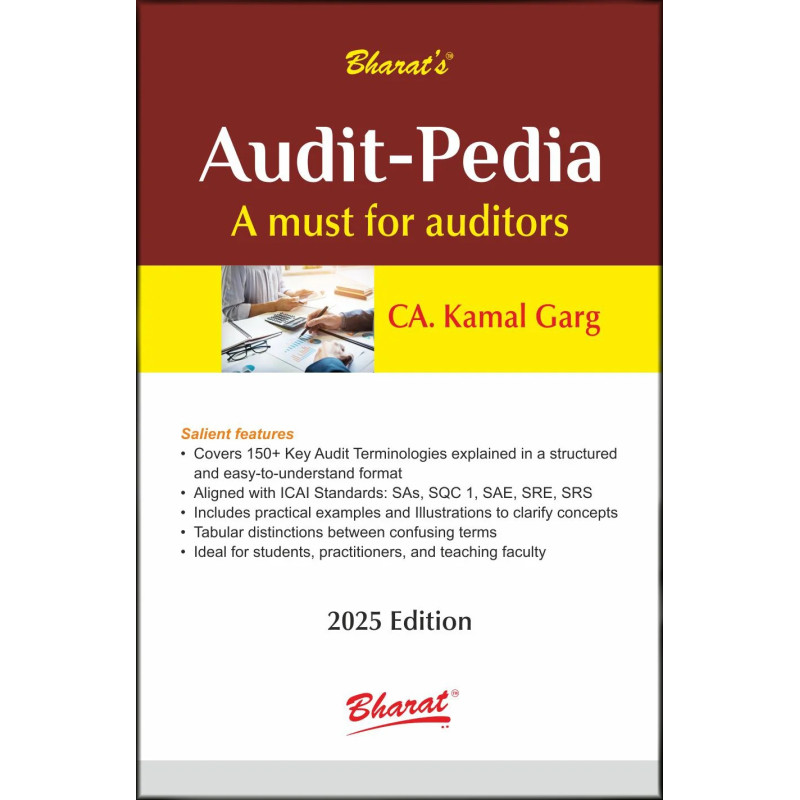
Bharat AUDIT-PEDIA by CA kamal garg 1st Edition 2025
Bharat AUDIT-PEDIA by CA kamal garg 1st Edition 2025
The first edition of the Book on Audit-Pedia (The Complete Dictionary of Audit Terminologies) is designed to simplify this experience. This book serves as a comprehensive reference, offering clear and practical explanations of terms commonly encountered in audits. Each term is presented with concise definitions, contextual explanations, and, where applicable, illustrations and examples that make the understanding more relatable and practical.
This Book caters to a broad audience viz. learners aiming to build their foundation in auditing, educators seeking a reliable resource, and professionals who need a ready reference in their daily work. Whether used for academic preparation, client interactions, or professional discussions, Audit-Pedia aims to support clarity, confidence, and consistency in audit communication.
Content of the book is as follows –
- True and Fair View
- Materiality
- Going Concern
- Emphasis of Matter (EOM)
- Audit Risk
- Independence
- Assertions
- Audit Documentation or Audit File or Working Papers
- Professional Skepticism
- Internal Control
- Audit Evidence
- Related Parties
- Fraud
- Sampling
- Analytical Procedures
- Test of Controls
- Test of Details
- External Confirmations
- Written Representations
- Subsequent Events
- Comparative Information
- Opening Balances
- Audit of Accounting Estimates
- Management Bias
- Using the Work of an Auditor’s Expert
- Management’s Expert
- Using the Work of another Auditor
- Using the Work of Internal Auditors
- Audit Committee under Companies Act, 2013
- Communication with those Charged with Governance (TCWG) and Management
- Joint Audit
- Unqualified (Clean) Audit Report
- Qualified Audit Report
- Adverse Audit Report
- Disclaimer of Opinion
- Emphasis of Matter Paragraph
- Other Matter Paragraph
- Key Audit Matters (KAMs)
- The Auditor’s Responsibilities Relating to Other Information (SA 720 – Revised)
- Professional Judgment
- Premise
- Risk of Material Misstatement
- Applicable Financial Reporting Framework
- Experienced Auditor
- Misstatement
- Clearly Trivial Misstatements
- Materiality in the Context of an Audit
- Materiality and Audit Risk
- Benchmarking
- Cut-off Procedures
- Substantive Analytical Procedures
- Compliance Procedures and Substantive Procedures
- Sufficient and Appropriate Audit Evidence
- Types of Audit Evidence
- Corroborative Audit Evidence
- Risk Assessment Procedures
- Audit Planning and Audit Strategy
- Audit Programme
- Planning Activities
- Internal Check
- Nature, Timing, and Extent of Audit Procedures
- Permanent File and Current File in Audit Documentation
- Assertions
- Engagement Team, Firm, and Personnel
- Network and Network Firm
- Engagement Quality Control Review
- Elements of a System of Quality Control
- Engagement Partner and Key Audit Partner Rotation Requirements
- Leadership Responsibilities for Quality within the Firm
- Ethical Requirements and Independence
- Acceptance and Continuance of Client Relationships and Audit Engagements
- Human Resources
- Engagement Performance
- Monitoring under SQC 1
- Complaints and Allegations under SQC 1
- Engagement Partner Responsibility
- Differences of Opinion within the Engagement Team
- Engagement Documentation
- Engagement Partner Change During an Ongoing Audit
- Quality Control Manual
- Letter of Engagement
- Recurring Audits
- Letter of Weakness
- Audit Considerations Relating to an Entity Using a Service Organisation
- Assurance Reports on Controls at a Service Organisation
- Audits of Financial Statements Prepared in Accordance with Special Purpose Frameworks
- Audits of Single Financial Statements and Specific Elements, Accounts or Items of a Financial Statement
- Engagements to Report on Summary Financial Statements
- Review Engagements
- Contradictory Evidence
- Compilation Engagements
- Agreed-Upon Procedures Engagements
- Walkthrough Procedures
- Vouching vVerification
- Audit Trail
- Surprise Check
- Examination in Depth
- Computer-Assisted Audit Techniques (CAATs)
- IT Controls
- Entity Level Controls (ELCs)
- Transaction Level Controls (TLCs)
- Reasonable Assurance
- Absolute Assurance
- Moderate Assurance
- Financial Statements
- Historical Financial Information
- Purpose and Objective of Audit
- Audit and Auditor
- Magnitude
- General Purpose Financial Statements
- the Audit Engagement
- Non-compliance with Laws and Regulations
- Information and Explanations
- Necessary for the Purpose of His Audit
- Sought and Obtained All the Information and Explanations
- Uncorrected Misstatements
- Undetected Misstatements
- Deficiency in Internal Control
- Significant Deficiency in Internal Control
- Business Risk
- Significant Risk
- Sampling Risk
- population
- Anomaly
- Non-Sampling Risk
- Sampling Unit
- Statistical Sampling
- Stratification
- Tolerable Misstatement
- Tolerable Rate of Deviation
- Roll Forward and Roll Backward Procedures
- Physical Inventory count
- Non- Responses in External confirmations
- Addressing Doubts on the Reliability of Confirmation Responses
- Oral Responses to Confirmation Requests
- Predecessor Auditor
- Plausible Relationships Among Financial &. Non-Financial Data
- Additional v Alternative Audit Procedures
- projecting Misstatements
- Auditor’s Point Estate or Range
- Estimation Uncertainty
- Management’s Point Estimate
- Outcome of an Accounting Estimate
- Mitigating Factors (Going Concern)
- Material Uncertainty for Going Concern
- Indicators for Going Concern
- Appropriateness or Inappropriateness of Going Concern
- Safeguards Managing Threats to compliance with Fundamental Principles
- Threats to Independence
- public Interest Entity (PIE)
- NOCLAR – Non-compliance with Laws and Regulations
- Risk Control Matrix (RCM)
- Sign-off
- Ticking ,Tagging and Tracing
About Author
CA. Kamal Garg is a Fellow Member of The Institute of Chartered Accountants of India (ICAI) and a First Class Commerce Baccalaureate from Deen Dayal Upadhyaya College, University of Delhi. He has also qualified post qualification course on Diploma in Information System Audit (DISA) conducted by ICAI.