CMA Final CFR CRACKER by CA Tarun Agarwal For Dec 26 & June 27
CMA Final CFR CRACKER by CA Tarun Agarwal For Dec 26 & June 27
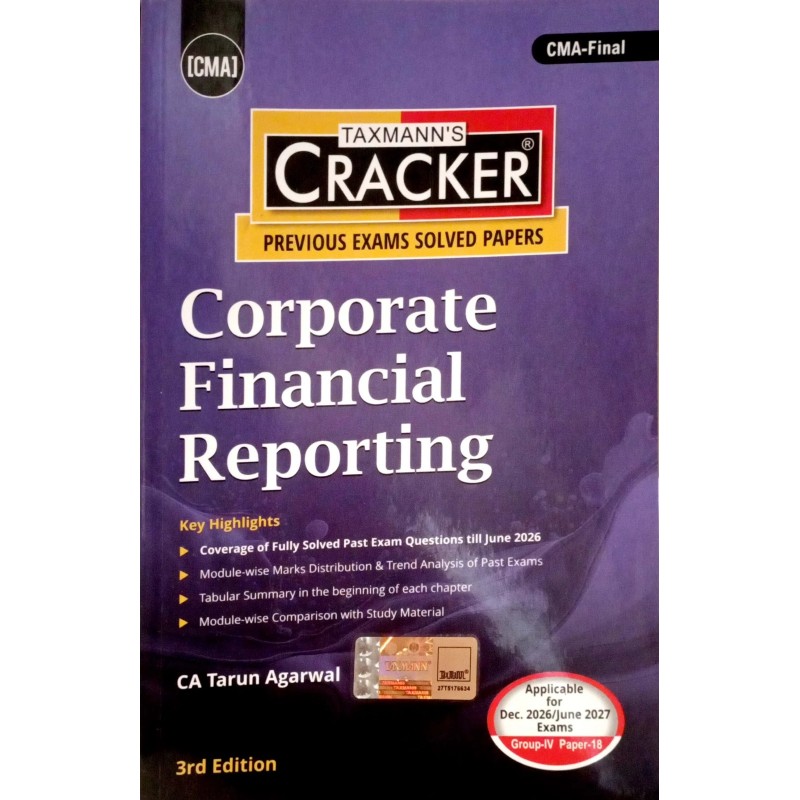
Corporate Financial Reporting | CRACKER is an exam-focused practice-and-revision companion for Paper 18 of the CMA Final (Group IV). It is built strictly around the ICMAI Syllabus 2022. The book compresses one of the most technically demanding papers of the CMA Final—Indian Accounting Standards (Ind AS), share valuation, financial instruments, business combinations, consolidation, modern reporting frameworks and government accounting—into a single, disciplined ‘crack-the-exam’ resource.
The CRACKER format is built on a revise-then-practise philosophy. Each chapter opens with a concise ‘A Quick Review’ of the underlying standard or topic, then moves straight into fully solved past examination questions, arranged topic by topic. The question coverage is substantial: the chapters carry around 284 solved questions, and two complete solved papers at the end add roughly 56 more—about 340 fully-solved questions in all. Because many questions have appeared in more than one sitting, they carry 430+ exam-attempt tags, each showing the attempt and its mark weightage, and answered with model solutions (including the 120+ working notes that practical problems demand). This Edition is updated with examination coverage through the June 2026 attempt, keeping it current for candidates targeting the December 2026 and June 2027 sittings.
The Present Publication is the 3rd Edition | June 2026, authored by CA. Tarun Agarwal, with the following noteworthy features:
- [Fully-Solved Past-Exam Questions (till June 2026)] An extensive, topic-wise bank of authentic CMA Final questions (around 340 solved questions), each tagged with its attempt + marks (e.g., [Dec. 2015, 5 Marks; Similar Question June 2017, 4 Marks]) and answered with model solutions and detailed working notes
- [Module/Chapter-wise Marks Distribution & Trend Analysis] A year-by-year map across the seven sittings from June 2023 to June 2026, breaking marks down by module (and, within Specific Accounting Standards, by individual chapter) with averages that expose where examiner emphasis really sits—plus a question-by-question trend table flagging each item as Theory, Practical, or both
- [Tabular ‘A Quick Review’ Summary in Every Chapter] The book’s signature opening recap (objective, definitions, recognition, measurement and disclosure) for fast pre-question revision, present across all 19 chapters/modules
- [Module-wise Comparison with the ICMAI/CMA Study Material] Every module is mapped to its corresponding official CMA Study Module, so students can move seamlessly between this book and the ICMAI material
- [Questions Classified by Type] Each chapter separates Objective Questions, Theory Questions and Numerical/Practical Problems, so students can drill conceptually and computationally with intent
- [Two Full Module-wise Solved Papers] Complete suggested answers for the December 2025 and June 2026 papers, presented module-wise for integrated, exam-condition practice
- [Strictly Aligned to Syllabus 2022] Structured along the eight prescribed modules of the official ICMAI syllabus
The book follows the eight modules of the Paper 18 syllabus. Page weight broadly mirrors exam weight—Specific Accounting Standards, Business Combination and Consolidation are the heaviest sections.
- Module 1 – Specific Accounting Standards (Ind AS)
- Accounting Policies, Changes in Accounting Estimates & Errors (Ind AS 8)
- Income Taxes (Ind AS 12)
- Property, Plant & Equipment (Ind AS 16)
- Leases (Ind AS 116)
- The Effects of Changes in Foreign Exchange Rates (Ind AS 21)
- Borrowing Costs (Ind AS 23)
- Impairment of Assets (Ind AS 36)
- Intangible Assets (Ind AS 38)
- Share-Based Payment (Ind AS 102)
- Operating Segments (Ind AS 108)
- Fair Value Measurement (Ind AS 113)
- Revenue from Contracts with Customers (Ind AS 115)
- Module 2 – Valuation of Shares
- Purposes of and factors affecting valuation; the Net Assets (Intrinsic Value), Yield and Fair Value methods. (High weightage; ~8.4 avg. marks)
- Module 3 – Accounting of Financial Instruments
- Ind AS 32 (Presentation), Ind AS 107 (Disclosure) and Ind AS 109 (Recognition, Measurement & Hedge Accounting); classification into financial assets, financial liabilities and equity
- Module 4 – NBFCs: Provisioning Norms, Accounting and Reporting
- RBI asset classification and provisioning norms for standard, sub-standard, doubtful and loss assets
- Module 5 – Accounting for Business Combination and Restructuring
- Ind AS 103 (acquisition method, goodwill/bargain purchase, and common-control combinations under the pooling-of-interest method), amalgamation and internal reconstruction. (One of the two heaviest-scoring modules; ~23.9 avg. marks)
- Module 6 – Consolidated & Separate Financial Statements
- Ind AS 110 (Consolidation/Control), Ind AS 111 (Joint Arrangements), Ind AS 28 (Associates & Joint Ventures – equity method) and Ind AS 27 (Separate Financial Statements). (Typically, the single largest mark contributor; ~24.9 avg. marks)
- Module 7 – Recent Developments in Financial Reporting
- A modern-reporting module covering Triple & Quadruple Bottom Line (3P/4P) reporting, Sustainability Reporting, CSR under the Companies Act 2013, Corporate Governance, Integrated Reporting (value-creation process), ESG Reporting, Human Resource Accounting/Reporting, Earnings Calls, the Value-Added Statement, Economic Value Added (EVA) and XBRL (features, users, advantages and adoption in India)
- Module 8 – Government Accounting in India
- Features and objectives of government accounting, cash vs. accrual basis, fund-based accounting, and the Indian framework—GASAB, IGAS and IGFRS
- Module-wise Solved Papers
- Full suggested answers for the December 2025 and June 2026 papers
The book is engineered around a deliberate plan → revise → practise → test sequence:
- Diagnostic Front Matter — Before the chapters begin, students get the Module-wise Marks Distribution, the Previous Exams Trend Analysis (question-by-question, each item flagged Theory, Practical, or both), and the Module-wise Comparison with the Study Material. Together, these let a candidate set a strategy and prioritise time before opening a single chapter
- Chapter-level ‘A Quick Review’ — Each chapter starts with a pointwise/tabular summary of the relevant standard or topic for a rapid conceptual refresh
- Past Examination Questions — The heart of every chapter. Questions are grouped into Objective, Theory, and Numerical/Practical, carry their exam references and marks, and are followed by suggested answers with working notes
- End-of-book Solved Papers — The two most recent attempts (December 2025 and June 2026) are reproduced module-wise with full answers for complete, timed practice
- This mirrors how the exam actually tests the subject—short objective items, theory, and substantial practical problems—so students build speed and accuracy.
About the Author –
CA Tarun Ramgopal Agarwal is a distinguished All-India Rank Holder at all levels of the Chartered Accountancy exams, earning a Gold Medal in Financial Reporting in the CA Final. In 2010, he was honoured by the Chartered Accountants Association, Ahmedabad, as the best CA student in Gujarat for securing 1st Place in the CA Final in the state. He holds multiple qualifications, including B.Com., CS, LL.B., CFA (Level 2), and FRM.