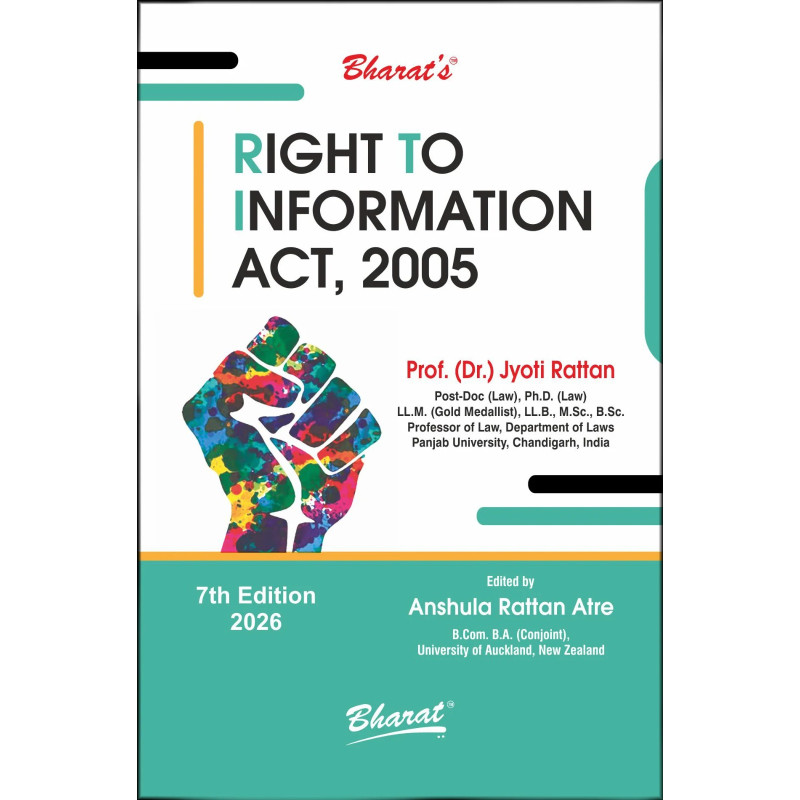
Right to Information, 2005 By Jyoti Rattan 7th Edition January 2026
Right to Information, 2005 By Jyoti Rattan 7th Edition January 2026
This text serves as a preface or introduction to a legal textbook on the Right to Information (RTI) Act, 2005.
Here is a Summary of the key points:
- Shift in Governance: It highlights the global and national transition from a culture of government secrecy to one of transparency and accountability.
- Constitutional Basis: It identifies the RTI Act as a tool that fulfills the fundamental right to freedom of speech under Article 19(1)(a), turning India into a truly participatory democracy.
- Book’s Objective: The author aims to present complex legal concepts in a simple, student-friendly, and accessible format for all readers.
- Updated Content: This edition includes recent case laws and practical examples to clarify the law.
- Critical Recent Amendment: A major focus of this edition is the analysis of the May 2027 amendment to Section 8(1)(j) (likely a typo for ‘j’ in your text), which was altered by the Digital Personal Data Protection (DPDP) Act to redefine the balance between privacy and public information.
Content
- Right to Information: International and National Scenario
- Challenges Affecting the Effectiveness of RTI AWS at the Global Level
- Right to Information Law in India
- Right to Information and Obligations of Public Authority
- The Central Information Commission
- The State Information Commission
- Powers and Functions of the Information Commissions, Appeal and Penalties
- Miscellaneous Provisions
- Evaluation of RTI Act, 2005
- Impact of DPDP Act on the RTI Act
Appendix 1 Application Format for Information under RTI Act, 2005
Appendix 2 Appeal Forms
About The Author
Prof. Dr. Jyoti Rattan, Professor, Department of Laws, Paniab University, Chandigarh holds a Post-Doc in Law, Ph.D. in Law. M.Sc. in Chemistry and is a Gold Medallist in LL.M.. besides B.Sc. and LL.B She did her Ph.D. in Law as a University Grants Commission (UGC) Senior Research Fellow