CMA Final Direct Tax Cracker By CA Tarun Agarwal Dec 26 Exam
CMA Final Direct Tax Cracker By CA Tarun Agarwal Dec 26 Exam
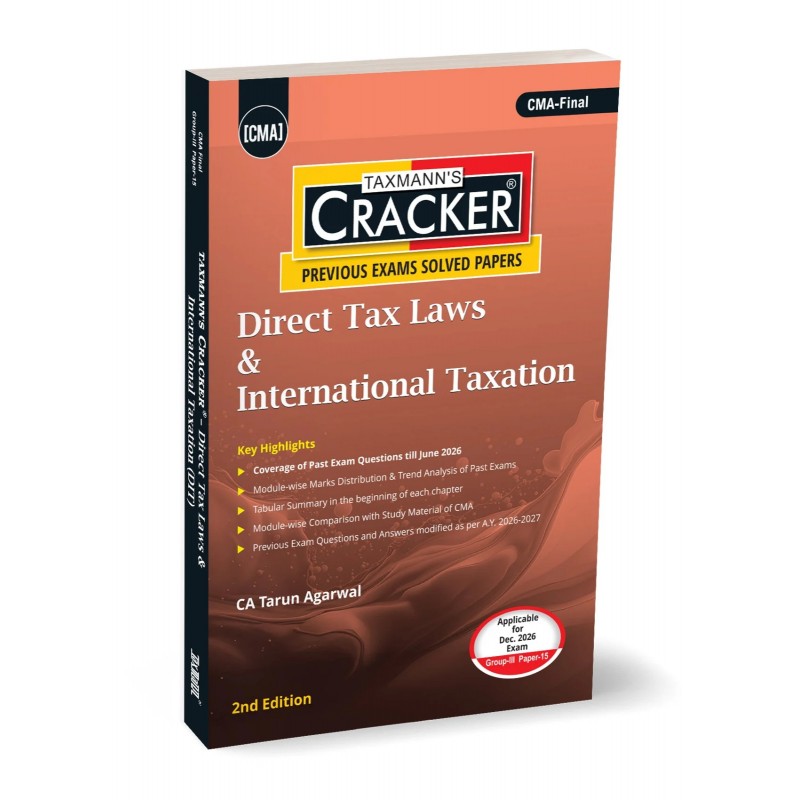
Direct Tax Laws and International Taxation – CRACKER is a purpose-built, examination-oriented companion for Paper 15 of the CMA Final (Group III). It is engineered around the examination itself rather than around teaching the subject afresh: it draws on more than a decade of actual CMA question papers, arranges them topic-by-topic, updates each one to the law in force, and pairs each with a model answer written the way an examiner expects to see it. The book’s job is to help a student convert conceptual understanding into marks under real exam conditions.
At its core is a large, curated bank of solved questions—approximately 465 in total—drawn from past CMA examinations spanning June 2015 right through to June 2026, including questions carried over from earlier syllabi and re-cast for the current one. Every question is stamped with its original exam sitting and mark value, and more than 320 of these questions carry a ‘Modified’ tag, signalling that the problem—and its solution—has been reworked to reflect Assessment Year 2026-27 provisions, rates, and thresholds. Nothing in the book asks a student to practise on stale law.
This Edition (July 2026) is specifically aligned with the December 2026 attempt. The practical solutions visibly apply the latest positions—the default tax regime under section 115BAC, the amended section 40(b) partner-remuneration limits, the disallowance of delayed payments to MSMEs, section 234C advance-tax interest, Health & Education Cess at 4%, and so on—so the practice mirrors exactly what the December 2026 paper will demand.
In short, it is designed to be the book a CMA Final student keeps open through the final weeks: concise enough for rapid revision, data-driven enough to prioritise the right topics, and rigorous enough to cover both the practical (computational) and theoretical sides of direct tax and international taxation.
The Present Publication is the 2nd Edition | July 2026, authored by CA. Tarun Agarwal, with the following noteworthy features:
- [Coverage of Past Exam Questions till June 2026] The solved bank draws on CMA papers from June 2015 through June 2026 and concludes with the full June 2026 solved paper (with suggested answers), arranged module-wise—so both the long history and the very latest sitting are covered
- [Chapter-wise Marks Distribution & Trend Analysis of Past Exams] Front-of-book tables break down marks by chapter across recent sittings (2023, 2024, 2025—June & December) with a computed 2026 average, plus a question-by-question trend analysis tagging each item as Theory or Practical—an at-a-glance map of where the marks actually sit
- [Tabular Summary at the Beginning of Each Chapter] 24 chapter-opening ‘Quick Review’ tables distil the core provisions and their treatment for fast, pre-exam recall before the questions begin
- [Module-wise Comparison with the CMA Study Material] A dedicated mapping aligns all 14 modules to the Institute’s official study-material module numbers (1–14), so students can confirm complete syllabus coverage and cross-reference with confidence
- [Previous Exam Questions & Answers Modified as per A.Y. 2026-27] Historical problems and their answers are rebuilt around present-day provisions, rates, and limits—more than 320 questions carry a ‘Modified’ tag—so nothing is practised on outdated positions
- [Every Question Exam-tagged & Mark-weighted] Each question shows its source sitting and marks (e.g., [June 2019, 2 Marks, Modified]), with ‘Modified’ and ‘Similar’ labels indicating where a problem has been adapted to current law
- [Objective & Practical Questions, Fully Solved] Many chapters include a dedicated ‘Objective Questions’ block (MCQ/1–2 mark) alongside descriptive and practical (computational) problems, with step-by-step working notes and computation tables in the answers
The book spans the complete Paper 15 syllabus across two sections—Direct Tax Laws and International Taxation—organised into fourteen modules.
- Section A – Direct Tax Laws
- It begins with the assessment and tax computation of various entities—individuals (including non-residents), companies, trusts, and mutual associations—then works through the machinery and procedural provisions: return of income; assessment procedure and dispute resolution; interest and fees; survey, search and seizure; collection, recovery and refund of tax; appeals; rectification; revision; settlement commission; and advance ruling. It continues through penalties and prosecutions, business restructuring, the many facets of tax planning, the CBDT and other authorities, e-commerce transactions and liability in special cases, Income Computation and Disclosure Standards (ICDS), the Black Money Act 2015, and a dedicated case-study module
- Section B – International Taxation
- It covers the heavily weighted cross-border topics: Double Taxation Avoidance Agreements (DTAAs), Transfer Pricing, and the General Anti-Avoidance Rule (GAAR). The book’s own trend analysis shows these carry substantial marks—Transfer Pricing and DTAA in particular are among the highest-scoring areas of the paper
- Consistent Design
- A quick conceptual recap, then a graded set of past-exam questions with model answers, so the underlying provision is reinforced and immediately seen in application
The book is built on a two-section, module-wise architecture that mirrors the official Paper 15 syllabus, deliberately layered so a student moves from orientation, to recall, to full exam practice.
- Two Sections, Fourteen Modules — Section A – Direct Tax Laws runs across eleven modules and Section B – International Taxation across three, following the official syllabus rather than a chapter-by-chapter textbook sequence.
- Strategy Tools — The book opens with exam-strategy tools placed ahead of the syllabus content—the chapter-wise marks distribution, the previous-exams trend analysis, and the module-wise comparison with the CMA Study Material—so the reader can decide what to prioritise before turning to a single question
- A Consistent Per-chapter Design — Inside each module the pattern repeats: a tabular ‘Quick Review’ fixes the core provisions, an ‘Objective Questions’ block (present in many chapters) tests quick recall, and a graded set of descriptive and practical questions with fully worked solutions builds exam stamina—every question tagged by sitting, marks, and answer type so students can calibrate both speed and depth.
About the Author –
CA Tarun Ramgopal Agarwal is a distinguished All-India Rank Holder at all levels of the Chartered Accountancy exams, earning a Gold Medal in Financial Reporting in the CA Final. In 2010, he was honoured by the Chartered Accountants Association, Ahmedabad, as the best CA student in Gujarat for securing 1st Place in the CA Final in the state. He holds multiple qualifications, including B.Com., CS, LL.B., CFA (Level 2), and FRM.