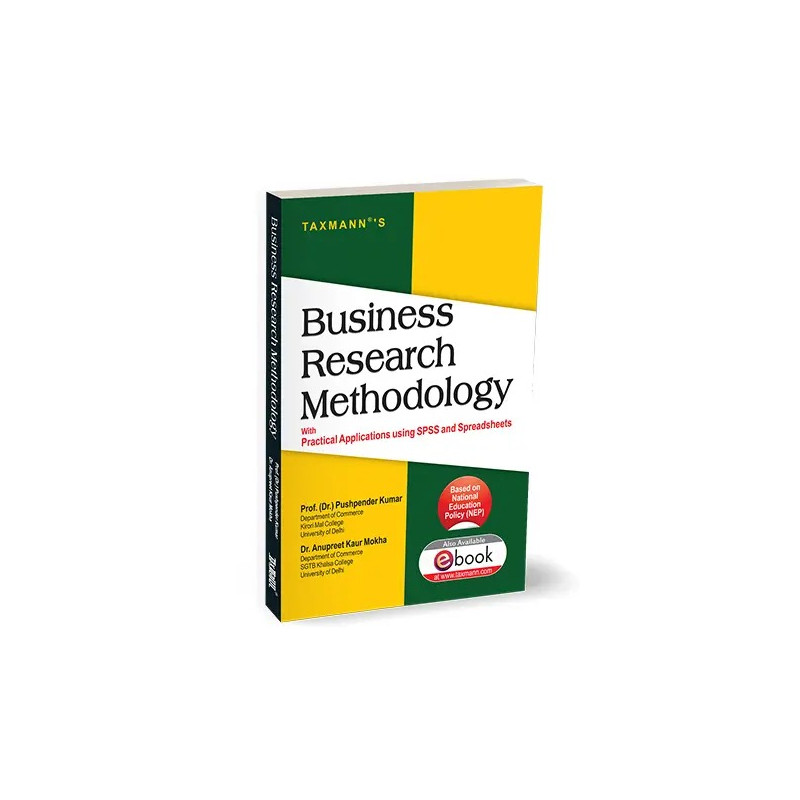
Taxmann Business Research Methodology Edition December 2025
Taxmann Business Research Methodology Edition December 2025
The Present Publication is the Latest Edition, authored by Prof. (Dr) Pushpender Kumar and Dr Anupreet Kaur Mokha, with the following noteworthy features:
- [Complete Coverage of the Research Cycle]
- [Highly Practice-driven]
- [Detailed Visuals]
- [Strong Conceptual Clarity]
- [Case Study Integration]
- [Ethics-focused]
- [Student-friendly Design]
- [Alignment with NEP Learning Outcomes]
- [Exam-ready Content]
The coverage of the book is as follows:
- Introduction to Research – Builds a strong conceptual foundation:
- Meaning, scope, and significance of research
- Research terminologies (concepts, variables, constructs, hypotheses, models, theories)
- Types of Research – Quantitative/qualitative, conceptual/empirical, fundamental/applied, cross-sectional/longitudinal
- Philosophical approaches (positivism, interpretivism, pragmatism)
- Deductive vs Inductive reasoning with frameworks and visuals
- Research Process – Step-by-step explanation
- How to conduct a literature review (steps, sources, synthesis)
- How to formulate research questions, with examples and common mistakes
- Research Design – Provides a blueprint for conducting research:
- Meaning and characteristics of research design
- Exploratory, descriptive, and experimental designs
- When and how each design is used in business studies
- Examples and structured diagrams to choose appropriate designs
- Data Collection – A comprehensive and application-rich unit:
- Measurement & Scaling
- Levels of measurement (nominal, ordinal, interval, ratio)
- Comparative scales (ranking), non-comparative scales (rating)
- Likert, semantic differential, Stapel scales
- Reliability & validity (types, measurement, examples)
- Survey Methods
- Types of Surveys – Online, telephonic, personal, mail-based
- Characteristics of a good survey
- Designing questionnaires, respondent bias, and pilot testing
- Sampling Techniques
- Concepts – Population, sampling units, sampling frame
- Probability Sampling – Random, stratified, systematic, cluster
- Non-probability sampling: convenience, purposive, quota, judgmental
- Sample size determination (logic, formulae, examples)
- Data Analysis using Spreadsheet & SPSS – Highly practical, tool-based, and skill-building:
- Data Preparation & Cleaning
- Handling missing values
- Detecting outliers
- Coding/recoding variables
- Classification of data
- Visual Presentation – Tables, line charts, bar charts, pie charts, histograms, box plots
- Descriptive Statistics
- Measures of central tendency (mean, median, mode)
- Measures of variation (range, IQR, variance, SD, coefficient of variation)
- Skewness, kurtosis, interpretation with visuals
- Inferential Statistics (with SPSS & Spreadsheet Procedures) – Each test includes a practical example, SPSS steps, spreadsheet method & output interpretation:
- One-sample Z-test & Two-sample Z-test
- One-sample t-test
- Paired-sample t-test
- Independent-sample t-test
- Chi-square tests (goodness of fit & independence)
- Non-parametric tests:
- Kolmogorov–Smirnov
- Mann–Whitney U
- Kruskal–Wallis
- Median test
- Sign test
- McNemar test
- Also includes numerical questions and practical exercises for every major concept
- Report Writing & Ethics – Focuses on academic writing and responsible research practices:
- Types of reports (contractual, project, research, evaluation, annual)
- Structure of a well-written research report
- Referencing and bibliography (with examples)
- Format and presentation guidelines (tables, figures, layout)
- Ethical issues at each research stage
- Rights and responsibilities of researchers, sponsors, and respondents