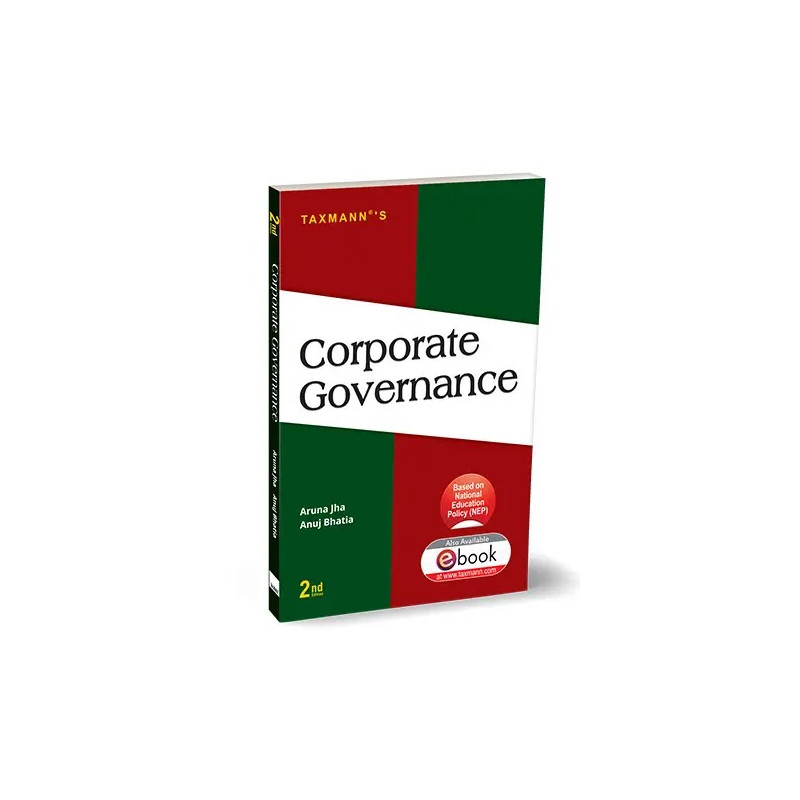
Corporate Governance By Aruna Jha, Anuj Bhatia Edition January 2026
Corporate Governance By Aruna Jha, Anuj Bhatia Edition January 2026
The Present Publication is the 2nd Edition, authored by Prof. (Dr) Aruna Jha and Anuj Bhatia, with the following noteworthy features:
- [Learning Objectives & Outcomes]
- [Integrated Theory–Law–Practice Approach]
- [Case-embedded Treatment]
- [Board-centric Governance Focus]
- [Regulatory Deep-dive]
- [Ancient Indian Thought & Ethics]
- [Assessment Support]
The coverage of the book is as follows:
- Introduction to Corporate Governance
- Explores the historical evolution from Berle & Means (1932) and Bob Tricker (1984) to contemporary scandals that triggered regulatory reforms. Introduces:
- Narrow and broader definitions (Cadbury, OECD 2023, ICSI)
- Need/benefits (value creation, stakeholder protection, global capital, ESG, sustainable growth)
- Four Pillars – Accountability, fairness, transparency, independence—illustrated via a simple diagrammatic table
- Governance vs management, with a structured comparison table and a figure showing shareholders–Board–management hierarchy
- Theoretical Framework of Corporate Governance
- A complete theory chapter covering:
- Agency/Shareholder Theory – Principal–agent conflict, information asymmetry, agency costs, monitoring mechanisms, ownership patterns
- Stewardship Theory – Trust-based, intrinsic motivation, CEO–Chairman unity, reduced monitoring costs
- Stakeholder Theory – Primary vs secondary stakeholders, shared value creation, CSR linkages (Nestlé example), board diversification for stakeholder representation.
- Resource Dependency Theory – Board as a resource-linking mechanism; interlocking directorships; external networks
- Managerial Hegemony Theory – Dominance of management, symbolic boards, passive shareholders, ideology of managerialism (Enron, Volkswagen examples)
- Comparative tables clearly differentiate Agency vs Stewardship and Agency vs Stakeholder perspectives
- Models of Corporate Governance
- Compares four broad models:
- Anglo-Saxon (outsider) Model – Dispersed shareholding, unitary boards, strong capital markets, activist investors, tight disclosure regime
- German Model – Two-tier boards, co-determination, bank-centric finance, cross-shareholding, stakeholder orientation, emphasis on supervisory board and employee representation
- Japanese Model – Keiretsu structure, main bank system, large insider boards, government influence, reforms post-Companies Act 2015 and Corporate Governance Code 2021
- Indian Model (modern) – Concentrated promoter ownership, rising institutional ownership, mandatory CSR and BRSR, key governance issues (family control, independent director shortages)
- Indian Model (ancient) – Kautilya’s rajadharma, dharma–artha–kama, Rajarshi leadership, Mandala theory, Yogakshema and CSR, whistle-blowing analogues in Arthashastra
- Board and Board Committees – The Epicentre of Governance
- Detailed treatment of:
- Legal position of directors; composition norms (minimum/maximum numbers, women director, resident director, independent director thresholds, small shareholder director)
- Duties under Section 166 (good faith, due care, conflict avoidance, no undue gain, non-assignment of office)
- Board powers under Section 179, statutory duties, KMP appointments, and risk management
- Mandatory committees (as per Companies Act):
- Audit Committee – Composition, powers, terms of reference, role in financial reporting and internal control
- Nomination & Remuneration Committee – Board & KMP appointments, performance evaluation, remuneration policies
- Stakeholders Relationship Committee – Grievance redressal for investors
- CSR Committee – Applicability thresholds, composition, 2% CSR spending and monitoring
- Insider Trading & Whistle Blowing – Quirky Governance
- Explains:
- SEBI (Prohibition of Insider Trading) Regulations 2015 – Definition of insider, UPSI, trading plans, structured digital database, enhanced whistle-blower incentives
- Whistle-blowing – Internal vs external, open vs anonymous, pros/cons, organisational whistle-blower policies, Companies Act vigil mechanism and SEBI framework, Whistle Blowers Protection Act 2014
- Shareholder Activism, Institutional Investors & Class Action Suits
- Covers:
- Shareholder Activism—forms, advantages, disadvantages, Indian trends (Eicher Motors, Siemens, Godfrey Phillips, etc.)
- Class Action Suits—concept, advantages, disadvantages, Section 245 Companies Act, admissibility thresholds, IL&FS/Jindal/ICICI Securities ongoing suits
- Institutional Investors—types, ownership statistics (with NSE data), mechanisms of participation (voting, engagement, public statements, coalition building), SEBI’s 2019 Stewardship Code
- CSR & Corporate Governance
- From Bowen and WBCSD definitions to Indian CSR:
- Business case for CSR (reputation, employee retention, cost savings, risk mitigation, community licence to operate)
- Critiques of CSR
- Gandhian Trusteeship as a normative base; Sarvodaya and ‘bahujana sukhaya, bahujana hitaya’ shaping redistribution and modern CSR
- Corporate Failures – Global & Indian
- Two major blocks:
- Global Failures – BCCI, Maxwell, Enron, WorldCom, Vivendi, Lehman Brothers, with each case structured as background → crisis → governance issues → aftermath
- Indian Failures – Satyam, Kingfisher, PNB Heist, IL&FS, ICICI–Videocon, Yes Bank; followed by a synthetic chapter on Common Governance Problems in Corporate Failures (financial manipulation, auditor failure, board passivity, CEO duality, weak risk management, regulatory gaps)
- Corporate Governance Reforms in India
- Brings together:
- Evolution from CII’s 1998 voluntary code, Clause 49, Birla Committee, Naresh Chandra, Narayana Murthy
- Companies Act 2013 – Independent directors, CSR, vigil mechanism, class action suits, SFIO, e-governance
- SEBI LODR 2015 – Board composition, quorum, independent woman director, Board evaluation, RMC, enhanced RPT and disclosure norms
- Kotak Committee 2017 – Larger board size, skill matrix disclosure, strengthened committees, improved RPT norms, and how these have been folded into LODR