CMA Inter Group 1 BLE, FA, DT & IDT and CA Crackers Dec 26 Exam
CMA Inter Group 1 BLE, FA, DT & IDT and CA Crackers Dec 26 Exam
Description
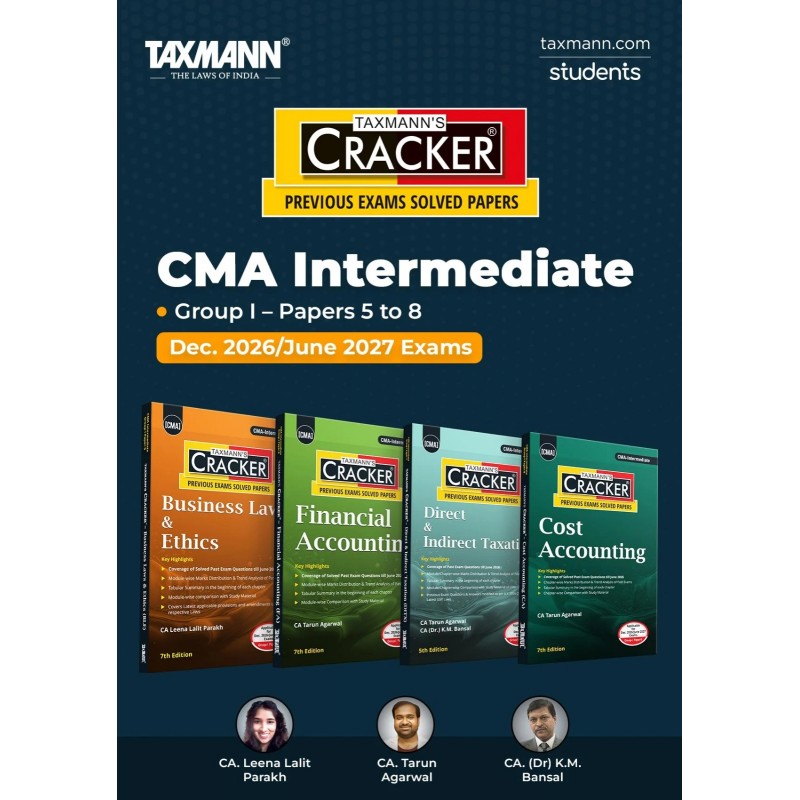
CRACKER COMBO for CMA Intermediate | Group I brings together all four papers of the first group—Business Laws & Ethics (Paper 5), Financial Accounting (Paper 6), Direct & Indirect Taxation (Paper 7) and Cost Accounting (Paper 8) as a single, coordinated set from Taxmann’s flagship CRACKER series. It is engineered around one conviction that runs through every title: the fastest way to score is to practise the questions the examiner actually sets and to answer them exactly as the examiner expects.
Each book is an exam-first, question-led revision companion, built strictly to the ICMAI Syllabus 2022. Instead of reteaching the subject, every title uses the Institute’s own examination history as its raw material—compiling a curated bank of genuine, previously asked ICMAI questions (objective and descriptive/practical) and pairing each with a complete, step-by-step model answer written to examination standard, with working notes, formats and stated assumptions. Solved questions run right up to and including the June 2026 attempt, and each volume draws on more than a decade of past papers, giving unusually deep, longitudinal coverage of how each topic has evolved.
Crucially, the COMBO is a structured practice system. Every book opens with the same three analytical tools (a marks distribution table, a question-by-question trend analysis, and a module- and chapter-wise mapping to the ICMAI Study Material), and every chapter opens with a scannable ‘A Quick Review’ capsule before the graded questions begin. The effect is a single, repeatable study rhythm across all four subjects — diagnose → prioritise → revise → practise (→ benchmark)—so a candidate can walk into the December 2026 or June 2027 attempt having revised each concept, seen exactly how it was tested, and drilled the highest-yield material first.
The Present Publication is the July 2026 Edition, authored by CA. Leena Lalit Parakh, CA. Tarun Agarwal & CA. (Dr) K.M. Bansal, with the following noteworthy features:
- [Solved Past-exam Questions till June 2026] Every relevant previously asked ICMAI question is reproduced with a detailed, step-by-step model answer, so candidates practise on authentic examination material
- [Deep, Decade-plus Historical Question Banks] Paper 5 from 2013, Paper 6 from 2011, Paper 7 across 2013–2025 (current and erstwhile syllabus), Paper 8 from June 2013—showing how each topic has been framed across many sittings, not just the latest few
- [Marks-distribution Tables (Weightage-first Revision)] Front-of-book tables showing how marks have been spread across modules/chapters over recent Syllabus-2022 attempts (broadly the last seven sittings, 2023–2026), each with a multi-year average
- [Previous-exams Trend Analysis] A granular, question-by-question map of every recent paper (July 2023 → June 2026), tagging each question to its chapter, marks and nature (Theory/Practical)—and, in Cost Accounting, whether it was compulsory
- [‘A Quick Review’ at the Start of Each Chapter] A crisp, boxed/tabular recap of key definitions, provisions, rates, formats and formulae for rapid recall and last-minute revision
- [Module/Chapter-wise Comparison with the ICMAI Study Material] Every module/chapter mapped to its corresponding number in the Institute’s official study material, so nothing prescribed is missed
- [Exam-tagged, Prioritisable Questions] Every question carries its originating attempt(s) and mark value (e.g., [Dec. 2017, Dec. 2018, 1 Mark], [June 2026, 2 Marks])
- [Repeat/’Similar Question’/’Modified’ Flags] Recurring high-yield items are flagged (e.g., ‘Similar Question in June 2026, 7 Marks’), and in Taxation, questions updated for amended law carry a visible ‘Modified’ tag (used several hundred times)
- [Fully Worked Solutions with Working Notes] Numerical answers laid out as step-wise computations with supporting working notes (120+ in Financial Accounting alone), modelling the presentation-marks-friendly style examiners reward
- [All Question Types Covered] MCQs (with answer keys), Fill-in-the-Blanks, True/False (‘state whether’), match-the-following, descriptive theory, curated ‘Other Important Questions’, and full-length practical problems
- [Latest Applicable Law] Each subject reflects its current, amended position; Taxation is solved for A.Y. 2026-27 under the new/default regime u/s 115BAC and the latest GST & Customs amendments
The coverage of the Combo is as follows:
- Paper 5 | Business Laws & Ethics · 7th Edition | June 2026 · CA. Leena Lalit Parakh
- A dedicated question bank whose single purpose is to convert a student’s reading of the law into marks. It mirrors the full architecture of Paper 5 across 13 modules in 4 sections:
- Section A — Commercial Laws: Introduction to Law & the Legal System in India; Indian Contract Act 1872; Sale of Goods Act 1930; Negotiable Instruments Act 1881; Indian Partnership Act 1932; Limited Liability Partnership Act 2008
- Section B — Industrial Laws: Factories Act 1948; Payment of Gratuity Act 1972; EPF & Miscellaneous Provisions Act 1952; ESI Act 1948; Code on Wages 2019
- Section C — Corporate Laws: Companies Act 2013
- Section D — Business Ethics: Business Ethics & Emotional Intelligence
- Every law is presented in its current, amended form, and each question is tagged with its exam term and marks. The book’s own marks analysis makes the strategy explicit: the Companies Act, the Contract Act and Business Ethics together carry the bulk of the paper
- Paper 6 | Financial Accounting · 7th Edition | July 2026 · CA. Tarun Agarwal
- Roughly 500+ pages covering the complete Paper 6 syllabus across 9 modules aligned 1:1 with the ICMAI Study Material, supported by 120+ working notes and a balanced mix of objective and full-length practical problems:
- Accounting Fundamentals — Concepts, conventions, GAAP, the accounting cycle, capital vs revenue, adjustments & rectification of errors
- Accounting for Special Transactions — Bills of Exchange, Consignment, Joint Venture
- Preparation of Financial Statements — Of commercial organisations, of not-for-profit organisations, and from incomplete records / single entry
- Partnership Accounting — Consistently the single highest-weighted area of the paper
- Lease Accounting
- Branch & Departmental Accounts
- Insurance Claim for Loss of Stock and Loss of Profit
- Hire Purchase & Instalment Sale Transactions
- Accounting Standards
- Questions carry their source session(s) and marks, and items appearing in more than one sitting are explicitly flagged (e.g., ‘Similar Question in June 2026, 7 Marks’)—a direct signal of what is repeatedly examined
- Paper 7 — Direct & Indirect Taxation · 5th Edition | June 2026 · CA. Tarun Agarwal & CA. (Dr) K.M. Bansal
- A chapter-wise solved question bank aligned to current law, covering the complete Paper 7 syllabus across two sections and six modules. Practical sums are computed for A.Y. 2026-27 (Direct Tax, under the default/new regime u/s 115BAC) and the latest amended GST & Customs provisions; questions adapted for amended law carry a visible ‘Modified’ tag
- Section A — Direct Taxation
- Module 1 — Basics of Income-tax Act: Basic Concepts, Basis of Charge & Capital/Revenue Receipts; Residential Status & Scope of Total Income; Agricultural Income; Income not forming part of Total Income
- Module 2 — Heads of Income: Salaries; House Property; Profits & Gains of Business or Profession; Capital Gains; Other Sources
- Module 3 — Total Income & Tax Liability of Individuals & HUF: Clubbing of Income; Set-off & Carry-forward of Losses; Deductions, Rebate & Relief; Taxation of Individual & HUF (incl. AMT); Advance Tax; TDS & TCS; Filing of Return; PAN; Self-Assessment & Intimation
- Section B — Indirect Taxation
- Module 4 — Concept of Indirect Taxes
- Module 5 — GST Law: Introduction; Levy & Collection of CGST/IGST; Time, Place & Value of Supply; Input Tax Credit; Computation of GST Liability; Registration; Tax Invoice & E-Way Bill; Returns & Payment of Tax
- Module 6 — Customs Law: Basic Concepts & Definitions; Types of Duties; Valuation Rules; Computation of Assessable Value & Duties
- Capstone: The June 2026 paper solved in full, module-wise (Suggested Answers, ~21 pages) across all six modules—a clean, current-standard benchmark to self-assess against
- Paper 8 — Cost Accounting · 7th Edition | July 2026 · CA. Tarun Agarwal
- A Previous Exams Solved Papers question bank of 700+ attempt-tagged questions covering 15 chapters mapped to ICMAI Modules 1–6, each chapter opening with a boxed tabular ‘Quick Review’:
- Module 1: Introduction to Cost Accounting
- Module 2: Material Costs · Employee Costs · Direct Expenses · Overheads
- Module 3: Cost Accounting Standards
- Module 4: Cost Book Keeping
- Module 5: Job Costing · Batch Costing · Contract Costing · Process Costing · Operating Costing
- Module 6: Marginal Costing · Standard Costing & Variance Analysis · Budget & Budgetary Control
- Breadth of coverage spans foundational concepts and cost classification → the four cost elements → cost accounting standards and book-keeping → all costing methods → decision-making and control. Repeat-appearance tags and ‘Similar Question in…’ cross-references flag how frequently a problem has recurred, so students can target high-probability items
Every book follows the same repeatable architecture, so students move seamlessly from one paper to the next without relearning how to use the material.
- Strategy-setting — Three analytical tools appear before the questions begin:
- Module/Chapter-wise Marks Distribution — Weightage across recent Syllabus-2022 attempts (broadly the last seven sittings, 2023–2026), with averages
- Previous Exams Trend Analysis — A question-by-question map of each recent paper (July 2023 → June 2026): chapter, marks and Theory/Practical (and, in Cost Accounting, the compulsory flag)
- Comparison with the ICMAI Study Material — Each module/chapter linked to its official study-material number
- A Consistent Per-chapter Design:
- ‘A Quick Review’ — Essential provisions, concepts, formats and formulae summarised up front
- Objective Practice — MCQs (with answer keys), True/False, match-the-following and Fill-in-the-Blanks, each carrying its exam reference and marks
- Descriptive/Numerical Practice — Past-exam theory and full-length practical problems, plus curated ‘Other Important Questions’, answered to examination standard with working notes
- Exam Tagging — Every question labelled with the term(s) it appeared in and its marks, with repeat/’similar’/’modified’ flags to surface high-yield items
- Benchmarking — The Taxation book closes with the full June 2026 paper, solved module-wise (Suggested Answers), allowing students to attempt a complete, current-standard paper and self-assess
- The Flow — Diagnose → revise → practise → benchmark—lets a student see where the marks are, revise a chapter’s essentials, attempt the questions actually asked on it, and (in Taxation) test themselves on a full recent paper, all in one volume.
About the Author
CA. Leena Lalit Parakh is a practising Chartered Accountant with over eleven years of academic experience, specialising in law, audit, strategic management, and economics. Renowned for her practical teaching approach, she has developed extensive educational resources and currently mentors CMA students at all levels in Surat. Her expert guidance has contributed to the success of numerous students, including over 25 All-India Rank holders.
CA Tarun Ramgopal Agarwal is a distinguished All-India Rank Holder at all levels of the Chartered Accountancy exams, earning a Gold Medal in Financial Reporting in the CA Final. In 2010, he was honoured by the Chartered Accountants Association, Ahmedabad, as the best CA student in Gujarat for securing 1st Place in the CA Final in the state. He holds multiple qualifications, including B.Com., CS, LL.B., CFA (Level 2), and FRM.