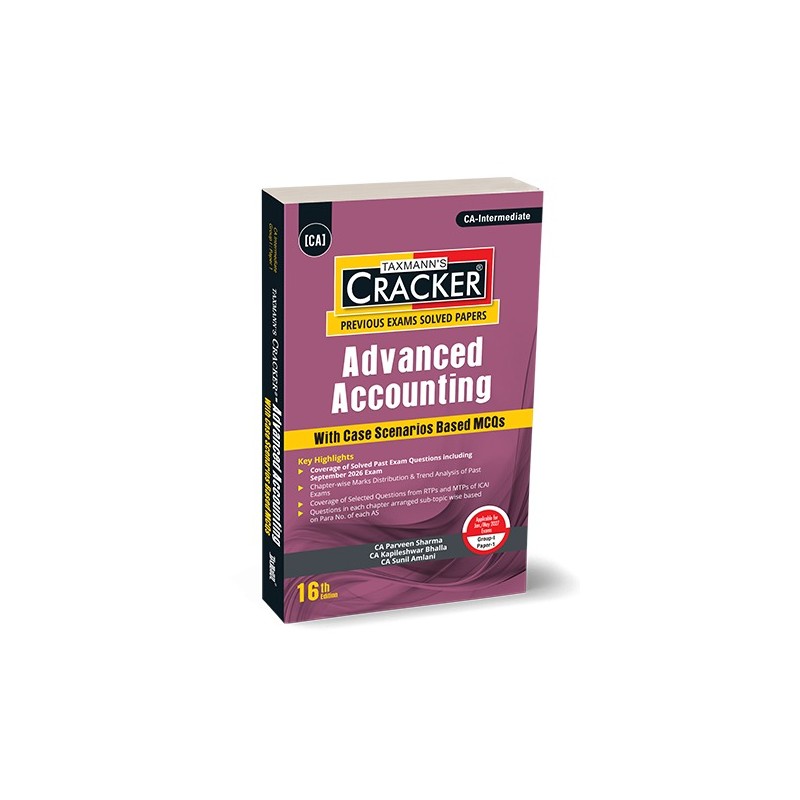
CA Inter Advanced Accounts CRACKER by CA Parveen Sharma
Description
Advanced Accounting | CRACKER is a question bank with full answers. It carries more than 600 questions across sixteen chapters. Each question sits in a grey box. The answer comes straight after it.
The answers are written out in full. Theory answers follow the same shape every time. They start by stating what the standard says, often quoting the exact paragraph. They end under a heading called "Analysis and Conclusion", where the rule is applied to the facts in the question.
Practical answers show the full working, not just the final figure. Every computation statement, working note and journal entry is printed. So are the complete formats: Schedule III balance sheets, statements of profit and loss, notes to accounts, cash flow statements by both methods, realisation accounts, capital reduction accounts, branch stock and branch adjustment accounts, and consolidated balance sheets. Each one is drawn out line by line.
Three things shape how the questions are arranged.
- First, questions are not listed one after another. They are grouped under grey heading bands, and each band names the topic being tested. In the Accounting Standards chapters most of these bands also give the paragraph numbers of the standard, so you work through a standard in the order the standard itself is written
- Second, the practical chapters use a difficulty ladder instead. They start with basic problems and move up to advanced ones, step by step
- Third, the consolidation chapter uses one fixed method for every problem: Analysis of Profit, then Minority Interest, then Cost of Control, then Special Issues, and only then the consolidated balance sheet and its notes
Every question also shows where it came from. A tag in italics sits under each one, naming the exam sessions it has appeared in and any ICAI Revision Test Paper or Mock Test Paper that carried it. Many tags name several sources, and some add the word "Similar", meaning the same problem came back later in different words.
The book ends with two full papers, May 2026 and September 2026, solved from start to finish. Even the optional "or" question in each paper is answered.
The Present Publication is the 16th Edition, authored by CA. Parveen Sharma, CA. Kapileshwar Bhalla & CA. Sunil Amlani, with the following noteworthy features:
- [Every Question Answered] More than 600 questions, each with its answer right below it
- [Theory Answers Follow One Shape] Each answer begins with what the standard says, often quoting the paragraph, and closes with an "Analysis and Conclusion" that applies the rule to the facts
- [Full Working on Practical Answers] Computation statements, working notes and ruled tables throughout, so you can trace every figure back to its arithmetic
- [Formats Drawn Out in Full] Journal entries and notes to accounts, plus Schedule III balance sheets, statements of profit and loss, cash flow statements by direct and indirect method, realisation accounts, capital reduction accounts, branch stock and branch adjustment accounts, and consolidated balance sheets
- [Topic Headings Instead of a Plain List] Every question sits under a grey band naming the topic, the method or the difficulty level. You know what a question is testing before you start it
- [Headings That Give Paragraph Numbers] In the Accounting Standards chapters the bands name the paragraphs being applied, for example "Changes in Accounting Policies (Based on Para Nos. 4 and 28 to 33)". The assets chapter is the most closely divided in the book
- [Problems Get Harder in Steps] The cash flow unit moves from theory, to classification of activities, to basic problems, to advanced problems, under each of the direct and indirect methods. Internal reconstruction runs the same way, from base-building problems up to combined amalgamation and reconstruction. Amalgamation and company final statements follow their own basic-to-advanced order
- [One Fixed Method for Consolidation] Every consolidation problem is solved the same way: Analysis of Profit, Minority Interest, Cost of Control, Special Issues, then the consolidated balance sheet and notes
- [Source Tags on Every Question] Each question ends with a tag naming every exam session it has appeared in, plus any ICAI Revision Test Paper or Mock Test Paper that carried it. Repeats are flagged "Similar" where the wording later changed
- [Short Notes After Answers] These record an assumption made, explain why an item was left out of a calculation, settle a classification point, or point to a related question
- [A Separate MCQ Chapter] Fifteen case scenarios and seventy-five two-mark MCQs, some taken from recent exams. Options are laid out and the answer is printed just below
- [Two Papers Solved Fully] The May 2026 and September 2026 papers are given complete with answers, each with a Part I of case scenario MCQs and a Part II of written and practical questions. The optional "or" question is answered too
- [Three Tables at the Start] A marks table showing what each chapter has carried across recent sessions, with an average per chapter. A trend table listing each question asked, its marks, and whether it was theory or practical. And a map linking the book's chapters and units to the ICAI Study Material
The coverage of the book is as follows:
- Opening Chapters
- Chapter 1 | Introduction to Accounting Standards. How the ASB makes a standard, set out step by step and closed with a summary flowchart. Also why IFRS became a global standard, carve-outs and carve-ins in Ind AS, and the International Accounting Standards Board
- Chapter 2 | Framework for Preparation and Presentation of Financial Statements. Split into theory questions and practical problems. Covers who uses financial statements, what makes them useful, the elements set out in a table with definitions, the different ways of measuring them, and working out profit under the capital maintenance concepts
- Chapter 3 | Applicability of Accounting Standards. How the ICAI sorts enterprises into levels, how companies are sorted into SMCs and Non-SMCs, and what each group is exempt from, both under the ICAI directive and under the Companies (Accounting Standards) Rules, 2006
- Accounting Standards Chapters, Grouped by Subject and Split into Units
- Chapter 4 | Presentation and Disclosures Based Accounting Standards. AS 1 Disclosure of Accounting Policies, AS 3 Cash Flow Statement, AS 17 Segment Reporting, AS 18 Related Party Disclosures, AS 20 Earnings Per Share, AS 24 Discontinuing Operations and AS 25 Interim Financial Reporting. The EPS unit is split by issue, from weighted average number of shares, through bonus and rights issues, up to diluted EPS
- Chapter 5 | Assets Based Accounting Standards. AS 2 Valuation of Inventories, AS 10 Property, Plant and Equipment, AS 13 Accounting for Investments, AS 16 Borrowing Costs, AS 19 Leases, AS 26 Intangible Assets and AS 28 Impairment of Assets. The investments unit carries separate ledger sets for fixed return, variable return and mixed securities
- Chapter 6 | Liabilities Based Accounting Standards. AS 15 Employee Benefits, split into short term and post employment benefits, and AS 29 (Revised) Provisions, Contingent Liabilities and Contingent Assets, split across recognition, measurement, reimbursement, contingent liabilities and contingent assets
- Chapter 7 | Accounting Standards Based on Items Impacting Financial Statements. AS 4 Contingencies and Events Occurring After the Balance Sheet Date, AS 5 Net Profit or Loss for the Period, Prior Period Items and Changes in Accounting Policies, AS 11 The Effects of Changes in Foreign Exchange Rates and AS 22 Accounting for Taxes on Income. The AS 4 and AS 5 units also carry mixed-problem sets
- Chapter 8 | Revenue Based Accounting Standards. AS 7 Construction Contracts and AS 9 Revenue Recognition. Every heading in this chapter gives its paragraph numbers
- Chapter 9 | Other Accounting Standards. AS 12 Accounting for Government Grants, split by type of grant and by refund, and AS 14 Accounting for Amalgamations, covering the methods of accounting and the disclosures
- Chapter 10 | Consolidated Financial Statements. AS 21 Consolidated Financial Statements, AS 23 Accounting for Investments in Associates and AS 27 Financial Reporting of Interests in Joint Ventures. It opens with case studies on the rules for preparing a consolidated balance sheet, uses the fixed method throughout, and also covers the consolidated profit and loss account and jointly controlled operations, assets and entities
- Company Accounts and Reconstruction Chapters
- Chapter 11 | Financial Statements of Companies. How items are shown under Schedule III, Division I, and the operating cycle. Managerial remuneration, including effective capital for a loss-making company. Dividend and appropriations. Then simple and advanced problems on the final statements, with full notes to accounts
- Chapter 12 | Buy-back of Securities and Equity Shares with Differential Rights. Sweat equity, then problems worked without the three tests and with the three tests. Each one is solved in steps, ending with the balance sheet after buy-back
- Chapter 13 | Amalgamation of Companies. The longest chapter in the book. Purchase consideration by the net payment, net asset and intrinsic value methods. Then basic and advanced problems on merger, problems on transactions before amalgamation, and basic and advanced problems on purchase. Includes realisation accounts and the balance sheet after amalgamation
- Chapter 14 | Accounting for Reconstruction of Companies. Graded parts, from conversion of shares into stock and sub-division of shares, through capital reduction done by journal entries and then by journal entries with the balance sheet, up to combined amalgamation and internal reconstruction problems
- Chapter 15 | Accounting for Branches including Foreign Branches. Debtors method at cost price and at invoice price, stock and debtors method, final accounts method, mixed-method problems, wholesale branch system, independent branches through journal entries, branch balance sheet and columnar trading and profit and loss account, and foreign branches
- MCQ Chapter and Solved Papers
- Chapter 16 | Multiple Choice Question Bank. Fifteen case scenarios and seventy-five two-mark MCQs covering the whole syllabus
- Solved Paper | May 2026. Part I and Part II with answers
- Solved Paper | September 2026. Part I and Part II with answers
Every chapter is built the same way:
- Chapter and Unit Openings — A numbered tab and title band open the chapter. In the Accounting Standards chapters, a unit heading then names the standard
- Grey Topic Bands — Bands divide the questions. Each one names the topic, and often the paragraph numbers behind it, or the method or difficulty level in the practical chapters
- The Question Box — Under each band, the question sits in a grey box in bold type. Where the same question has been asked in very different words, both versions are printed in the same box
- The Source Tag — An italic tag closes the box, naming where the question came from. Where a box holds two versions, each carries its own tag
- Theory Answers — The answer follows right away, marked "Ans." and set in normal type, so question and answer are easy to tell apart. It then runs through its named stages
- Practical Answers — These run through computation statements, working notes, journal entries, ledger accounts and full formats, and close with a short note where one is needed
- Running Heads and Page Numbers — The top of each page carries the chapter number and name. Page numbers run by chapter