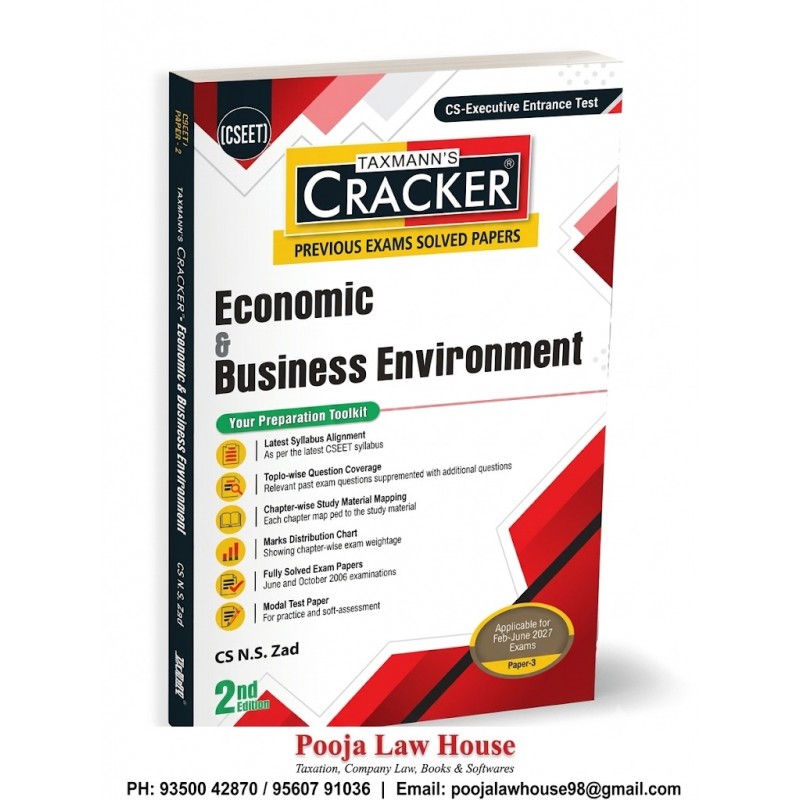
CSEET Economic & Business Environment Cracker
Economic & Business Environment – CRACKER is a solved question bank for Paper 3 of the CS Executive Entrance Test (CSEET). It covers the Paper 3 syllabus chapter by chapter, through questions with complete answers.
Built for focused exam preparation, it brings topic-wise practice, recent exam papers and a model test paper together in one volume.
The Present Publication is the 2nd Edition for CSEET Paper 3, applicable for the Feb./June 2027 Exams. It is authored by CS N.S. Zad and published by Taxmann in October 2026, with the following noteworthy features:
- [Latest Syllabus Alignment] The book is prepared as per the latest CSEET syllabus for Paper 3. It covers both parts of the paper, Economic Environment and Business Environment
- [Topic-wise Question Coverage] Questions are arranged chapter by chapter and topic by topic. Relevant past exam questions are supplemented with additional questions, giving more than 200 solved questions in all
- [Chapter-wise Study Material Mapping] A table maps each chapter of the book to the matching chapter of the study material, so the two can be used side by side
- [Marks Distribution Chart] A chart shows the marks each chapter carried in the June 2026 and October 2026 exams, along with the average. It shows at a glance which chapters carry more weight
- [Previous Exam Trend Analysis] A table lists every question of the June and October 2026 papers with its question number, chapter and marks
- [Fully Solved Exam Papers] The June 2026 and October 2026 papers are solved in full. Each question is shown with its marks, followed by a suggested answer
- [Model Test Paper] A full Model Test Paper is given for practice and self-assessment. It is set in two parts, each with a compulsory question and a choice of questions. The questions come first and the suggested answers follow, so students can attempt the paper before checking their answers
The book is divided into two parts, covering a total of 12 chapters.
- Part A — Economic Environment
- Basics of Demand & Supply and Forms of Market Competition — The meaning and scope of economics, economic systems, the laws of demand and supply, elasticity of demand and supply, and forms of market competition, including monopoly and price discrimination
- National Income Accounting & Related Concepts — National income and its uses, GDP and related measures, the GDP deflator, personal and disposable income, and the value added, income and expenditure methods
- Indian Union Budget — The objectives of the budget, the revenue and capital budgets, fiscal, revenue and primary deficits, types of budget, tax and non-tax revenue, and capital receipts and expenditure
- Indian Financial Markets — The role and structure of financial markets, the money, commodity, derivatives and cryptocurrency markets, the banking sector and NBFCs, shares and debentures, and MSMEs
- Indian Economy — The primary, secondary and tertiary sectors, agricultural policy, Industrial Policy 1991, the balance of payments, and FDI and FPI
- Part B — Business Environment
- Entrepreneurship Scenario — The traits and types of entrepreneurs, intrapreneurship, government initiatives such as Stand-Up India and Startup India, and the bottlenecks to entrepreneurial growth
- Business Environment — The internal, micro and macro environment, trade and auxiliaries to trade, Ease of Doing Business, and One District One Product
- Key Government Institutions — NITI Aayog, the Ministry of Corporate Affairs, SEBI, RBI and IBBI
- Global Environment — The global business environment, liberalization and globalization, and bodies such as the WTO, UNCTAD, EU, IMF, OECD, APEC, ADB and SCO
- Environmental Governance — Sustainable development, responsible business conduct, BRSR, the Social Stock Exchange, Environmental Impact Assessment and the Carbon Credit Trading Scheme
- AI & Business Environment — Computer systems, artificial intelligence, cybersecurity, e-commerce and m-commerce, supply chain management, CRM, digital currency and business information systems
- Elements of Corporate Governance — The principles and benefits of good corporate governance, the Basel Committee recommendations, SEBI’s reporting requirements, and bodies such as NFCG, ACGA and ICGN
The chapters follow a set pattern:
- Theoretical Questions — Each chapter opens with numbered questions in shaded boxes. Some chapters group them under topic headings. Where a question can be worded in two ways, both wordings are shown, joined by ‘Or’
- Point-wise Answers — Answers are set out in short points with bold key terms. Tables, formulas and quoted definitions are used where they help. Answers on demand, supply and elasticity also carry diagrams
- Distinctions — Most chapters then compare related concepts point by point, largely in side-by-side tables
- True/False with Reasons — Chapters 1 to 11 include True/False statements. Each is marked True or False with a short reason
- Practical Problems — Chapters 1 to 3 end with solved numerical problems on elasticity, national income, the GDP deflator and budget figures. Each is worked step by step