Taxmann The Doctrine of Promissory Estoppel Ashok Saraf
Taxmann The Doctrine of Promissory Estoppel Ashok Saraf
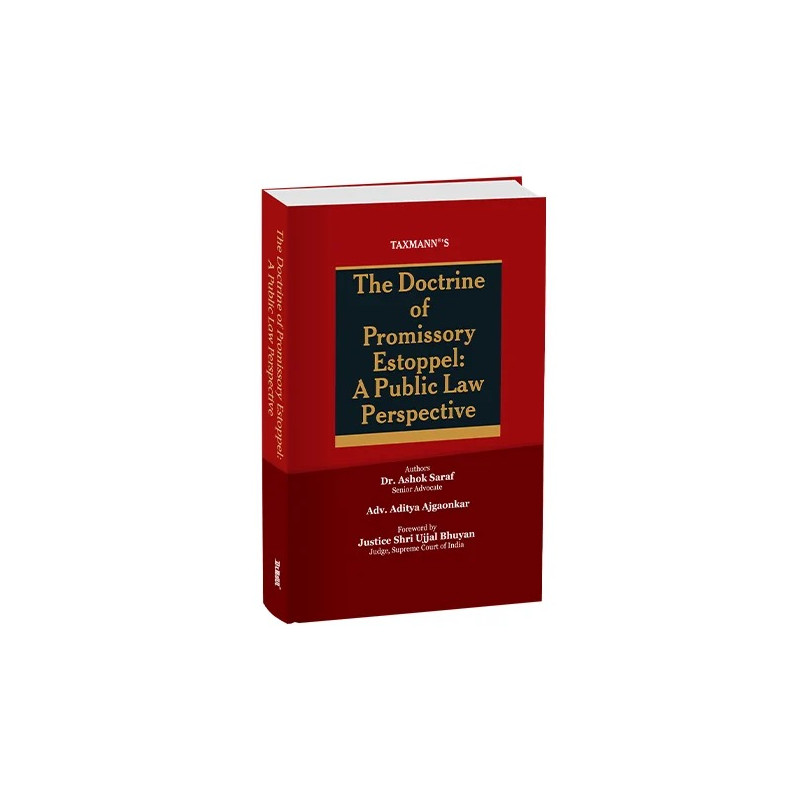
The Present Publications is the Latest Edition, authored by Dr Ashok Saraf (Senior Advocate) and Adv. Aditya Ajgaonkar, with the following noteworthy features:
- [Public Law-First Lens] Unlike typical treatises on estoppel that primarily view the doctrine as a matter of contract or evidence law, this work examines promissory estoppel solely within the realm of public law. It explores how it functions when one party is the State or a public authority, and where private reliance intersects with governmental discretion
- [Historical Depth Combined with Doctrinal Precision] The book goes beyond merely cataloguing cases; it reconstructs the intellectual history of the doctrine—tracing from Lord Denning’s formulations in Central London Property Trust v. High Trees House and Moorgate Ltd. v. Twitchings, to the Indian Supreme Court’s innovative adaptations in Indo-Afghan Agencies and Motilal Padampat. It carefully analyses why the doctrine developed differently in India compared to England
- [Landmark Case Analysis Throughout] Key rulings from the Supreme Court and various High Courts are not only cited but are examined in context and critically evaluated. The discussion of Hero Motocorp Ltd. v. Union of India, CCE v. Bal Pharma Ltd., State of Gujarat v. Arcelor Mittal Nippon Steel (India) Ltd., and others demonstrates how the doctrine has been applied, misapplied, and refined
- [Robust Engagement with Competing Doctrines] The book clearly maps the relationship between promissory estoppel and the doctrine of legitimate expectation—drawing on constitutional principles under Article 14, tracing both doctrines to their shared origins in Lord Denning’s work, and analysing their points of convergence and divergence in relation to the State
- [Critical Perspective] The final chapter offers an honest and critical reflection, raising pointed questions about inconsistency in the Supreme Court’s rulings, the conflation of promissory estoppel with judicial estoppel, and the overarching need for certainty and predictability in public law
- [Foreword by a Sitting Supreme Court Judge] Justice Ujjal Bhuyan’s foreword lends the book institutional authority and situates it within the broader framework of constitutional governance and administrative accountability
The book covers the following core substantive themes:
- The definitional architecture of promissory estoppel—distinguishing it from common law estoppel by conduct, proprietary estoppel, equitable estoppel, and judicial estoppel
- The statutory treatment of estoppel under the Indian Evidence Act 1872 and the Indian Contract Act 1872, and the gap left by the absence of any codified rule for promissory estoppel
- The transplantation of the doctrine from English equity into Indian jurisprudence—the role of Lord Denning, the High Trees case, and the Indian Supreme Court’s initial resistance before eventual adoption
- The contribution of judicial activism to the birth and expansion of the doctrine in India, examined honestly alongside the tension between judge-made law and the separation of powers
- The foundational schism in Indian case law regarding whether the doctrine can operate against the government and, if so, under what conditions
- The cardinal rule that there can be no estoppel against a statute—its scope, rationale, and the cases that have tested its limits
- The doctrine of executive necessity and how governmental representations may be validly withdrawn when public interest or changed circumstances supervene
- The intersection of electoral and political promises with promissory estoppel—what happens when a government makes representations on the strength of which industries or individuals act, and then changes policy
- The public interest exception—when the State may legitimately resile from a representation without incurring equitable liability
- The comparative analysis of legitimate expectation and promissory estoppel—their shared equitable roots, their divergent normative footing in Indian constitutional law, and the circumstances in which each operates as a more effective remedy
- The demand for certainty and consistency in Indian public law, including a critical examination of judicial inconsistencies in applying the doctrine to tax statutes
- The book draws extensively on case law spanning taxation, land law, export incentive schemes, industrial policy incentives, and governmental grants—the domains in which the doctrine has been most actively litigated
About the authors
Dr Ashok Saraf is a Senior Advocate and prolific legal author, widely recognised as an authority in taxation, policy, and commercial law. He was designated as a Senior Advocate by the Gauhati High Court at the age of 36.6 years, making him the youngest to receive this honour. He has served as the Advocate General for the State of Arunachal Pradesh. His practice encompasses a broad spectrum of law, and he has authored works on various legal subjects and fields. He is based in Guwahati, Assam, and practices across the country.
Adv. Aditya Ajgaonkar is a practising advocate at the Bombay High Court, Mumbai, specialising in taxation, economic offences, and commercial litigation. He is a regular contributor on economic laws for various professional associations and is recognised for applying sharp research rigour to complex legal issues. Based in Mumbai, he also regularly practises in Delhi.