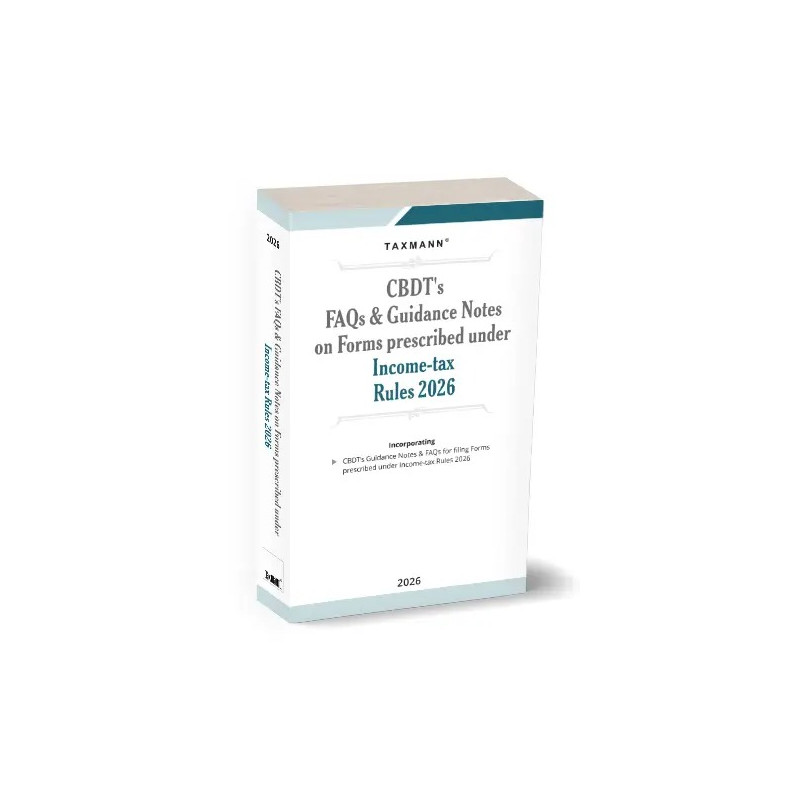
CBDT’s FAQs & Notes on Forms under Income-tax Rules 2026
CBDT’s FAQs & Notes on Forms under Income-tax Rules 2026
The Present Publication is the 2026 Edition, edited by Taxmann’s Editorial Board, with the following noteworthy features:
- [CBDT Guidance as Primary Authority] Every guidance note reproduced is CBDT-issued—not a practitioner’s interpretation. Where a professional has relied on this guidance in completing a prescribed form, that reliance carries formal weight in compliance and penalty proceedings
- [Dual Statutory Cross-Reference Throughout] Every form entry carries an explicit footnote cross-referencing its predecessor form under the 1962 Rules and mapping the governing section from the Income-tax Act 1961 to its equivalent in the Income-tax Act 2025
- [Standardised Guidance Architecture] Every form in the volume follows a consistent internal structure:
- Purpose — What the form accomplishes and which statutory provision it serves
- Who Should File — Eligible/obligated categories of taxpayers
- Frequency and Due Dates — Filing calendar, including quarter-wise tables where applicable
- Structure of the Form — Part-by-part breakdown of what information is required and why
- Filing Method — Online-only, DSC or EVC, UDIN requirements for accountant certificates
- Historical Filing Count — Actual filing volume data from prior years
- Changes Proposed — Qualitative explanation of what has changed from the predecessor form
- FAQs — Numbered Q&A covering mandatory filing, revision eligibility, consequences of non-filing, document requirements, and common errors
- [Substantive Guidance Depth] The guidance is not perfunctory. For complex forms, it runs to multiple pages of substantive analysis. This is practical, deployment-ready material
- [Smart Form Transition Documentation] The guidance systematically documents the shift from the old form architecture to the new digital framework—including auto-population of taxpayer master data, real-time field validations, dropdown-based category selection, API integrations, UDIN linkage for accountant certificates, and the replacement of ‘Assessment Year/Financial Year/Previous Year’ with ‘Tax Year’ throughout. These changes are documented form-by-form, making the guidance equally useful for the IT teams implementing the new e-filing system