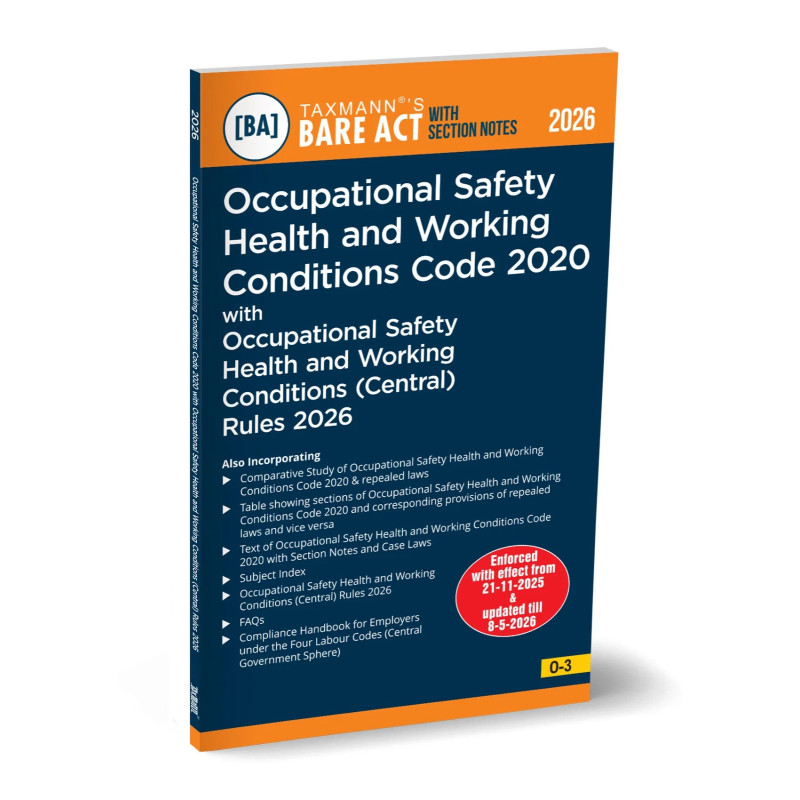
Occupational Safety Health and Working Conditions Code 2020 Bare Act Edition 2026
Occupational Safety Health and Working Conditions Code 2020 Bare Act Edition 2026
Descriptions : –
Occupational Safety Health and Working Conditions Code 2020 (‘OSHWC Code 2020’) with Occupational Safety Health and Working Conditions (Central) Rules 2026 [Bare Act with Section Notes] by Taxmann is a fully consolidated, application-ready statutory publication presenting India’s occupational safety, health and working conditions law in its complete, post-enforcement form. The Occupational Safety, Health and Working Conditions Code—brought into force with effect from 21st November 2025—subsumes and replaces thirteen foundational labour-protection statutes, namely the Factories Act 1948, the Mines Act 1952, the Dock Workers (Safety, Health and Welfare) Act 1986, the Building and Other Construction Workers (Regulation of Employment and Conditions of Service) Act 1996, the Plantations Labour Act 1951, the Contract Labour (Regulation and Abolition) Act 1970, the Inter-State Migrant Workmen (Regulation of Employment and Conditions of Service) Act 1979, the Working Journalists and Other Newspaper Employees (Conditions of Service) and Miscellaneous Provisions Act 1955, the Working Journalists (Fixation of Rates of Wages) Act 1958, the Motor Transport Workers Act 1961, the Sales Promotion Employees (Conditions of Service) Act 1976, the Beedi and Cigar Workers (Conditions of Employment) Act 1966, and the Cine-Workers and Cinema Theatre Workers (Regulation of Employment) Act 1981, reconstituting them into a single legislative architecture governing registration of establishments, duties of employer and employee, occupational safety and health standards, health, safety and working conditions, welfare provisions, hours of work and annual leave with wages, employment of women, contract labour and inter-state migrant workers, and sector-specific regulation of factories, mines, docks, building and construction work, plantations, audio-visual workers, journalists, sales promotion employees, motor transport workers, and beedi and cigar workers. This 2026 Edition introduces, as its core editorial feature, Section Notes—identifying the corresponding provision of the repealed Act beneath each statutory provision—together with relevant Case Laws reproduced under the section, enabling practitioners to translate the jurisprudence of thirteen legacy statutes into the new Code-based architecture at the clause level. The publication completes the statutory ecosystem with the finally notified Occupational Safety, Health and Working Conditions (Central) Rules 2026, a front-placed Comparative Study, two-way sectional cross-reference Tables covering all thirteen repealed Acts, a Subject Index, Notifications, FAQs covering all four Labour Codes, and a practitioner-oriented Compliance Handbook—making it a complete, single-volume operational reference for understanding, applying, and complying with India’s occupational safety, health and working conditions law in its post-enforcement phase. The law stated in this book is updated as on 8th May 2026.
This publication is intended for users who apply, interpret, administer, or transition into the Occupational Safety, Health and Working Conditions Code regime, including:
- Labour & Employment Law Practitioners advising on factories, mines, dock work, building and construction, contract labour, inter-state migrant workmen, and sector-specific working-condition matters
- Occupiers, Factory Managers, Mine Owners and Agents, Dock Employers, Plantation Employers, Principal Employers, and Contractors responsible for registration, licensing, working-condition compliance, and welfare obligations under the Code
- Corporate HR Heads, Personnel Managers, IR Managers, and Compliance Officers managing working hours, leave with wages, overtime, employment of women, registers and returns, and contract-labour compliance
- Safety Officers, Welfare Officers, Medical Officers, and Certifying Surgeons appointed under the Code, together with safety committees and emergency-response coordinators
- Inspector-cum-Facilitators, Labour Commissioners, Chief Inspectors, Welfare Officers, and other authorities administering inspection, facilitation, and prosecution under the Code
- Newspaper Establishments, Audio-Visual Production Houses, Sales Promotion Employers, Motor Transport Undertakings, and Beedi and Cigar Manufacturers interpreting the special sectoral provisions retained from the repealed Acts
- Building and Other Construction Workers’ Welfare Board Officials and Cess Functionaries operating in the transition between the BOCW framework and the consolidated Code architecture
- Trade Unions, Worker Representatives, and Inter-State Migrant Worker Representatives interpreting registration, journey allowance, displacement allowance, and statutory entitlements
- Chartered Accountants, Company Secretaries, and Cost Accountants conducting labour-code due diligence, statutory audits, and OSH-compliance reviews
- Law Students, Academicians, and Policy Researchers studying India’s transition from thirteen legacy occupational-safety statutes to the Code-based framework
The Present Publication is the 2026 Edition, covering the amended and updated text of the Occupational Safety Health and Working Conditions Code [Act No. 37 of 2020] with Rules, with the following noteworthy features:
- [Section Notes – Core USP] Corresponding-provision notes placed immediately beneath each statutory provision, identifying the source section in the repealed Act—Factories Act 1948, Mines Act 1952, Dock Workers Act 1986, BOCW Act 1996, Plantations Labour Act 1951, Contract Labour Act 1970, Inter-State Migrant Workmen Act 1979, Working Journalists Act 1955, Working Journalists (Fixation of Rates of Wages) Act 1958, Motor Transport Workers Act 1961, Sales Promotion Employees Act 1976, Beedi and Cigar Workers Act 1966, and Cine-Workers and Cinema Theatre Workers Act 1981—turning the Bare Act into a portability bridge between the legacy regime and the new Code at the clause level
- [Case Laws Beneath the Section] Relevant judicial precedents are reproduced under each section to confirm standard interpretations carried forward from the repealed Acts, enable quick precedent verification, and provide authoritative reference for adjudication, licensing disputes, registration challenges, and prosecutions under the Code
- [Two-Way Statutory Cross-Reference Tables] A master table moving from Code section to corresponding provisions of the thirteen repealed laws, together with thirteen reverse-direction tables—one each for the Beedi and Cigar Workers Act 1966, BOCW Act 1996, Cine-Workers and Cinema Theatre Workers Act 1981, Contract Labour Act 1970, Dock Workers (Safety, Health and Welfare) Act 1986, Factories Act 1948, Inter-State Migrant Workmen Act 1979, Mines Act 1952, Motor Transport Workers Act 1961, Plantations Labour Act 1951, Sales Promotion Employees Act 1976, Working Journalists and Other Newspaper Employees Act 1955, and Working Journalists (Fixation of Rates of Wages) Act 1958—enabling readers to locate provisions in either direction without consulting separate sources
- [Front-Placed Comparative Study] A detailed subject-wise and clause-wise comparison between the Occupational Safety, Health and Working Conditions Code 2020 and the thirteen repealed Acts, identifying retained provisions, substantive departures, including unified registration, harmonised definitions of factory, mine, employee, worker, contractor, and principal employer, threshold revisions, the consolidated framework for contract labour and inter-state migrant workers, expanded coverage of audio-visual workers in place of the cine-workers regime, gender-neutral provisions for night-shift work, the new Inspector-cum-Facilitator architecture replacing legacy inspectorate models, and consciously omitted concepts
- [Occupational Safety, Health and Working Conditions (Central) Rules 2026] The notified Central Rules, which supersede the corresponding subordinate legislation under the Factories, Mines, Dock Workers, BOCW, Plantations, Contract Labour, Inter-State Migrant Workmen, Motor Transport Workers, Sales Promotion Employees, Beedi and Cigar Workers, Working Journalists, and Cine-Workers regimes in the relevant respects, provide the operative procedural framework for implementation, covering registration, licensing, returns, registers, safety committees, welfare facilities, leave, and inspection
- [Three Schedules to the Code] The First Schedule (applicability thresholds chapter-wise and listed industries), the Second Schedule (matters concerning health, safety, welfare provisions and working conditions in factories, mines and dock work for which rules may be framed), and the Third Schedule (list of notifiable occupational diseases)—reproduced as part of the statutory text
- [Subject Index] A comprehensive Subject Index enabling navigation of the statutory text by concept, term, sector, defined expression, or compliance area
- [FAQs on the Four Labour Codes] A consolidated FAQ section addressing common practitioner and employer queries across the Code on Wages, the Industrial Relations Code, the Occupational Safety, Health and Working Conditions Code, and the Code on Social Security, covering registration and licensing, definitional changes, threshold revisions, contract labour engagement, hours of work and overtime, employment of women, crèche facility, notifiable diseases, and worker protection
- [Compliance Handbook for Employers under the Four Labour Codes (Central Government Sphere)] A practitioner-oriented handbook covering wage compliance, working hours and overtime, registers and records, gender-equal treatment, occupational safety, social-security contributions, and statutory deadlines, annexing the First Schedule applicability matrix and converting the legal framework into actionable operational checklists
- [Statement of Objects, Notes on Clauses, and Appendix] Includes the original Statement of Objects and Reasons, section-wise Notes on Clauses, and an Appendix reproducing provisions of other Acts referred to within the Occupational Safety, Health and Working Conditions Code 2020—closing the legislative-history loop
- [Authoritative Bare Act Presentation] Maintains Taxmann’s Bare Act editorial integrity—pure statutory text supported by Section Notes, Case Laws, and comparative context, without interpretational dilution
The publication is organised across three Divisions, sequencing context, primary law, subordinate legislation, and operational compliance:
- Division One | Occupational Safety, Health and Working Conditions Code 2020
- Two-Way Sectional Tables—Code v Repealed Laws, and the reverse mapping for each of the thirteen repealed Acts
- Comparative Study of the Occupational Safety, Health and Working Conditions Code 2020 versus the Factories Act 1948/Mines Act 1952/Dock Workers (Safety, Health and Welfare) Act 1986/Building and Other Construction Workers Act 1996/Plantations Labour Act 1951/Contract Labour (Regulation and Abolition) Act 1970/Inter-State Migrant Workmen Act 1979/Working Journalists and Other Newspaper Employees Act 1955/Working Journalists (Fixation of Rates of Wages) Act 1958/Motor Transport Workers Act 1961/Sales Promotion Employees Act 1976/Beedi and Cigar Workers Act 1966/Cine-Workers and Cinema Theatre Workers Act 1981
- Arrangement of Sections
- Text of the Occupational Safety, Health and Working Conditions Code 2020, with Section Notes and Case Laws
- First to Third Schedules
- Subject Index
- Statement of Objects and Reasons
- Notes on Clauses
- Appendix—Provisions of Other Acts Referred to in the Occupational Safety, Health and Working Conditions Code 2020
- Division Two | Rules
- Arrangement of Rules
- Occupational Safety, Health and Working Conditions (Central) Rules 2026
- Division Three | Notifications and Clarifications
- Notifications—enforcement of the Code, repeal of the thirteen subsumed Acts, appropriate Government designations, and rule-making authority
- FAQs on the Four Labour Codes
- Compliance Handbook for Employers under the Four Labour Codes (Central Government Sphere)