Business Laws & Management Paper 4 Cracker Shruti Soni Edition May 2026
Business Laws & Management Paper 4 Cracker Shruti Soni Edition May 2026
Descriptions : –
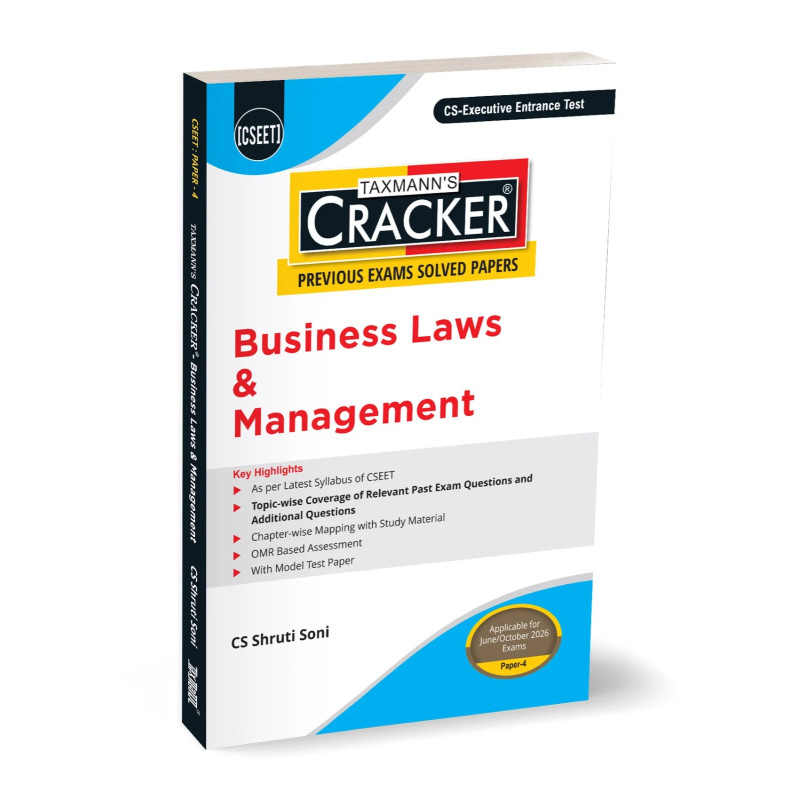
Business Laws & Management – CRACKER is an exam-focused companion volume for CSEET Paper 4 under the latest revised syllabus prescribed by the Institute of Company Secretaries of India. Applicable for the June 2026 and October 2026 sittings, the book consolidates the entire syllabus into fourteen chapters organised in two parts—Business Laws (six chapters covering the principal commercial statutes) and Business Management (eight chapters covering the functions, principles and modern approaches to management, closing with management knowledge specifically relevant to Company Secretaries).
The CRACKER format prioritises rapid, topic-wise revision through concise statutory and conceptual summaries followed by an extensive bank of multiple-choice questions calibrated to the OMR-based pattern of the actual examination. Every chapter is mapped to the corresponding chapter in the ICSI Study Material, allowing candidates to move between the two without disruption, and the volume closes with a full-length Mock Test Paper that simulates the live exam structure.
The Present Publication is the May 2026 Edition, authored by CS Shruti Soni, with the following noteworthy features:
- [Strictly Aligned with the Latest CSEET Syllabus] Every chapter, section reference, and question set has been mapped to the most recently revised CSEET syllabus issued by the Institute of Company Secretaries of India for Paper 4, ensuring that nothing in the book falls outside the scope of the June 2026 and October 2026 examinations and that no examinable area is left uncovered
- [Topic-wise Coverage of Past Exam Questions with Additional Questions] Past CSEET examination questions have been classified topic-wise within each chapter rather than aggregated at the end, so that students can attempt questions immediately after revising the corresponding theory. Where past examinations have only briefly covered a particular topic, the author has provided additional practice questions in the same MCQ format to ensure that every examinable concept receives adequate depth of practice
- [Chapter-wise Mapping with the ICSI Study Material] A dedicated Chapter-wise Comparison with Study Material table at the front of the book links each CRACKER chapter to the corresponding chapter of the ICSI Study Material, enabling students to switch between the two volumes seamlessly, identify the source provisions on which a question is based, and use the CRACKER as a parallel revision tool without losing alignment with the institute’s prescribed reading
- [OMR-based Assessment Format] Every question in the book is structured in the OMR/MCQ format used in the live computer-based CSEET, with four answer choices per question and a single correct option. This mirrors the actual examination interface, so that practice translates directly into exam-day familiarity with question construction, distractor patterns and time-per-question discipline
- [Concise Topical Summaries before each Question Set] Each topic opens with a short, exam-oriented summary of the relevant statutory provisions, definitions, section references and conceptual frameworks before the question set begins. This eliminates the need for a separate notebook or constant reference back to the Study Material during revision, and allows the CRACKER to function as a self-contained revision volume in its own right
- [End-of-chapter Answer Keys] Every MCQ block in each chapter is followed by a clearly tabulated answer key, enabling immediate self-assessment, per-topic score tracking, and quick identification of weak areas for targeted remediation before the next study session
- [Full-length Mock Test Paper] A complete Mock Test Paper is provided at the end of the volume, drawn proportionately from both Part A (Business Laws) and Part B (Business Management) in line with the actual syllabus weightage. It is calibrated for use as a final-week diagnostic and as a timed-attempt rehearsal ahead of the computer-based examination, providing students with a reliable end-to-end exam simulation
- [Tabular Treatment of Comparative Provisions] Wherever two or more concepts intersect or contrast—partnership vs LLP, sale vs agreement to sell, conditions vs warranties, holder vs holder in due course, void vs voidable agreements, AGM vs EGM, and similar examiner-favoured distinctions—the book presents them in side-by-side tables. This treatment aids rapid recall under examination conditions and pre-empts the comparison-style MCQs that recur in CSEET papers
The book is divided into two parts, with the following substantive coverage:
- Part A – Business Laws
- Foundational Jurisprudence — Sources of Indian law (primary and secondary), the doctrines of stare decisis, ratio decidendi and obiter dicta, persuasive and authoritative precedents, customs and personal laws, the broad constitutional framework, and the architecture of the Indian legal, legislative, executive and judicial system
- Elements of Company Law — Incorporation of companies, memorandum and articles of association, share capital, members and shareholders, classes of meetings (Annual General Meeting, Extra-Ordinary General Meeting, Board Meeting and class meetings), notice and quorum requirements, proxy provisions, minutes of meetings, the concept of the Board, appointment, qualification and disqualification of directors, and the role of Key Managerial Personnel
- Elements of Law of Contracts — The full anatomy of a contract—offer and acceptance, consideration, capacity to contract, free consent, lawful object, void and voidable agreements, agreements opposed to public policy, wagering agreements, contingent contracts, quasi-contracts, performance and discharge, breach and remedies, and the specific contracts of indemnity, guarantee, bailment, pledge and agency
- Elements of Law Relating to Partnership and LLP — Integrated treatment of the Indian Partnership Act 1932 and the Limited Liability Partnership Act 2008—formation of a partnership, types of partners, rights and duties of partners, implied authority and the statutory restrictions on it, reconstitution of a firm (admission, retirement, expulsion, insolvency, death, transfer of interest), dissolution, registration of firms, and the distinguishing features of the LLP form against the traditional partnership
- Elements of Law Relating to Sale of Goods — The contract of sale and the agreement to sell, conditions and warranties (express and implied), passing of property and risk, transfer of title by non-owners under the maxim nemo dat quod non habet, performance of the contract, rights of the unpaid seller (lien, stoppage in transit, resale), and rules governing auction sales.
- Elements of Law Relating to Negotiable Instruments — Promissory notes, bills of exchange and cheques, parties to negotiable instruments, the distinction between holder and holder in due course, negotiation and endorsement, presentment, discharge of parties and instruments, dishonour by non-acceptance and non-payment, noting and protest, crossing of cheques (general, special, not negotiable, account payee), and payment in due course
- Part B – Business Management
- Introduction to Management — Concept, nature, scope and importance of management; management as art, science and profession; levels of management; managerial roles and skills; and the relationship of management with administration
- Functions of Management | Planning — Meaning, nature and importance of planning; types of plans; the planning process; objectives, strategies, policies and procedures; and Management by Objectives (MBO) as a structured planning and control framework
- Functions of Management | Organising — Meaning and process of organising; organisation structure; departmentation; authority and responsibility; line, staff and functional authority; span of management; delegation of authority; and decentralisation versus centralisation
- Functions of Management | Staffing — Meaning, nature and importance of staffing; manpower planning; recruitment and selection; placement, induction and training; performance appraisal; and promotion, transfer and separation
- Functions of Management | Directing — Concept and elements of directing; leadership and leadership styles; theories of motivation (Maslow, Herzberg, McGregor and others); the communication process; barriers to effective communication; and supervision
- Functions of Management | Coordinating, Reporting, Budgeting — Coordination as the essence of management; types and techniques of coordination; the reporting function; principles of effective reporting; budgeting as a tool of planning and control; and types of budgets.
- Principles of Management and Modern Approaches — Henri Fayol’s fourteen principles of management; F.W. Taylor’s scientific management; the human relations and behavioural schools; and the modern approaches—systems, contingency, behavioural and quantitative schools of management thought
- Management Knowledge for Company Secretaries — Recognition of the Company Secretary as Key Managerial Personnel under the Companies Act 2013; the scope of corporate secretarial services; financial market services covering issue management, listing/delisting and securities-related work; taxation services under Income Tax, GST and Customs laws; HR management services; advisory and consultancy services; representational appearances before tribunals and authorities (NCLT, CCI, RERA, SEBI, tax authorities and others); and the statutory mandate for Secretarial Audit under Section 204 of the Companies Act 2013
The volume is organised in two Parts arranged across four progressive blocks of fourteen chapters, with a Mock Test Paper at the close.
- Foundation Block (Chapter 1) — Establishes legal terminology, doctrines and the constitutional framework before any specific statute is introduced, giving readers the meta-vocabulary required to interpret the operative chapters that follow
- Statutory Block (Chapters 2–6) — Sequential treatment of the six commercial statutes constituting Part A: Companies Act 2013, Indian Contract Act 1872, Indian Partnership Act 1932 read with the LLP Act 2008, Sale of Goods Act 1930, and Negotiable Instruments Act 1881
- Conceptual and Functional Block (Chapters 7–12) — A conceptual entry chapter on the meaning and scope of management, followed by five chapters covering the five classical functions in the standard sequence
- Planning → Organising → Staffing → Directing → Coordinating, Reporting and Budgeting
- Theoretical and Applied Block (Chapters 13–14) — Principles and modern schools of management thought, followed by management knowledge specifically tailored to the working role of the Company Secretary
- Mock Test Paper — A full-length OMR-format paper covering both Parts in proportion to syllabus weightage.
- Within each chapter, the systematic approach is uniform:
- Concise topic-wise theory presentation with statutory section references for legal chapters
- Tabular comparisons where two or more concepts intersect or contrast
- Topic-wise MCQ blocks combining past CSEET questions with additional practice questions
- End-of-chapter answer keys
About the Author : CS Shruti Soni
CS Shruti Soni is a seasoned Company Secretary with nearly two decades of multifaceted experience and a flair for excellence and research across the academic, technical and practical dimensions of the profession.
She has served as Assistant Secretary in the Corporate Laws and Corporate Governance Committee (CL&CGC) of the Institute of Chartered Accountants of India (ICAI), and earlier with the Department of Academics and Professional Development of the Institute of Company Secretaries of India (ICSI). Her tenure with the Secretarial Standards Board of ICSI, her involvement with various Professional Development Committees of both Institutes, and her participation in regulatory deliberations alongside the Ministries, industry and academia have lent considerable depth to her scholarly work.