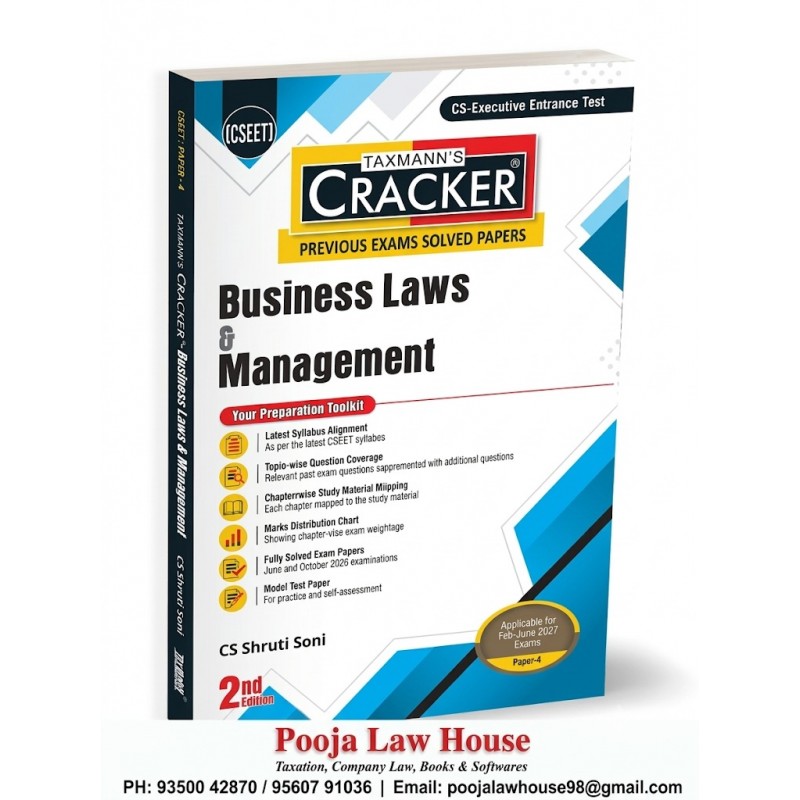
CSEET Business Laws & Management Paper 4 Cracker
Business Laws & Management – CRACKER is an exam-focused book for Paper 4 of the CS Executive Entrance Test (CSEET). It is set out in 14 chapters, six on Business Laws and eight on Business Management.
Every chapter gives point-wise notes on its topics, followed by multiple choice questions (MCQs) from past exams and additional questions, with answers. The book ends with a Mock Test Paper and the June 2026 and October 2026 papers, solved in full.
The Present Publication is the 2nd Edition, published in October 2026. It is applicable for the February and June 2027 exams and is part of Taxmann’s CRACKER series of previous exams solved papers. This book is authored by CS Shruti Soni, with the following noteworthy features:
- [Latest Syllabus Alignment] The book follows the latest CSEET syllabus for Paper 4. The notes include recent changes, such as the new small company limits that apply from 1st December 2025. The questions cover recent laws, such as the Bharatiya Nagarik Suraksha Sanhita 2023, the Mediation Act 2023 and the Digital Personal Data Protection Act 2023
- [Topic-wise Question Coverage] Each chapter has its own bank of MCQs, with more than 2,500 across the book. They include questions from past CSEET papers, CSEET Mock Tests and E-Bulletins, and earlier CS Foundation papers, plus additional questions. In the chapters on Contracts, Sale of Goods and Negotiable Instruments, the questions are also grouped by topic. For example, the Contracts questions sit under heads such as Offer, Acceptance, Consideration and Bailment
- [Source Tag on Past Questions] A question taken from a past paper carries a tag that shows its source, such as [CSEET January 2025] or [CS Foundation June 2015]. Selected questions are also marked [Scoring Question]
- [Varied Question Formats] The bank mixes direct questions with fill in the blanks, true or false, match the following, assertion and reason, statement-based, sequence and situation-based questions
- [Chapter-wise Study Material Mapping] A table at the front links each chapter to the matching chapter of the CSEET Study Material. The book splits the functions of management into five chapters, from Planning to Coordinating, Reporting and Budgeting. All five link to Chapter 8 of the Study Material
- [Marks Distribution Chart] A chart at the front shows the marks each chapter carried in the June 2026 and October 2026 exams, with the average for each chapter
- [Fully Solved Exam Papers] The June 2026 and October 2026 papers come with suggested answers to all 100 questions in each. Where more than one option is accepted, the answer key says so
- [Mock Test Paper] A 100-question Mock Test Paper, for practice and self-assessment, covers both parts: Business Laws (60 marks) and Business Management (40 marks). Its answer key follows the paper
The coverage of the book is as follows:
- Part A – Business Laws
- Chapter 1 | Introduction to Law
- Nature and meaning of law, sources of Indian law, precedents, stare decisis, ratio decidendi and obiter dicta. Jurisprudence, the Indian legal system, the Constitution of India and emerging legislations. The questions also test Latin maxims and legal terms
- Chapter 2 | Elements of Company Law
- Meaning and features of a company, lifting of the corporate veil, kinds of companies, incorporation and share capital. General meetings, directors and Board meetings, CSR, key managerial personnel and the company secretary
- Chapter 3 | Elements of Law of Contracts
- Essentials of a valid contract, offer and acceptance, consideration, capacity, free consent and legality of object. Void agreements, contingent and quasi-contracts, discharge and breach, indemnity and guarantee, agency and e-contracts
- Chapter 4 | Elements of Law Relating to Partnership and Limited Liability Partnership
- Partnership and its true test, kinds of partners, minors in a firm, the rights, duties and authority of partners, and reconstitution and dissolution of firms. The LLP, from incorporation and designated partners to liability, filings, audit, winding up and conversion
- Chapter 5 | Elements of Law Relating to Sale of Goods
- The contract of sale, and how a sale differs from an agreement to sell, bailment and hire-purchase. Kinds of goods, price, conditions and warranties, caveat emptor, delivery, rights of an unpaid seller, sale by non-owners and auction sales
- Chapter 6 | Elements of Law Relating to Negotiable Instruments
- Promissory notes, bills of exchange and cheques, kinds of bills, maturity and days of grace, crossing, endorsement, holder in due course, presentment, material alteration and discharge
- Part B – Business Management
- Chapter 7 | Introduction to Management
- Meaning, features and nature of management, and management as an art, a science and a profession. Levels and functions of management, coordination, and management styles from autocratic to servant leadership
- Chapter 8 | Functions of Management: Planning
- Features, importance and limits of planning, the planning process, and strategic, departmental, standing and single-use plans
- Chapter 9 | Functions of Management: Organising
- The organising process, organisation structure and span of management, line, staff and functional authority, delegation, centralisation and decentralisation, kinds of structure, and formal and informal organisation
- Chapter 10 | Functions of Management: Staffing
- Nature and importance of staffing, the staffing process, sources of recruitment, selection, training and development, and performance appraisal
- Chapter 11 | Functions of Management: Directing
- Nature and principles of directing, communication and its barriers, motivation, including the Maslow and Herzberg models, incentives, leadership styles and supervision
- Chapter 12 | Functions of Management: Coordinating, Reporting, Budgeting
- Features, principles and elements of coordination, management reports at each level, budgeting and budgetary control, kinds of budgets and zero-based budgeting
- Chapter 13 | Principles of Management and Modern Approaches
- The growth of management thought, Taylor’s scientific management, Fayol’s principles, Weber’s bureaucracy, human relations and behavioural theories, systems and contingency approaches, leadership theories, MBO and MOST analysis
- Chapter 14 | Management Knowledge for Company Secretaries
- The ICSI, and the functions and duties of a company secretary. Company secretaries in practice and their services, from secretarial audit to taxation and management services. Why a company secretary needs management knowledge
- Papers
- Mock Test Paper — Business Laws & Management
- Solved Paper — June 2026 (Suggested Answers)
- Solved Paper — October 2026 (Suggested Answers)
Each chapter is built the same way:
- Straight into the Topic — A chapter opens with its number and title, and the notes begin on the same page
- Notes in Short Points — Topics sit under shaded headings. The notes are mostly short numbered or bulleted points, with key lines in bold. The chapters on the Acts give section numbers in brackets
- Tables, Charts and Examples — Side-by-side tables compare ideas that are easy to mix up, such as sale and agreement to sell, or delegation and decentralisation. Some management chapters add labelled charts, such as organisation charts and Maslow’s need hierarchy. Short examples show how a rule works, and the chapters on the Acts cite leading cases
- Questions, then Answers — The notes are followed by the chapter’s MCQs. An answer key for all the questions closes the chapter