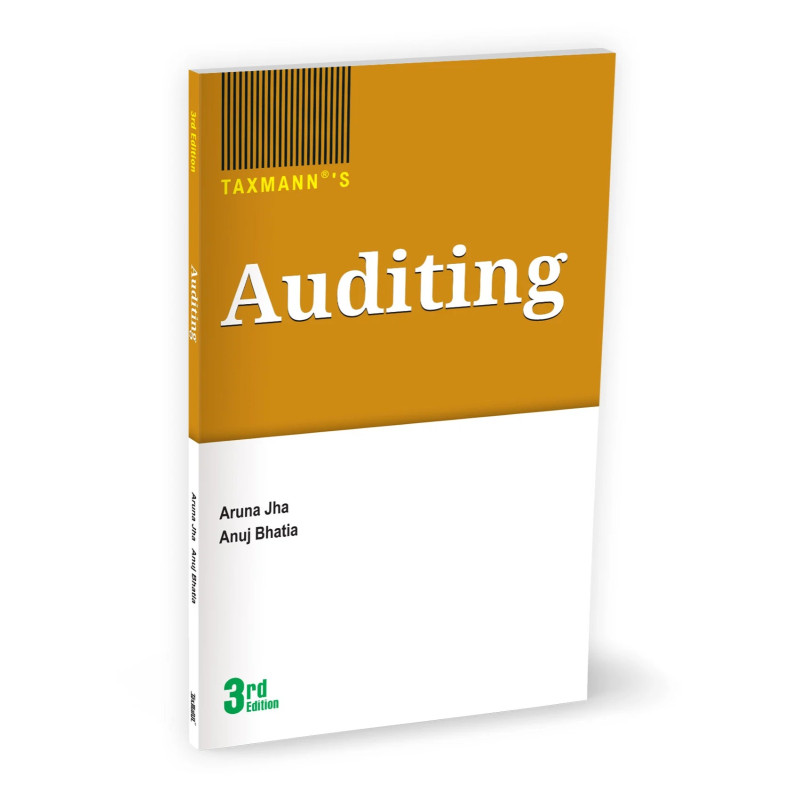
Auditing by Aruna Jha & Anuj Bhatia 3rd Edition June 2026
Auditing by Aruna Jha & Anuj Bhatia 3rd Edition June 2026
Descriptions :
Auditing is a complete undergraduate textbook on the theory, standards, and statutory framework of financial audit as practised in India. It develops the subject along the actual arc of an engagement—from the meaning and objectives of an audit, through planning, internal control, evidence, vouching, and verification, to the company auditor’s appointment, report, and liabilities—before extending into the regulatory architecture and the specialised audits of banks, insurers, and forensic engagements. What distinguishes the treatment is that concepts are never taught in the abstract: each is anchored to the relevant Standard on Auditing issued by the ICAI, the governing section of the Companies Act, 2013, and, where it shaped the law, the decided case. This Edition has been revised and updated to the latest University of Delhi syllabus (DSE-5.5: Auditing) and to current developments in the profession, including the revised SA 700 reporting series and the rise of the NFRA.
This book is intended for the following audience:
- Students of B.Com. (Hons.) and B.Com. under the Undergraduate Curriculum Framework (UGCF) at the University of Delhi
- Students at Other Universities following a comparable undergraduate auditing paper
- Learners Preparing the Foundations of Audit before professional study (CA/CS/CMA)
- Teachers Seeking a Syllabus-Mapped Classroom Text with built-in assessment and solved examination practice
The Present Publication is the 3rd Edition, authored by Dr Aruna Jha and CA. (Dr) Anuj Bhatia, with the following noteworthy features:
- [Standards-Anchored Throughout] Every topic is tied to the governing Standards on Auditing—SA 200, SA 240, SA 500, the revised SA 700/701/705/706 series, SA 315, SA 330, and SQC-1—so students read theory and authority together
- [Statute at the Point of Use] Statutory provisions are explained where they apply, including the Companies Act 2013 provisions on accounts and audit, the Insurance Act 1938, the C&AG Act 1971, and the SEBI (LODR) Regulations 2015
- [Landmark Case Law] Judicial decisions are discussed where they shaped the auditor’s duty—Kingston Cotton Mills (1896), Westminster Road Construction (1932), and the Supreme Court’s reasoning in S. Sukumar v. ICAI (2018)
- [Lessons from Real Corporate Failures] Satyam, Yes Bank, DHFL, the Harshad Mehta and PNB scams, Enron, and WorldCom are used to illustrate professional skepticism, fraud risk, and the case for independent oversight
- [Lucid, Example-Led Exposition] Concepts are presented clearly and succinctly, supported by a large number of worked examples drawn from practical situations
- [Tables and Figures for Quick Recall] Extensive comparative tables (error vs. fraud, continuous vs. annual audit, vouching vs. verification, internal control vs. internal check) and figures fix key distinctions
- [Chapter-End Self-Assessment] A ‘Test Your Knowledge’ question set closes every chapter
- [Solved Examination Practice] Three previous year question papers are appended—B.Com. (Hons.) Sem V (Dec. 2024 and Dec. 2025) and B.Com. Sem V (Dec. 2025)
The coverage of the book is as follows:
- Nature and Scope of Auditing
- The meaning, nature, objectives, scope, advantages, and inherent limitations of auditing, and its interdisciplinary character spanning accounting, law, behavioural sciences, statistics, economics, financial management, and information technology
- Classification of Audits
- The full classification by organisational structure (statutory, government, private), by specific objective (independent financial audit, tax audit under section 44AB, secretarial audit under section 204, cost audit), and by time (continuous, annual, interim, balance sheet audit)
- Audit Planning and Documentation
- Audit planning, the audit programme, the audit notebook, audit documentation, and the assembly of permanent and current audit files
- Internal Control, Check and Audit
- The internal control system, internal check with reference to specific transactions, statutory internal audit under section 138, and the inter-relationship between the three
- Audit Evidence and Sampling
- Audit evidence under SA 500, test checking, and audit sampling
- Vouching
- Vouching of credit sales and returns, purchases, and the debit and credit sides of the cash book
- Verification and Valuation
- Verification and valuation of specific assets and liabilities, and the auditor’s duty in each
- The Company Auditor
- Eligibility, appointment and compulsory reappointment, ceiling on number of audits, remuneration under section 142, removal, rights, and duties under sections 143–146
- The Auditor’s Report
- The report as a means of communication, its elements under the revised SA 700 series including the communication of Key Audit Matters under SA 701, and the five report types: unmodified, emphasis-of-matter, qualified, disclaimer, and adverse (the latter three being modified opinions under SA 705)
- Auditor’s Liabilities
- The civil and statutory liabilities of the auditor under common law and the Companies Act 2013
- National Financial Reporting Authority (NFRA)
- Its evolution, statutory basis under section 132, powers, composition, and relationship with the ICAI
- Audit of Banking Companies
- Sectoral audit covering loans and advances, NPAs, and the key financial items of a bank
- Audit of Insurance Companies
- Sectoral audit under the Insurance Act, 1938 and the IRDA Regulations, 2002, including policy lapse, revival, surrender, and reinsurance
- Forensic Audit
- Its definitions, the fraud triangle, the distinction from financial audit, and the laws and standards governing it
- Audit in a Computerised Environment
- Audit strategies, Computer Assisted Audit Techniques (CAATs), CIS/EDP internal controls, and the audit trail
The book runs to fifteen chapters mapped to the five units of the prescribed syllabus, sequenced to mirror the conduct of an audit.
- Block I | Foundations (Chapters 1–2) — The meaning, objectives, scope, principles, and full classification of auditing
- Block II | Process and Control (Chapters 3–5) — Audit planning and documentation, the internal control system, and audit evidence and sampling
- Block III | Substantive Testing (Chapters 6–7) — Vouching of transactions and the verification of assets and liabilities
- Block IV | The Company Auditor (Chapters 8–10) — Appointment and removal, the auditor’s report, and the auditor’s liabilities
- Block V | Regulation and Specialised Audit (Chapters 11–15) — The NFRA, bank audit, insurance audit, forensic audit, and audit in a computerised environment
- Each chapter follows a uniform internal architecture
- A graded conceptual exposition
- The governing standard and statutory provision set out at the point of relevance
- Illustrative examples and comparative tables, figures where a distinction is visual
- A closing ‘Test Your Knowledge’ section
- The three previous year papers at the end give students timed examination practice across both the Honours and the General streams
About the Author :
Dr Aruna Jha is a Professor in the Department of Commerce at Shri Ram College of Commerce (SRCC), University of Delhi, with nearly three decades of teaching and research experience. She has authored books on Auditing and Corporate Governance, and her research papers have appeared in Scopus-indexed, Web of Science-indexed, and UGC-recognised journals. She has presented papers at numerous national and international conferences, and has worked on projects funded by government and research agencies, as well as CSR Impact Assessment engagements for corporates.
CA. (Dr) Anuj Bhatia is an Assistant Professor in the Department of Commerce at Shri Ram College of Commerce (SRCC), University of Delhi. He holds a Bachelor of Business Administration (BBA) and a Master of Commerce (M.Com.) from Sardar Patel University, Gujarat, where he was awarded Gold Medals at both the undergraduate and postgraduate levels for academic excellence. A UGC NET-JRF qualifier, he secured the Best Performance Award—ranked 1st nationally—in the National Accounting Talent Search Examination (Senior Level) conducted by the Indian Accounting Association in 2015. At SRCC, he teaches Auditing and Corporate Governance, Financial Management, and Corporate Accounting. His scholarly work has appeared in prestigious international journals and books, including ABDC ‘A’ Category publications.