
- -30%
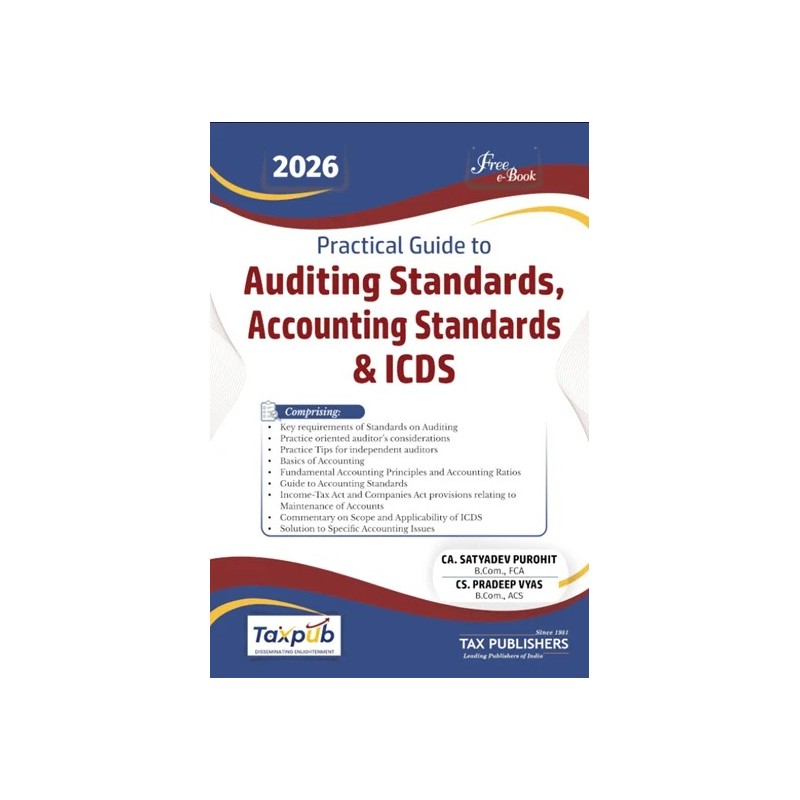
Practical Guide to Auditing Standards, Accounting Standards & ICDS Satyadev Purohit Edition 2026
The Institute of Chartered Accountants of India (ICAI), the apex body governing accounting and auditing profession in India, has issued Accounting Standards (ASs) and Auditing Standards (SAs) along with Standards on Review Engagements (SRE), Assurance Engagements (other than Audits or Reviews of Historical Financial Information) (SAE) and Standards on Related Services (SRS).
The Accounting Standards issued by the ICAI are required to be followed by all non-company entities and also by the companies that are not required to follow Indian Accounting Standards (Ind-AS), while preparing their books of account.
The Auditing Standards are concerned with the audit of financial statements by independent auditors, which provide detailed auditing framework for conducting audits of financial statements and contain various audit requirements and related application guidance to explain these requirements. These Standards are required to be followed by independent auditors in conducting audit of all corporate and non-corporate entities.
The present books is conceived and written with a view to provide an instant guide to the recognition, measurement and disclosure requirements contained in the Accounting Standards as well as the requirements relating to conducting the audit of financial statements as contained in the Standards on Auditing issued by the ICAI.
For the sake of better perception of the subject matter, the present book has been divided into the following six Parts:
Part I titled Auditing Standards contains introduction, key requirements and practice oriented analysis on the Standards on Auditing, Standards on Review Engagements, Assurance Engagements and Related Services as issued by ICAI.
Part II titled Basics of Accounting provides a general introduction about accounting, accounting principles, and accounting ratios.
Part III titled Accounting Standards is the heart of book. It provides a detailed study of the recognition, measurement and disclosure requirements contained under the currently applicable Accounting Standards issued by the ICAI.
Part IV deals with accounting for income-tax purposes. It inter alia incorporates the Tax Accounting Standards (TAS) issued by the Government.
Part V deals with certain specific accounting issues as arising in the interpretation of Accounting Standards/Guidance Notes.
Part VI of the book is devoted in providing a detailed commentary on the Income Computation and Disclosure Standards (ICDS) issued by the Central Government in exercise of the powers conferred under sub-section (2) of section 145 of the Income-tax Act, 1961.
The main difference between ASs and ICDSs is that while ASs are required to be followed for purpose of maintenance of books of account, the ICDSs are applicable for computation of income chargeable under the head Profits and gains of business or profession or Income from Other Sources and not for the purpose of maintenance of books of accounts.
The present Book thus constitutes the one and only comprehensive and complete guide for Accounting, Auditing, Tax and Corporate professionals and small companies. It is aimed at providing delightful reading instead confusing and bewildering sort of treatment.
In spite of inclusion of quite a few illustrations as and where necessary, and without compromising with comprehensiveness of treatment, we have succeeded in accommodating the subject matter within the boundaries of a single volume, making it the most economic accounting volume which takes care of practically all the needs of the most Accountants.
We feel that despite the painstaking efforts and a sincere analytical study tried to be provided by me in this Book, possibility of certain shortcomings cannot be ruled out. Therefore, we solicit creative feedback from our learned readers, bringing to us notice any mistake, error, omission or discrepancy that might have crept in. Needless to add that we shall feel highly obliged.