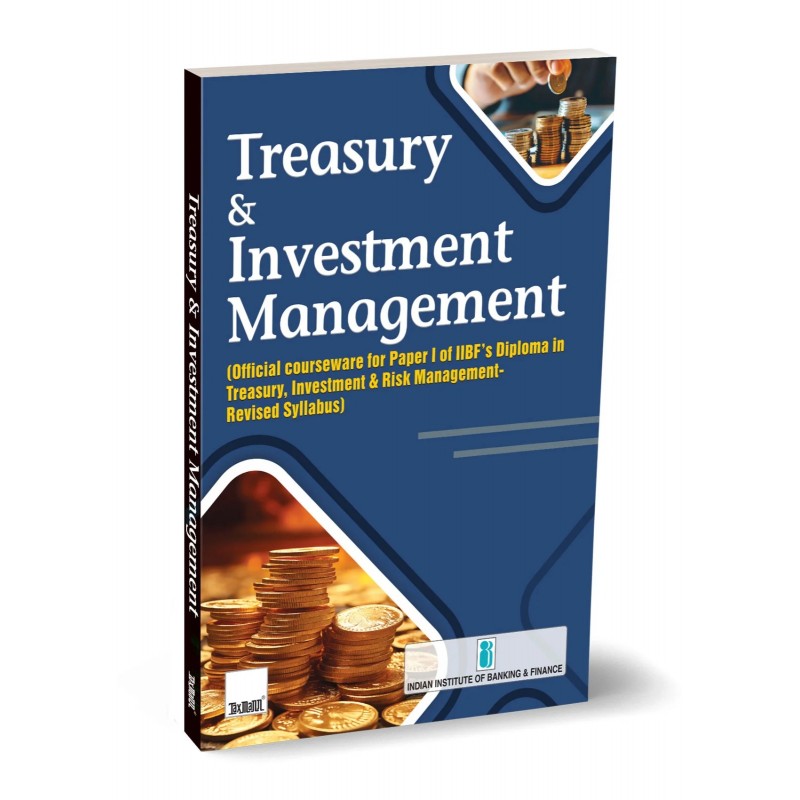
Treasury & Investment Management is the official, IIBF-authorised courseware for Paper I of the Certificate Examination in Treasury, Investment and Risk Management (DTIRM) conducted by the Indian Institute of Banking & Finance (IIBF). Comprehensively revised and released as the 2026 Edition, it offers a complete, front-to-back account of how a modern bank treasury actually works—beginning with the structure and functioning of financial markets, moving through the products that are traded and priced, and ending with the operations, risk controls, regulations, and technology that hold the dealing room together.
Written in a structured, self-study style, the book carries the reader from first principles (what a money market is, how an exchange rate is quoted) to genuinely advanced material (pricing an interest-rate swap, computing NDTL for CRR/SLR, running a front-mid-back office control framework). It is deliberately India-anchored—built around RBI, SEBI, FEDAI, FIMMDA, and CCIL frameworks and instruments—while situating that domestic detail within global market practice.
What sets this Edition apart is its currency. It has been updated to reflect contemporary market conventions and the latest regulatory developments, and it gives real coverage to the forces reshaping treasury today: treasury automation, Straight-Through Processing (STP), ERP integration, blockchain applications, advanced electronic trading and settlement platforms, and the transition away from LIBOR to alternative risk-free benchmark rates such as SOFR. The outcome is a book that serves equally as a structured examination text and as a practical desk reference for practitioners who need an authoritative, up-to-date guide to navigating an integrated treasury environment with competence, compliance, and confidence.
The book is written for anyone who needs a rigorous, practice-oriented grounding in treasury and investment management:
- DTIRM Examination Candidates using it as the prescribed Paper I courseware
- Banking and Finance Professionals looking to build or formalise their treasury expertise
- Treasury Dealers and Front/Mid/Back Office Staff who want one reference spanning dealing, settlement, accounting, and control
- Investment Managers and Fixed-Income/Forex Practitioners seeking applied coverage of products, pricing, valuation, and portfolio management
- Risk, Audit, and Compliance Practitioners who need to understand treasury exposures and the regulatory architecture around them
- Students, Faculty, and Researchers in Banking, Finance, and Management Programmes wanting an authoritative, exam-aligned text
The Present Publication is the 2026 Edition, updated by Mr Veerasekaran Manimaran (Former DGM | Canara Bank) and Mr N V Chalapathi Rao (Former IIBF Faculty & Retd. DGM | erstwhile Syndicate Bank). Taxmann exclusively publishes this book for the Indian Institute of Banking and Finance (Certificate Examination in Treasury, Investment & Risk Management (DTIRM)—Paper I), with the following noteworthy features:
- [Official IIBF Courseware] The prescribed, syllabus-aligned text for DTIRM Paper I, structured as a self-contained study kit that covers the full syllabus
- [Fully Revised 2026 Edition] Refreshed to reflect current market conventions, RBI guidelines, and evolving regulatory expectations
- [End-to-end Treasury Coverage] Markets → products → treasury operations → liquidity → risk → dealing-room controls → regulation → technology, in a single logical progression
- [Emerging-technology Coverage] Treasury automation, STP, ERP integration, blockchain, and modern trading/settlement platforms, with a dedicated chapter on the role of information technology in treasury
- [Benchmark-reform Ready] Explains the LIBOR transition to alternative reference rates (e.g., SOFR) and its practical implications for pricing and product terms
- [Worked, Quantitative Treatment] Day-count conventions, bond valuation and DCF, and the pricing of futures, forward rate agreements (FRAs), and interest-rate/currency swaps
- [Regulatory Source Material Built In] Reproduces and explains RBI guidelines, FEDAI rules, and extracts from the FIMMDA Handbook of Market Practices, plus CCIL settlement mechanics
- [Governance, Ethics & Controls] Treasury governance, conflicts of interest, code of conduct for the dealing room, investment controls, and functional segregation of front/mid/back office
- [Built-in Self-Assessment] ‘Check Your Progress’ multiple-choice questions at chapter ends, supported by diagrams, charts, and illustrations throughout
- [Two Ready-reference Annexures] General Principles (dealing controls, FEDAI/FIMMDA practice) and a comprehensive Treasury Terminology glossary
- [Dual-purpose Design] Equally effective as an exam-preparation text and as a professional desk reference
The coverage of the book is as follows:
- Financial Markets
- An overview of markets and their functions; classification into money, foreign-exchange, mutual-fund, capital, insurance, and commodity markets; the role of emerging markets (BRICS); and the roles and functions of participants—banks, primary dealers, financial institutions, stock exchanges, brokers, investment/merchant bankers, foreign institutional investors, custodians, and depositories. Positions the key regulators (RBI, SEBI, IRDAI, AMFI)
- Money Market
- Key operational features and functions of the Indian money market; the need for the market; participants (Central Government, scheduled commercial banks, private-sector companies, provident/pension funds, life and general insurers, mutual funds, NBFCs, and primary dealers); and instruments—call/notice money, term money, bank fixed deposits, certificates of deposit, commercial paper, the bill rediscounting scheme, interbank participation certificates, treasury bills, cash management, municipal bonds, and repos and tri-party repos
- Capital Markets
- Equity and preference shares; borrowing and lending in foreign currency by Authorised Dealers; Global, American, and Indian Depository Receipts (GDRs/ADRs/IDRs) including governing legislation, eligibility and investment requirements; when-issued securities and their mechanics; credit-linked notes; algorithmic trading (benefits, risks, and challenges); and External Commercial Borrowings (ECBs) with their regulatory framework
- Technical Analysis of the Financial Markets
- Dow Theory; trend concepts; major reversal and continuation patterns; volume and open interest; long-term charts; moving averages; oscillators; point-and-figure charting; Japanese candlesticks; Elliott Wave theory; money management and trading tactics; a technical checklist; advanced indicators; and trading strategies
- Foreign Exchange (FX) Markets
- Exchange-rate definitions and quotations; factors influencing rates; the role of banks in the Indian forex market and its link to money-market operations; international financial institutions (World Bank Group, multilateral/regional/bilateral development banks); correspondent banking and NRI/PIO accounts; risks in foreign trade; and the roles of EXIM Bank, RBI, and FEDAI, including FEDAI guidelines, forex valuation, revaluation effects, Registered Foreign Portfolio Investors, and foreign-exchange trading strategies
- Debt Markets & Fixed Income Securities
- Terminology and types of bonds; Government of India securities (auction process, STRIPS, bootstrapping); State Development Loans; other approved and non-SLR securities; PSU bonds and corporate debentures; bond dynamics (discounted cash flow, time value of money, accounting and valuation); bond portfolio management; and green bonds
- Interest Rate Quotations and Market Terminology
- Fixed vs. floating and simple vs. compound interest; yield; premium and discount; front-end vs. rear-end; day-count conventions; and the LIBOR transition
- Derivatives—A Detailed Study
- Characteristics, functions and users of derivatives; futures (currency, bond, and stock-index futures, and futures pricing); forward rate agreements (conventions and pricing); swaps (interest-rate swap pricing, types of IRS, currency swaps, and RBI guidelines); and a detailed treatment of options—calls and puts, European vs. American style, moneyness (in/at/out-of-the-money), intrinsic value and premium, pricing models including the binomial tree, option Greeks, exotic options, and interest-rate options
- Treasury Management
- Sources of profit for treasury; the global scenario, including Zero Interest Rate Policy and the impact of commodities (oil and gold) on treasury operations; RBI measures; the scope and functions of treasury management; the nature of treasury assets and liabilities and treasury objectives; organisational structure; and integrated treasury as both a cost centre and a profit centre—its functions, nature of integration, and benefits
- Liquidity Management
- Objectives, sources and deployment of liquidity; the Cash Reserve Ratio (with computation of Net Demand and Time Liabilities); the Statutory Liquidity Ratio (computation, penalties, Form VIII return, and cost of maintenance); the Clearing Corporation of India (CCIL)—products handled, FX-Clear and FX-Retail, novation and multilateral netting, margins, and G-Secs; and RTGS
- Risk Analysis and Control
- Operational risk and its mitigation; financial risks (credit and liquidity risk); market risk (event risk and balance-sheet interest-rate risk); RBI risk-management guidelines and norms (risk management in banks, asset-liability pricing, adding new products); and forex/market risk, including open positions and gaps, gap (interest-rate/swap) risk, and customer credit risk
- Front Office/Mid Office/Back Office
- Front-office and dealing functions; the mid-office; back-office operations; operational clarity; documentation; monitoring; settlement of transactions; and investment accounting and internal controls.
- Regulations, Supervision and Compliance of Treasury Operations
- RBI guidelines (organisational set-up and the dealing room); extracts from the FIMMDA Handbook of Market Practices (management controls, know-your-counterparty, recording of conversations, off-premise dealing, dealing hours, rate scan, conflicts of interest, rotation of dealers, confirmations); and dealing procedures and principles (negotiation of terms, firmness of quotation, delivery, concluding a deal, passing of names by brokers, reporting on the NDS, oral/written confirmations, settlement of differences, holidays/market disruption); the components of multi-currency balance sheets; and a closing snapshot of ethics, morals, and the code of conduct for the dealing room
- Role of Information Technology in Treasury Management
- The Negotiated Dealing System and other trading platforms; Straight-Through Processing; settlement and custody; treasury technology and innovations (ERP integration and blockchain); and why the treasury-technology relationship—spanning operations, liquidity management, and efficiency—can no longer be ignored
- Annexure 1—General Principles
- Internal-control fundamentals, functional segregation of front/mid/back office, off-premise dealing, dealing days and hours, and FEDAI market-practice rules
- Annexure 2—Treasury Terminology
- An extensive glossary of treasury terms (from SGL, SLR, and securitisation to SOFR, SWIFT, RTGS, vostro accounts, yield curve, YTM, and zero-coupon yield) for quick professional reference
Rather than a loose set of topics, the book is built as a self-study courseware with a consistent, repeatable architecture:
- A Single Logical Arc — The material moves from market foundations, to products, to treasury operations, liquidity and risk, and finally to dealing-room controls, regulation, and technology, with each block building on the one before it
- A Consistent Chapter Template — Every chapter begins with a detailed, multi-level sub-section outline, develops the material through narrative supported by worked examples, illustrations, tables, and diagrams, and closes with a ‘Check Your Progress’ set of multiple-choice questions followed by an answer key
- A Stand-alone Reference Layer — The two annexures at the back (General Principles—dealing controls and FEDAI/FIMMDA market practice; and a Treasury Terminology glossary) are designed to be consulted independently of the chapters, as a desk reference.
About The Author-
Indian Institute of Banking & Finance – Established in 1928 as a Company under Section 26 of the Indian Companies Act, 1913, the Indian Institute of Banking and Finance (IIBF), formerly known as the Indian Institute of Bankers (IIB), is a professional body of Banks, Financial Institutions and their employees in India. With a total membership of over 10 Lakhs, IIBF is the largest institution of its kind in the world. It aims to develop professionally qualified and competent bankers and finance professionals primarily through education, training, examination, consultancy/ counselling and continuing professional development programs.’