Cost & Management Audit Cracker Tarun Agarwal, Leena Lalit Parakh Dec 26
Cost & Management Audit Cracker By CA Tarun Agarwal, Leena Lalit Parakh Dec 26
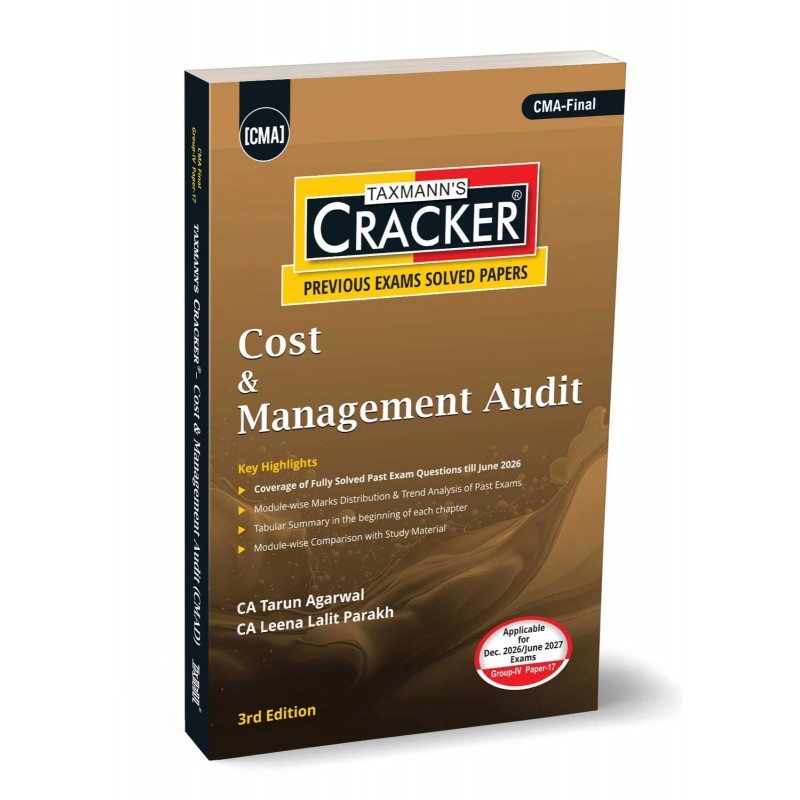
Cost & Management Audit – CRACKER is a past-examination-driven question-and-answer companion for CMA-Final, Group-IV, Paper-17, part of Taxmann’s CRACKER ‘Previous Exams Solved Papers’ series. Rather than re-teaching the subject, it reorganises the entire Paper-17 syllabus into a fully solved question bank arranged module-by-module in the same order as the institute’s study structure, so candidates revise the subject the way the examiner sets it. Each topic is approached through a quick conceptual recap, followed by the actual questions that have appeared in the examination—objective and descriptive alike—with model answers, fully worked numerical solutions, and the sitting and marks tagged against every question. The result is a single, practice-first revision instrument that exposes exactly how each area has been examined, where the marks concentrate, and how answers are expected to be framed and presented. It is built for the final stretch of preparation and is intended to be worked alongside the official study material, not in place of it.
The Present Publication is the 3rd Edition | June 2026, authored by CA. Tarun Agarwal and CA. Leena Lalit Parakh, with the following noteworthy features:
- [Fully Solved Past Questions (Up to June 2026)] Within each chapter the questions are segregated into Objective Questions (1–2 mark short-answer, fill-in-the-blank and select-the-option items) and Theory Questions (the descriptive and analytical questions, largely 7-mark with a range of 4–10 mark items), with every question carrying its examination sitting and marks for instant weightage
- [Step-by-Step Worked Numericals] Worked numerical and practical problems are presented in full, complete with cost statements, prime-cost build-ups, make-or-buy and export-decision evaluations, ratio and profitability computations and the supporting working notes—so application-type questions are not merely stated but solved step by step
- [Tabular ‘Quick Review’ in Every Chapter] A ‘Quick Review’ summary at the start of every chapter and sub-chapter condenses the core concept before the candidate attempts the questions—rendered in tabular or diagrammatic form for the rule- and standard-based topics and in concise prose for the conceptual ones
- [Module-wise Marks Distribution] Mapped across the June and December sittings from 2023 through 2026, with per-module averages, to steer effort toward the consistently high-scoring areas
- [Previous Exams Trend Analysis] A question-by-question map of recent papers (December 2023 to June 2026) recording the compulsory question, the chapter examined, the marks, and whether the item was theoretical or practical—revealing the examiner’s recurring patterns
- [Module-wise Comparison with the Study Material] Mapping every module and chapter of the book to the corresponding ICMAI/CMA institute module, so candidates can move between this CRACKER and their official content without gaps
- [Latest Solved Papers (December 2025 & June 2026)] Module-wise solved papers for the two most recent sittings, with suggested answers, reinforcing model-answer structure on full, current papers
- [Updated for Current Rules & Standards] Content reflects the prevailing statutory and standards position—the Companies (Cost Records and Audit) Rules 2014, the relevant provisions of the Companies Act, 2013, the Cost Accounting Standards and GACAP, and the Cost Auditing and Assurance Standards, with XBRL-based reporting addressed
The coverage of the book is as follows:
- Cost Audit | Concept & Foundations
- Nature, scope, genesis, objectives and utility of cost audit, and the role of Cost Accounting Standards
- Companies (Cost Records and Audit) Rules 2014
- Applicability, maintenance of cost records, the appointment machinery and the CRA forms regime
- The Cost Auditor | Appointment, Ethics & Liabilities
- Eligibility, qualifications and disqualifications, appointment, registration, rotation, remuneration, removal, rights, duties and liabilities; professional ethics; the duty to report fraud; and the consequences of fraud and false statements
- Cost Accounting Standards & GACAP
- Overview of Cost Accounting Standards and the Generally Accepted Cost Accounting Principles (GACAP)
- Cost Auditing & Assurance Standards
- Including professional judgment, professional skepticism and risk assessment
- Cost Audit Programme, Documentation & Execution
- Cost audit planning, documentation, the audit process and its practical execution
- Cost Audit Report & XBRL Filing
- Preparation and filing of the cost audit report, including qualified and adverse reports and filing to the MCA in XBRL format
- Management Audit | Fundamentals
- Nature and scope, the need for management audit and reporting, reliability of information, and the role of the CMA
- Management Reporting & Performance Analysis
- Capacity utilisation, productivity and efficiency, utilities and energy efficiency, key costs and contribution, profitability, working capital and liquidity, manpower analysis, and management accounting tools
- Management Audit Across Functions
- Corporate services, development and personnel evaluation, consumer service, environmental pollution control, energy and utilities, propriety, CSR and social cost-benefit analysis audits
- Corporate Image Evaluation & ESG Audit
- Including audit checks across managerial functions and corporate divisions, and ESG audit
- Information Systems Security Audit
- Compliance and security frameworks, cyber security and forensics, and IT audit in the banking sector
- Internal Control & Internal Audit
- Concept, the auditor’s relationship to internal control, and the evolution of the profession
- Operational Audit under the Companies Act 2013
- Audit preparation, the engagement letter, CARO, and internal audit in the manufacturing sector
- Audit of Service Organisations
- Hospitals, hotels, educational institutions, co-operative societies, self-help groups, NGOs, local bodies, government expenditure and commercial accounts
- Forensic Audit & Fraud Risk Management
- Fraud risk management, financial forensics and techniques, ethical considerations and professional opportunities
- Anti-Money Laundering (AML)
- International standards on combating money laundering and terrorist financing, and the risk-based approach for the accounting profession
The book opens with three analytical front-matter tools—the Module-wise Marks Distribution, the Previous Exams Trend Analysis, and the Module-wise Comparison with the Study Material—before progressing through 18 modules organised into four sections:
- Section A — Cost Audit (Modules 1–8)
- Section B — Management Audit (Modules 9–13)
- Section C — Internal Audit, Operational Audit & Other Related Issues (Modules 14–16)
- Section D — Forensic Audit & Anti-Money Laundering (Modules 17–18)
- Within this architecture every chapter follows a uniform internal sequence
- A Quick Review concept snapshot, followed by Past Examination Questions segregated into Objective Questions and Theory Questions—the latter incorporating the fully worked numerical and practical problems—each item carrying its sitting and marks
- The most extensively developed modules are the Cost Accounting Standards and GACAP module, the Companies (Cost Records and Audit) Rules module, and the Management Reporting and Analysis module, mirroring their dominant share of marks in the published examination history
- The volume closes with module-wise solved papers for December 2025 and June 2026 (suggested answers), worked in the same module order as the rest of the book so candidates finish on complete, current papers.
About The Author
CA Tarun Ramgopal Agarwal is a distinguished All-India Rank Holder at all levels of the Chartered Accountancy exams, earning a Gold Medal in Financial Reporting in the CA Final. In 2010, he was honoured by the Chartered Accountants Association, Ahmedabad, as the best CA student in Gujarat for securing 1st Place in the CA Final in the state. He holds multiple qualifications, including B.Com., CS, LL.B., CFA (Level 2), and FRM.
CA. Leena Lalit Parakh is a practising Chartered Accountant with over eleven years of academic experience, specialising in law, audit, strategic management, and economics. Renowned for her practical teaching approach, she has developed extensive educational resources and currently mentors CMA students at all levels in Surat. Her expert guidance has contributed to the success of numerous students, including over 25 All-India Rank holders.