CMA Final Group 4 CMAD CFR ITLP and SPMBV Crackers Dec 26 Exam
CMA Final Group 4 CMAD CFR ITLP and SPMBV Crackers Dec 26 Exam
Description
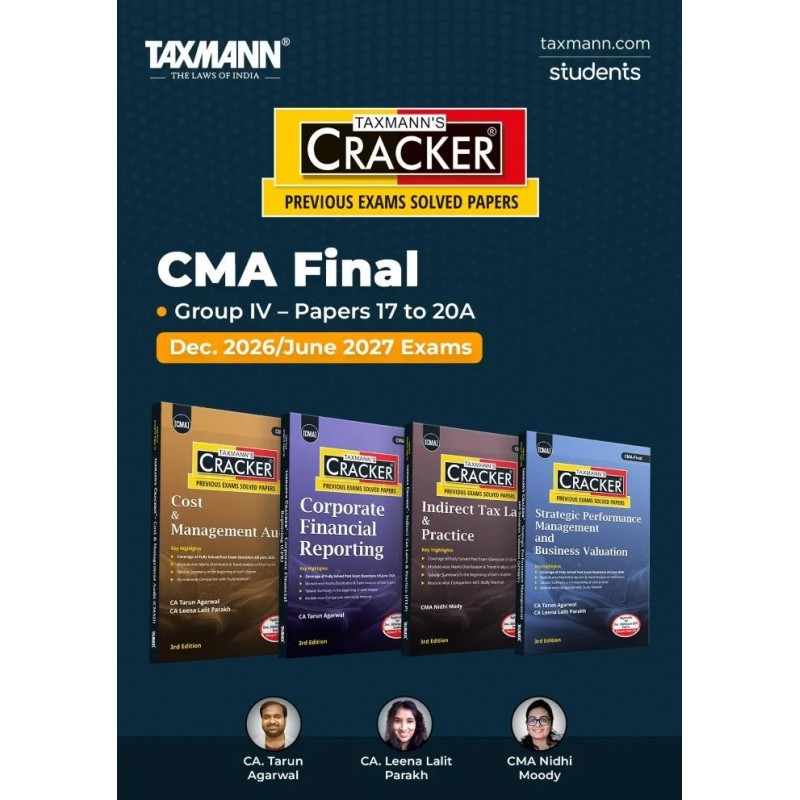
CRACKER COMBO for CMA Final – Group IV is a coordinated set of four exam-focused, practice-first companions from Taxmann’s flagship CRACKER series, assembled to cover the entire final group of the CMA course under the ICMAI Syllabus 2022. Where a study text teaches the subject, the CRACKER does the opposite: it takes a candidate who has already studied the law and its concepts and drills that knowledge into marks in the examination hall.
Group IV is one of the two groups a student must clear at the Final level, and it bundles together four very different disciplines—audit, financial reporting, indirect tax, and strategic performance/valuation. Preparing for them from four separately styled books is a real source of friction in the last weeks before the exam. This combo removes that friction: all four titles run on the same ‘revise-then-practice’ engine, so a candidate learns one method and applies it across all four papers.
Each book distils its paper into a fully solved, module-by-module question bank arranged in the exact order of the ICMAI study structure. Every topic opens with a tabular ‘A Quick Review’ concept-and-formula recap, then moves straight into authentic past-examination questions solved in full—objective, theory, and numerical/practical—each tagged with its sitting and marks. Every volume then closes with module-wise solved papers for the two most recent sittings (December 2025 and June 2026). Because the entire set is updated with solved coverage through the June 2026 attempt and reflects the prevailing law/standards position, it is precisely calibrated for the December 2026 and June 2027 examinations and is designed to be worked alongside—not instead of—the official study material.
The Present Publication is the July 2026 Edition, authored by CA. Tarun Agarwal, CA. Leena Lalit Parakh & CMA Nidhi Moody, with the following noteworthy features:
- [Practice & Solutions]
- Fully-solved Past-Exam Questions (till June 2026) — Deep, topic-wise banks of authentic CMA Final questions with complete, examiner-style model answers and detailed working notes. Several titles reach back over a decade (to 2015), with earlier-syllabus questions remapped to the current modules
- Every Question Tagged with Attempt & Marks — Each item carries its sitting and mark weightage (e.g., [Dec. 2015, 5 Marks; Similar Question June 2017, 4 Marks]), with repeats flagged, so high-frequency, ‘favourite’ topics are instantly visible
- Theory/Practical Classification — Within each chapter, questions are segregated into Objective, Theory, and Numerical/Practical, so students drill conceptually and computationally with intent
- Step-by-Step Worked Numericals — Practical problems solved in full, with cost statements, computations, and supporting working notes—application questions are demonstrated, not merely stated
- [Revision & Recall]
- Tabular ‘A Quick Review’ in Every Chapter — A crisp pointwise/tabular concept-and-formula recap opens each chapter and sub-chapter for rapid pre-question revision (formula sheets embedded for the quantitative papers)
- [Exam Intelligence & Planning]
- Module-wise Marks Distribution — Weightage tables mapped across recent sittings (broadly 2023 → 2026, with averages) to steer effort toward consistently high-scoring areas
- Previous Exams Trend Analysis — A question-by-question, attempt-by-attempt map recording the compulsory question, the chapter examined, the marks, and whether each item was theory or practical—exposing the examiner’s recurring patterns
- Module-wise Comparison with the ICMAI/CMA Study Material — Every module and chapter mapped to its corresponding official study module, so candidates move between the CRACKER and the institute’s content without gaps
- [Updated, Amended & Complete]
- Latest Module-wise Solved Papers (Dec. 2025 & June 2026) — The two most recent papers reproduced with suggested answers, re-sequenced module-wise and cross-referenced to chapters, so students finish on complete, current, exam-condition practice.
- Updated for Amended Law, Rules & Standards — Content reflects the prevailing statutory/standards position applicable to the December 2026 and June 2027 attempts
The coverage of the COMBO is as follows:
- Paper 17 — Cost & Management Audit (CMAD)
- Solved past questions up to June 2026, updated for the Companies (Cost Records and Audit) Rules 2014, relevant provisions of the Companies Act 2013, the Cost Accounting Standards & GACAP, the Cost Auditing & Assurance Standards, and XBRL-based reporting. Organised into 18 modules across four sections:
- Section A | Cost Audit (Modules 1–8) — Concept & foundations; the Cost Records and Audit Rules 2014; the Cost Auditor (appointment, ethics, rotation, duties, liabilities, fraud reporting); Cost Accounting Standards & GACAP; Cost Auditing & Assurance Standards; audit programme, documentation & execution; and the Cost Audit Report & XBRL filing to the MCA
- Section B | Management Audit (Modules 9–13) — Fundamentals; management reporting & performance analysis (capacity, productivity, energy, profitability, working capital, manpower); management audit across functions; corporate image & ESG audit; and Information Systems Security Audit (cyber security, forensics, IT audit in banking)
- Section C | Internal Audit, Operational Audit & Other Related Issues (Modules 14–16) — Internal control & internal audit; operational audit under the Companies Act 2013 (engagement letter, CARO); and audit of service organisations (hospitals, hotels, educational institutions, co-operatives, NGOs, local bodies, government)
- Section D | Forensic Audit & Anti-Money Laundering (Modules 17–18) — Forensic audit & fraud risk management; and AML—international standards and the risk-based approach for the accounting profession
- Most Extensively Developed — Cost Accounting Standards & GACAP, the Cost Records and Audit Rules, and Management Reporting & Analysis—mirror their dominant share of marks
- Paper 18 — Corporate Financial Reporting (CFR)
- One of the most technically demanding papers, compressed into a single disciplined resource with ~340 fully solved questions (≈284 in chapters plus ≈56 across two solved papers), 430+ exam-attempt tags, and 120+ working notes, updated through June 2026. Structured along the eight prescribed modules (19 chapters):
- Module 1 | Specific Accounting Standards (Ind AS) — Ind AS 8, 12, 16, 116, 21, 23, 36, 38, 102, 108, 113, 115
- Module 2 | Valuation of Shares — Net Assets (Intrinsic), Yield, Fair Value methods
- Module 3 | Accounting of Financial Instruments — Ind AS 32, 107, 109
- Module 4 | NBFCs — RBI asset classification & provisioning norms
- Module 5 | Business Combination & Restructuring — Ind AS 103; amalgamation and internal reconstruction (one of the two heaviest-scoring modules; ~23.9 avg. marks)
- Module 6 | Consolidated & Separate Financial Statements — Ind AS 110, 111, 28, 27 (typically the single largest mark contributor; ~24.9 avg. marks)
- Module 7 | Recent Developments in Financial Reporting — 3P/4P reporting, sustainability, CSR, corporate governance, Integrated Reporting, ESG, HR accounting, Value-Added Statement, EVA, XBRL
- Module 8 | Government Accounting in India — Cash vs. accrual, fund-based accounting, GASAB, IGAS, IGFRS
- Plus, full suggested answers for the December 2025 and June 2026 papers
- Paper 19 — Indirect Tax Laws & Practice (ITLP)
- A deep bank of 400+ fully solved questions drawn from attempts spanning June 2015 to June 2026, answered in structured, point-wise form citing the governing sections, rules, FTP paragraphs, and notifications. Fully updated for the latest law—including the Baggage Rules, 2026, Foreign Trade Policy [2023] (with schemes such as RoDTEP), and the SEZ Scheme. Coverage spans two sections and sixteen modules:
- Section A | Goods & Services Tax (GST) Act and Rules — Basics, supply & composition; time, place, value of supply; input tax credit; TDS & TCS; e-way bill; refunds; returns; registration; accounts & records; audit, assessment, inspection, search & seizure, demands & recovery, offences & penalties, appeals & revision, advance ruling; and miscellaneous provisions (anti-profiteering, e-invoicing, transitional provisions, electronic ledgers)
- Section B | Customs Act & Rules (with Allied Laws) — Customs basics & import valuation, warehousing, duty drawback, Baggage Rules 2026, import at concessional rate, remission, refund, trade facilitation; Foreign Trade Policy [2023]; and the Special Economic Zone (SEZ) Scheme
- Plus, module-wise solved papers with suggested answers for December 2025 and June 2026
- Paper 20A — Strategic Performance Management & Business Valuation (SPMBV)
- A self-study question bank updated to June 2026 (reaching back to 2015), organised into two equally weighted sections (50% each) and nine modules, with formula sheets embedded in each Quick Review:
- Section A — Strategic Performance Management (50%):
- Module 1 – Introduction to Performance Management (8 chapters): Productivity/efficiency, financial performance analysis, procure-to-pay, supply chain, order-to-cash, CRM, customer profitability
- Module 2 – Performance Management, Evaluation & Improvement Tools (10 chapters): Balanced Scorecard, Du-Pont/RONA, benchmarking, Six Sigma/Lean, SQC, PDCA, MIS (digital environment), TPM, TQM, DEA (the single highest-weighted module in the paper; ~24-mark average)
- Module 3 – Economic Efficiency of the Firm (3 chapters): Economic indicators, profit optimisation, pricing
- Module 4 – Enterprise Risk Management (3 chapters): Risk management, corporate risk, corporate failure (Altman Z-score)
- Section B — Business Valuation (50%):
- Module 5 – Fundamentals of Business Valuation: Enterprise Value, leverages, Gordon growth, CAPM, WACC
- Module 6 – Laws & Compliance in Business Valuation: IBC 2016, fair value, the regulatory framework
- Module 7 – Valuation Methods & Approaches: DCF, FCFF/FCFE, relative valuation, beta, equity valuation
- Module 8 – Valuation of Assets & Liabilities: Net asset value, intangibles, EVA/MVA, bond valuation
- Module 9 – Valuation in Mergers & Acquisitions: Exchange ratio, EPS impact, synergy, purchase consideration (the highest-weighted, most practical module in Section B; ~21-mark average)
- Plus, module-wise solved papers (with cross-references) for December 2025 and June 2026
Every book is engineered around the same deliberate plan → revise → practise → test sequence, so a student moves between papers without relearning how to use the book:
- Strategic/Diagnostic Front Matter — Before the chapters begin, each title opens with three planning tools: the Module-wise Marks Distribution, the Previous Exams Trend Analysis (question-by-question, with each item flagged as Theory/Practical), and the Module-wise Comparison with the Study Material. Together, these let a candidate set a strategy and prioritise time before opening a single chapter
- Syllabus-aligned Sections & Modules — Content follows the official ICMAI order (18 modules/4 sections for CMAD; 8 modules for CFR; 16 modules/2 sections for ITLP; 9 modules/2 sections for SPMBV)
- A Uniform Chapter Anatomy — Each chapter follows the same design
- A Quick Review (concept/framework/formula recap—tabular or diagrammatic for rule- and standard-based topics, concise prose for conceptual ones)
- Past Examination Questions grouped into Objective, Theory, and Numerical/Practical, each carrying its sitting and marks, and answered with model solutions and working notes
- Module-wise Solved Papers — The two most recent attempts (December 2025 and June 2026) reproduced with full suggested answers, re-sequenced module-wise (not in original order) and cross-referenced to the relevant chapter/page, enabling topic-anchored, full-length revision
- This mirrors how the exam actually tests each subject—short objective items, theory, and substantial practical problems—so students build speed, accuracy, and answer-writing discipline together.
About the Author
CA Tarun Ramgopal Agarwal is a distinguished All-India Rank Holder at all levels of the Chartered Accountancy exams, earning a Gold Medal in Financial Reporting in the CA Final. In 2010, he was honoured by the Chartered Accountants Association, Ahmedabad, as the best CA student in Gujarat for securing 1st Place in the CA Final in the state. He holds multiple qualifications, including B.Com., CS, LL.B., CFA (Level 2), and FRM.
CA. Leena Lalit Parakh is a practising Chartered Accountant with over eleven years of academic experience, specialising in law, audit, strategic management, and economics. Renowned for her practical teaching approach, she has developed extensive educational resources and currently mentors CMA students at all levels in Surat. Her expert guidance has contributed to the success of numerous students, including over 25 All-India Rank holders.
CMA Nidhi Mody is an accomplished professional who secured All India Rank 6 in CMA Final and Rank 12 in CMA Inter. She holds a B.Com degree and is certified in DISSA (ICMAI). With over five years of practical experience in GST, she brings hands-on expertise in indirect taxation and costing. Nidhi has also gained valuable industry exposure through her tenure at a listed company, further enhancing her practical understanding of finance and compliance.