
- -30%
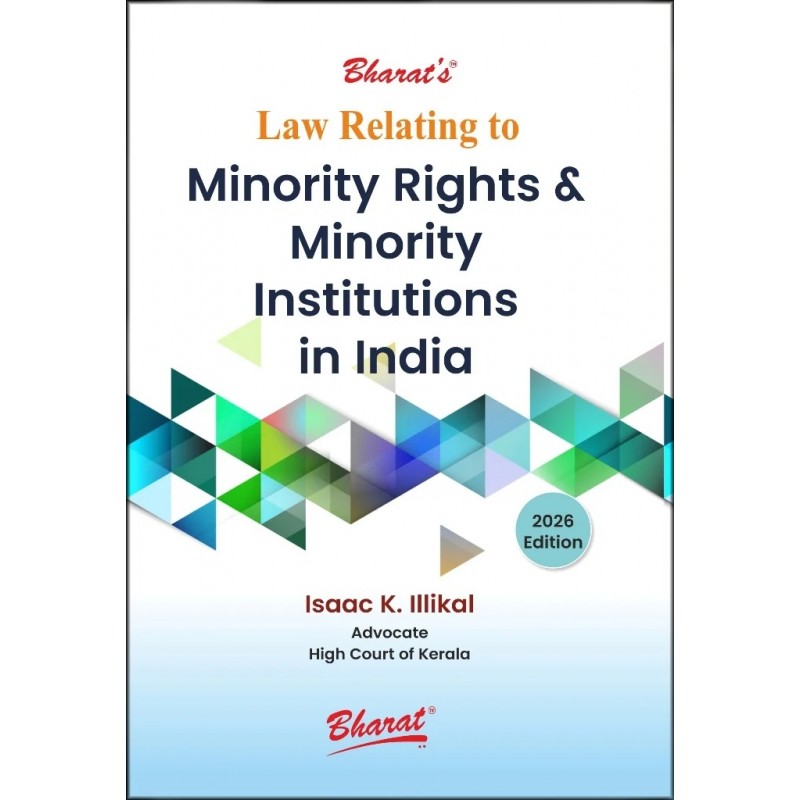
Law Relating to Minority Rights & Minority Institutions in India by Isaac K. Illikal 1st Edition 2026
The Constitution of India embodies a profound commitment to pluralism, recognising that the strength of the nation lies not in uniformity but in its remarkable diversity of religion, language, culture, and tradition. Among the many constitutional safeguards crafted by the framers, Article 30(1), which guarantees to religious and linguistic minorities the right to establish and administer educational institutions of their choice, occupies a unique position. It is not merely a legal provision; it is a solemn constitutional assurance that minority communities shall have the freedom to preserve their identity and contribute to the nation’s educational and cultural development.
Despite the constitutional clarity of this guarantee, the practical application of Article 30 has been the subject of continuous judicial scrutiny and legislative intervention. Over the decades, numerous decisions of the Supreme Court of India and the High Courts have interpreted its scope, defined its limits, and balanced it against the legitimate regulatory powers of the State. These decisions, though authoritative, are dispersed across hundreds of judgments delivered over more than seven decades. Consequently, lawyers, judges, educational administrators, academicians, and minority institutions often find it difficult to ascertain the precise legal position on a particular issue.
This book is an attempt to bridge that gap.
The work traces the historical evolution of minority rights from their international origins to their constitutional recognition in India. It examines the deliberations of the Constituent Assembly, the philosophy that inspired the incorporation of Articles 29 and 30, and the constitutional vision of the framers who sought to assure minority communities of equality, security, and participation in the life of the nation. The book further analyses the jurisprudence developed by the Supreme Court and various High Courts on every significant aspect concerning minority educational institutions from establishment, administration, admissions, appointments, service conditions, affiliation, regulation, governmental control, autonomy, and State aid, to the permissible limits of regulatory intervention.
Wherever possible, emphasis has been placed on the prevailing legal position. Overruled and obsolete precedents have largely been omitted to avoid unnecessary confusion, enabling the reader to appreciate the law as it presently stands. While the discussion is rooted in constitutional doctrine, it also seeks to present the subject in a practical and accessible manner so that it may serve not only members of the Bar and the Bench but also educational managers, administrators, policy makers, researchers, and students of constitutional law.
Chapter 1 Who are Minorities? Minority Rights Around the World
Chapter 2 Minority Rights in India
Chapter 3 National Commissions for Minority & their Educational Institutions
Chapter 4 Cultural and Educational Rights
Chapter 5 The Right of Minority to Choose Managing or Governing Body in its Educational Institutions
Chapter 6 The Right to Choose its Teachers and to Take Disciplinary Action Against Them
Chapter 7 The Right to Admit Students
Chapter 8 The Right to Use its Properties and Assets for the Benefit of its Own Institution
Chapter 9 Rights of Minority in the Professional Education Sector
Chapter 10 Right to Education & Laws of Reservation in Relation to Minority
Chapter 11 Other Important Cases on Minority Rights
Chapter 12 Lack of Formal Declaration of Minority Status Not An Impediment for the Exercise of Minority Rights
Annexure Master Table of Cases (Minority Educational Institutions – Articles 29 & 30 Jurisprudence)
Appendix 1 National Commission for Minority Educational Institutions Act, 2004
Appendix 2 The National Commission for Minorities Act, 1992
Isaac K. Illikal is an Advocate practicing before the High Court of Kerala, with nearly eighteen years of experience in the legal profession. Over the course of his practice, he has developed significant expertise in education law, service law, constitutional law, and administrative law, regularly appearing before the High Court and statutory tribunals. He has been actively involved in several landmark cases concerning the rights of Minority Educational Institutions, university administration, service jurisprudence, disciplinary proceedings, and constitutional protections under the Constitution of India, particularly Articles 29 and 30. His extensive engagement with these areas has provided him with a practical understanding of the evolving legal principles governing educational institutions and minority rights. Mr. Illikal holds a B.A.L, LL.B. and LL.M., besides several specialised qualifications in international and commercial law, including a Diploma in International Business Law, Diploma in U.S. Technology Law and Paralegal Studies, Diploma in International Contract Negotiation, Drafting and Enforcement, Diploma in U.S. Corporate Law and Paralegal Studies, and a Certificate Course in Professional Commercial Arbitration. He is also a Certified International Arbitrator accredited by the Indian Institute of Arbitration & Mediation (IIAM) and the Asia Pacific Centre for Arbitration & Mediation (APCAM).