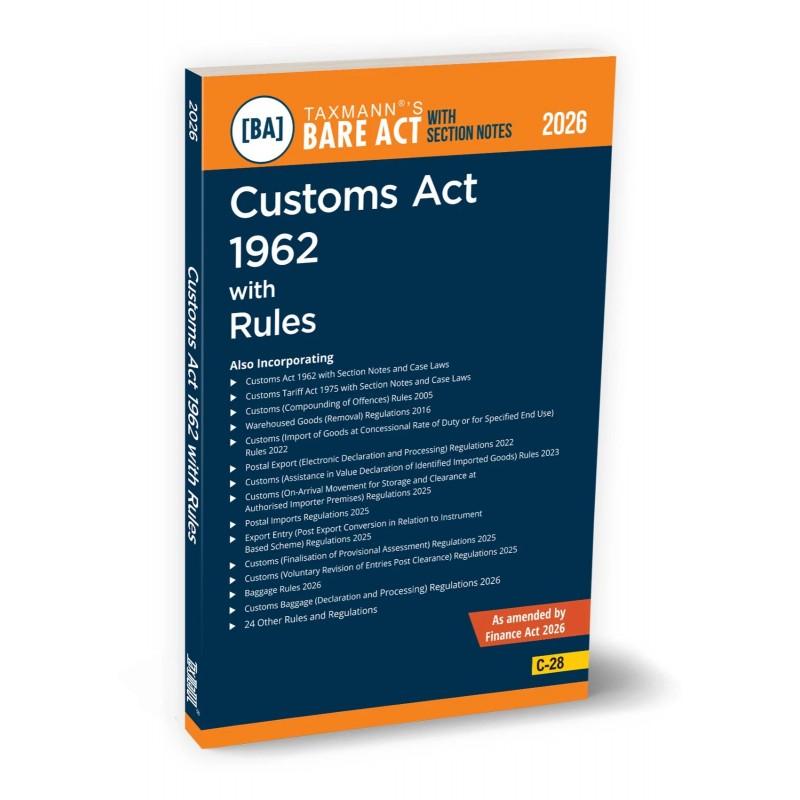
Customs Act 1962 Bare Act with Section Notes By Taxmann’s Editorial Board Edition 26
Customs Act 1962 Bare Act with Section Notes By Taxmann’s Editorial Board Edition 26
Description
Customs Act 1962 [Bare Act with Section Notes] by Taxmann is a three-division working compendium that sets the Customs Act 1962 alongside the Customs Tariff Act 1975 and a compilation of 36 subordinate Rules and Regulations, allowing a reader to move from an enabling section to the regulation framed under it, and on to the tariff consequence, inside a single volume.
What separates this Edition from a conventional bare Act is its integrated editorial apparatus. Beneath the statutory text, Divisions One and Two carry structured COMMENTS blocks—131 of them in total—made up of paragraph-numbered Section Notes, Relevant Rule/Regulation pointers directing the reader to the operative subordinate legislation, and, in the Customs Act, discrete Case Laws blocks citing the Supreme Court, the High Courts and CESTAT with full parallel citations to SCC, ELT, GST, GSTL, Centax, AIR and taxmann.com. The statutory text is heavily footnoted: 921 ‘with-effect-from’ annotations run through the book—785 in the Customs Act alone, touching 207 of its 276 pages—recording every insertion, substitution, renumbering and omission with the amending Act and its effective date. The footnotes even capture legislative dead ends, such as the clause that was to be inserted by the National Tax Tribunal Act 2005 before that Act was declared unconstitutional in Madras Bar Association v. Union of India [2014] 49 taxmann.com 515.
The volume opens with a four-page ‘Guide to the Finance Act 2026’, which reduces the customs-side amendments to a snapshot table—amending section, provision affected, date of effect—and then sets out, provision by provision, the text as it read before and after. The result answers three questions at once: what the law says today, what changed and when it bites, and where to look next
This book is intended for the following audience:
- Customs and Indirect-Tax Practitioners—advocates, chartered accountants, cost accountants and consultants advising on classification, valuation, exemption, warehousing, drawback, refunds and adjudication
- CESTAT and High Court Litigators who need the exact current section text, along with the anchor authorities already flagged in the Case Laws blocks
- Departmental Officers of the CBIC—assessment, adjudication, audit and preventive formations applying the Act, the Tariff and the regulations daily
- Importers, Exporters, Customs Brokers and EXIM/Logistics Professionals, particularly those handling bills of entry, shipping bills, sea cargo manifests, bonded warehousing, postal and courier consignments, and baggage clearance
- Corporate Trade Compliance, Supply Chain, and In-House Legal Teams managing FTA and rules-of-origin claims, IGCR (concessional-rate) obligations, and electronic ledger operations
- Advance-ruling Applicants and their Advisers, given the newly extended five-year validity regime
- Students and Examinees (CA/CS/CMA finals, LL.B./LL.M., departmental promotion examinations) for whom the bare Act is prescribed and the Section Notes serve as a first-pass explanation
The Present Publication is the 2026 Edition, covering the amended (by the Finance Act 2026) and updated text of the Customs Act [Act No. 52 of 1962], with the following noteworthy features:
- [Current Law, Amendments In-text] Amended up to the Finance Act, 2026. Every customs amendment is woven into the running text rather than relegated to an appendix, so the reader works from the live legal position
- [Finance Act 2026 Guide] A prefatory editorial ‘Guide to the Finance Act, 2026’ with a snapshot table covering sections 145 to 152, the staggered effective dates, and ‘before vs. after’ extracts of each altered provision
- [Section-wise Commentary] 131 comment blocks across the two Acts, containing 169 Section Notes: paragraph-numbered analytical notes explaining scope, conditions and mechanics. Under section 14, for instance, the notes set out the two mandatory conditions for accepting transaction value, the additions imported by Valuation Rule 10, and the applicable rate of exchange
- [Rule Cross-references] 35 ‘Relevant Rule/Regulation’ pointers (29 in the Customs Act, 6 in the Tariff Act) linking a section directly to the rules made under it: section 14 to the Customs Valuation Rules, 2007; sections 5 and 12 of the Tariff Act to seventeen sets of FTA origin rules
- [Case Laws] 25 discrete case law blocks in the Customs Act, with citation-complete judicial authority. The Tariff Act’s notes discuss classification jurisprudence inline
- [Amendment Footnotes] 921 effective-date footnotes tracing the legislative history of each clause across six decades of Finance Acts
- [Navigation Aids] Twin Arrangement of Sections tables and twin Subject Indexes, one pair for each Act
- [Allied Rules & Regulations] 36 instruments, each with its own Arrangement of Rules, its parent notification and date, and footnotes citing 68 distinct notifications in all
- [Statutory Forms] 63 forms reproduced in full, plus 5 annexures and 2 appendices
The structure of the book is as follows:
- Front Matter — Contents, then the Guide to the Finance Act 2026: a snapshot table, followed by provision-by-provision before/after analysis and the four tariff schedules with their staggered commencement dates
- Division One | Customs Act 1962 — Arrangement of Sections → annotated Text (with Comments, Section Notes, Relevant Rule/Regulation pointers, Case Laws and amendment footnotes) → the Schedule of Repeals → Subject Index
- Division Two | Customs Tariff Act 1975 — Arrangement of Sections → annotated Text → First Schedule (interpretative chapeau with Rule Notes) → Second Schedule – Export Tariff (in full) → Subject Index
- Division Three | Rules & Regulations — Thirty-six instruments in broadly chronological order of notification, each opening with its own Arrangement of Rules and its parent notification citation, and closing with the relevant Forms, Annexures and Appendices
- Within the Acts, each chapter is announced by its heading, sections run in serial order with omitted provisions retained in place (marked with the omitting Act and date), and the running heads carry both the section number and the division-wise folio—so the statutory scheme, the current text, the legislative history and the interpretative aids sit together on the page.
Taxmann’s Editorial Board
Taxmann’s Research & Editorial Board includes Chartered Accountants, Company Secretaries, and Lawyers working under the editorial direction of Editor-In-Chief Mr Rakesh Bhargava. The team operates at the junction of legal expertise and editorial rigour, producing content that meets the high standards of India’s professional knowledge community.