
- -10%
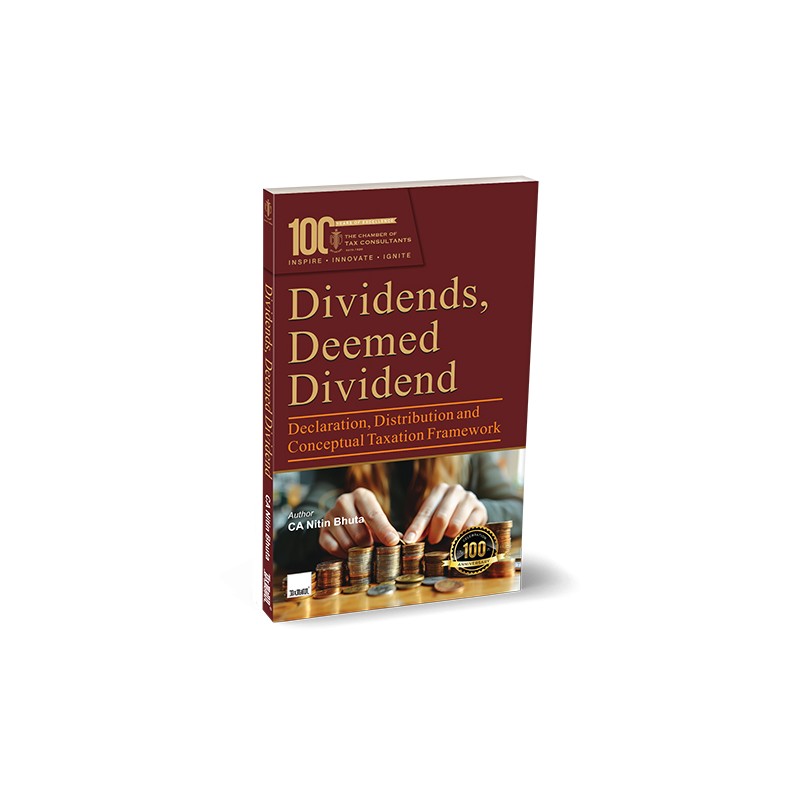
A dividend looks like the simplest transaction in corporate finance: a company earns profit, and gives some of it to its owners. That simplicity is an illusion. By the time a single rupee reaches a shareholder, it has had to survive Section 123 of the Companies Act 2013; the inclusive—and famously elastic—definition in Section 2(22) of the Income-tax Act 1961; the newly enacted Section 2(40) of the Income-tax Act 2025; a withholding obligation whose trigger point may have just moved; FEMA's Non-Debt Instruments Rules; an applicable DTAA read alongside the Multilateral Instrument; and some seventy years of accumulated judicial precedent, much of it decided on facts that no longer exist.
Dividends, Deemed Dividend—Declaration, Distribution and Conceptual Taxation Framework is CA. Nitin Bhuta's attempt—to hold all of that in a single hand. Drawing on thirty-three years of practice, the author has compressed a subject that ordinarily sprawls across three or four volumes into 142 pages of text across 21 chapters, without hollowing it out. As reviewer CA Srinivasan Anand. G. observes: 'The subject matter of a lengthy commentary running into 100s of pages in three or four volumes has been captured in a thin handy book in a concise manner.'
What makes the book distinctive is its refusal to read tax law in a vacuum. The structural insight running through it is that a defective declaration under company law is the seed of a tax dispute—so the two must be read together. The book therefore moves fluidly between the Board resolution and the assessment order, between the Register of Members and Form 27Q, between Section 52 of the Companies Act and Section 2(22)(e) of the Income-tax Act. That is how the problem actually presents itself in practice, and almost never how it is written about.
It is also, unusually, a book written from inside a transition. It does not merely note that the Income-tax Act 2025 exists—it maps it, section by section and rule by rule, against the 1961 Act, then goes further and asks the question practitioners actually need answered: do the old judgments still work? The answer given is nuanced and, importantly, hedged. Under the doctrine of continuity, precedents under ITA 1961 'would, in principle, continue to hold persuasive value' under ITA 2025—but readers are expressly advised to test each pronouncement against the revised framework before relying on it. That is a more honest position than most transition literature takes.
Above all, the book takes positions. Contested questions are framed as 'Posers' and answered with the author's own reasoned view—on whether Section 56(2)(x) is triggered on capital reduction, whether PMS fees are deductible against dividend income, whether a year-end provision for proposed dividend attracts TDS, when a dividend held up by RBI approval becomes taxable, whether Section 94(7) reaches shares acquired by gift or inheritance. Several of these views are contentious, and the author says so, flagging where a position 'is likely to be subject to scrutiny and litigation.' A practitioner can disagree with them. But they are usable—which is more than can be said of a hedge.
The book is pitched at anyone who has to make, defend, verify, or advise on a dividend decision:
· Chartered Accountants and Tax Consultants—advising on declaration, quantifying deemed dividend exposure, determining withholding, defending positions in assessment and appeal
· Advocates and Litigators—the Section 2(22) analysis is built on tracked Supreme Court and High Court precedent, indexed four ways for retrieval
· Statutory Auditors—Rule 11(f) requires the auditor's report to state 'Whether the dividend declared or paid during the year by the company is in compliance with section 123 of the Companies Act 2013.' The 44-point checklist exists to discharge precisely that duty
· Tax Auditors—direct guidance on Clause 36A of Form 3CD (deemed dividend) and its analogue Clause 48 of Form 26 under ITR 2026, including what must be reported and, pointedly, what the auditor is not required to opine on
· Company Directors and Boards—who carry the statutory obligation, and the personal exposure
· Company Secretaries and Compliance Officers—record dates, book closure, minutes, MR-3, stock exchange intimation
· CFOs and Corporate Tax Teams, especially in closely held groups where intra-group loans routinely mutate into deemed dividends
· International Tax and FEMA Practitioners—FC-GPR, FC-TRS, APR, TRC, Form 10F, beneficial ownership, POEM, MLI Article 8
· Investors, NRIs and their Advisors—dividend income, treaty relief, foreign tax credit
· Students and Academics—a coherent integrated framework rather than fragmented statutory reading
The Present Publication is the Latest Edition, commissioned by The Chambers of Tax Consultants, authored by CA. Nitin Bhuta and published exclusively by Taxmann, with the following noteworthy features:
· [Multi-disciplinary Text] Company law, tax law, FEMA and audit are read as one system. Not four subjects bolted together, but a single argument: the Articles authorise, the Board recommends, the AGM approves, the bank account segregates, the TDS crystallises, the auditor verifies, the assessee reconciles. Break the chain anywhere, and the consequences travel in every direction
· [Mapping Tables] Includes two full comparative tables—ITA 1961/IT Rules 1962 vs. ITA 2025/IT Rules 2026
· [The Core, Dissected] A 30+page forensic treatment of Section 2(22)/Section 2(40). Every sub-clause (a) through (f) is analysed for its cumulative conditions, then stress-tested scenario by scenario with the governing precedent attached
· [The Select Committee Record] Verbatim Parliamentary Select Committee proceedings on Clause 2(40). The book's most distinctive research contribution
· [Positions, Not Hedges] Contested questions posed and answered. Eleven numbered Posers across five blocks, each with the author's view, the reasoning, and, where warranted, a candid risk rating.
· [A Working Paper for Rule 11(f)] A 44-point Corporate Dividend Audit Checklist with a formal sign-off block. Segmented into Corporate Law Documentation, Income Tax Law Documentation and Any other Documentation, with Yes/No/NA, tagged document reference, and Prepared By/Reviewed By/Approved By/Working Papers Verified By. It is a working paper, not an illustration
· [Four Ways In] A 70-entry Index of Judicial Citations, Circulars and Notifications—plus an Alphabetical Judgment Index (61 judgments), a Subject-wise Index and an Income-tax Section-wise Index. Four routes into the same material
· [Thirty Treaties at a Glance] A 30-country DTAA withholding rate table, with holding-threshold conditions and allocation of taxing rights
· [Knows Its Own Limits] Demonstrates intellectual honesty about its own boundaries. The author expressly declines to litigate buy-back capital gains controversies, noting that the book 'deals exclusively with the taxation of dividends'; and concedes that cross-border dividend taxation 'could, in itself, warrant a dedicated treatise'