
- -30%
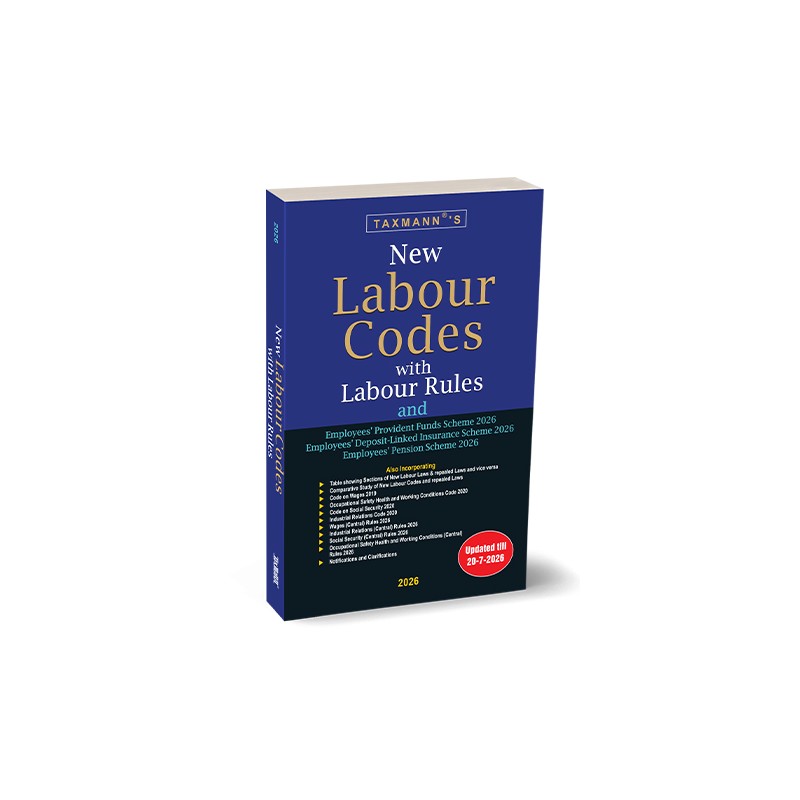
New Labour Codes with Labour Rules is a single, self-contained working volume of the new labour-law regime—the complete enforced text of all four Codes, their notified Central Rules, the Model Standing Orders, the rewritten provident fund, insurance and pension schemes, the supporting notifications, a full set of FAQs, and a practical employer handbook, gathered in one place. It exists because the regime that consolidated 29 central Acts into four Codes is now in force, and compliance work needs the operative material consolidated rather than scattered across bare acts, gazette notifications, and circulars.
The Edition is built to be used two ways:
· As the authoritative day-to-day reference for the Codes, rules, and schemes as they actually apply
· Transition manual for anyone moving off the repealed Acts
The law is stated as enforced with effect from 21-11-2025, with the central rules notified on 8-5-2026, the provident fund, insurance and pension schemes notified on 29-6-2026, and the text updated till 20-07-2026.
This book is intended for all stakeholders who require clarity, continuity, and compliance certainty under the Labour Codes framework, including:
· HR, Payroll, and Personnel Heads responsible for day-one and ongoing compliance across wages, social security, safety, and industrial relations
· Employers, Factory and Establishment Managers, and Compliance Officers transitioning from the 29 repealed central Acts
· Practising Chartered Accountants, Company Secretaries, Cost Accountants, and Advocates advising on labour and employment matters
· In-House Legal and ER Teams drafting standing orders, wage structures, registers, and policies under the new definitions
· EPFO and ESIC Compliance Teams, Provident Fund Trustees, and Exempted Establishments working to the 2026 schemes and the revised exemption, trusteeship, and online-return conditions
· Aggregators and Platform Businesses now drawn into statutory social-security obligations for the first time, at 1% to 2% of annual turnover, capped at 5% of amounts paid to gig and platform workers
· Government Officers, Inspectors-Cum-Facilitators, and Tribunal Members administering the Codes
· Faculty and Students in Law, Management, and Professional Courses studying the consolidated framework
The Present Publication is the July 2026 Edition, updated till 20-07-2026. It is authored/edited by Taxmann's Editorial Board, with the following noteworthy features:
· [Two-Way Concordance Tables] Thirty-three tables—four forward, one per Code, and twenty-nine in reverse, one for every repealed Act—so that every section of each new Code is mapped to its corresponding provision in the repealed law, and the reverse, from each old Act back to its new home. Provisions with no ancestor are flagged 'New Section'; provisions that simply lapsed are left deliberately blank, as with Equal Remuneration Act Sec. 16, Minimum Wages Act Sec. 26, and Payment of Bonus Act Secs. 33, 36, 37 and 39. Decades of precedent, circulars and internal SOPs built on the old numbering remain usable
· [Provision-by-Provision Comparative Study] Four studies running to some 131 pages, drawing out the substantive shifts against the repealed Acts—for example, bonus is now to be paid 'by crediting it in the bank account of the employee' rather than in cash [Section 39], while gross profit, further deductible sums, and set-on and set-off are left to the rules [Sections 32, 34 and 36]. Findings are carried in the headings themselves, so the change is visible before the analysis is read; each is sourced to the Parliamentary Standing Committee Report, the Statement of Objects and Reasons, or the Central Government's clarifications on the Bills; and the studies stay candid where the drafting is imperfect, noting for instance that without the missing definitions 'section 40 is unworkable'
· [Complete Notified 2026 Central Rules] Alongside the principal law: the Code on Wages, Industrial Relations, Social Security, and OSH&WC (Central) Rules, together with the Model Standing Orders and the Other Beneficiaries Medical Facilities Scheme, all gazetted 8-5-2026, so procedural detail sits with the statute. The OSH&WC Rules alone run to 186 rules, organised sector by sector for factories, mines, construction, beedi and cigar, motor transport, dock work and plantation. Between them these instruments supersede 51 predecessor rule-sets and schemes, each preamble listing them in full
· [The Three New Social Security Schemes 2026] Reproduced with every form, annexure and actuarial table—the insurance benefit reworked to a floor of ₹2,50,000 and a ceiling of ₹7,00,000, further increased by 20%; pension computed as pensionable wages multiplied by pensionable service and divided by 70, with a guaranteed minimum of ₹1,000 a month; e-Passbook and UAN-based automatic transfer obligations on employers; revised exemption, trusteeship and audit conditions; and a common accountability rule requiring claims to be settled in 20 days, failing which 12% interest is chargeable and recoverable from the Commissioner's own salary
· [Model Standing Orders in Three Sector Versions] Separate schedules for the mining, manufacturing and service sectors, each a complete set of standing orders covering classification of workers including fixed term employment, shifts, attendance, leave, service records, termination, misconduct and grievance redressal. The misconduct lists are brought up to date with sexual harassment tied to the POSH framework, and the service-sector schedule additionally provides for work from home, remote locations and virtual workplaces
· [Every Prescribed Form, Register and Return] The complete forms inventory reproduced in place—Forms I to IX with Appendices A to D under the Wages Rules, I to XVI under the Industrial Relations Rules, I to XXX under the Social Security Rules, I to XXVII with Annexures I to VII under the OSH&WC Rules, and I to XII under the Provident Funds Scheme—covering the employee register, attendance register cum muster roll, wage register, wage slip, nomination, electronic challan cum return, licence and registration applications, and the compounding forms
· [Multiple FAQ Sets] Seven sets running to 127 questions, comprising code-wise FAQs and dated official clarification sets, addressing practical questions on the 50% wage rule—with a fully worked numerical illustration—gratuity applicability dates, ESI coverage during transition, leave encashment and its carry-forward, contract-labour core and non-core activities, and whether States may levy a cess on gig and platform workers alongside aggregator contributions
· [Compliance Handbook for Employers (Central Government Sphere)] The Ministry's own handbook, chapter-wise across all four Codes with every obligation cited to its governing section: a reform-metrics summary recording 1,228 sections streamlined into 480, 1,436 rules into 351, 181 forms into 73 and 84 registers into just 8; a closing action-point checklist sorting every duty into foundational, monthly, periodical or annual, and event-based compliance; and five annexures reproducing the key definitions of wages, employee and worker, the conditions of service requiring notice of change, the 29 notifiable diseases, and the applicability schedule
· [Notifications and Clarifications] Appended to each Code, keeping supporting executive material in context, and indexed code-wise at the close of the volume with notification number, date and page
The structure of the book is as follows:
· Division One | Code on Wages 2019 — Arrangement of sections, full text, notifications
· Division Two | Industrial Relations Code 2020 — Arrangement of sections, full text, notifications
· Division Three | Code on Social Security 2020 — Arrangement of sections, full text, notifications
· Division Four | Occupational Safety, Health and Working Conditions Code, 2020 — Arrangement of sections, full text, notifications
· Division Five | Rules — The Code on Wages, Industrial Relations, Social Security, and OSH&WC (Central) Rules, 2026; the Model Standing Orders, 2026; and the Other Beneficiaries and Members of their Families Medical Facilities Scheme, 2026, all notified 8-5-2026; together with the Employees' Provident Funds Scheme, 2026, the Employees' Deposit-Linked Insurance Scheme, 2026, and the Employees' Pension Scheme, 2026, notified 29-6-2026
· Division Six | FAQs and Clarifications — The FAQ sets and the Compliance Handbook for Employers, with action-point summary, key-definition annexures, and schedules