- -30%
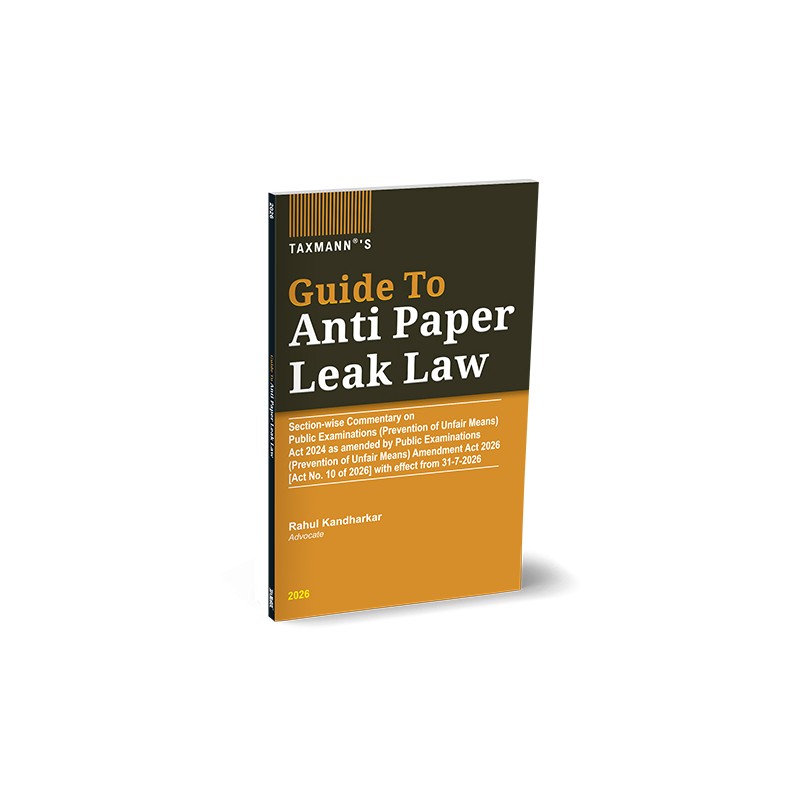
Taxmann Guide to Anti Paper Leak Law By Rahul Kandharkar Edition August 2026
Guide to Anti Paper Leak Law is a section-wise commentary on India's dedicated central legislation against examination malpractice—the Public Examinations (Prevention of Unfair Means) Act 2024—presented in its fully amended form following the Amendment Act of 2026. The book reproduces each section in its currently amended text and follows it with a structured analytical commentary supported by judicial precedents, covering the ingredients of every offence, its classification, the punishment attracted, the statutory duty to report, and the provision's interaction with the Bharatiya Nyaya Sanhita 2023, the Bharatiya Nagarik Suraksha Sanhita 2023 and the Bharatiya Sakshya Adhiniyam 2023.
Since the Act has yet to generate a substantial body of case law of its own, the commentary draws extensively on settled jurisprudence from cognate special statutes and the general criminal law, applying it to provisions no court has yet had occasion to construe. The volume is self-contained: every instrument the commentary cross-refers to—the amending Act, the Rules with their prescribed forms, the Statement of Objects and Reasons, the Criminal Law (Amendment) Ordinance 1944, and the allied definitional provisions—is reproduced in the appendices.
This book is intended for the following audience:
· Advocates & Criminal Law Practitioners—appearing in prosecutions and defences under the Act, including before the newly designated Special Fast Track Courts and in bail and appeal matters before the High Court
· Special Public Prosecutors & Public Prosecutors—appointed for Special Fast Track Courts under the Act read with the Bharatiya Nagarik Suraksha Sanhita 2023
· Judges & Judicial Officers—of Courts of Session designated as Special Fast Track Courts, and High Court Benches hearing appeals under the Act
· Investigating Officers—of and above the rank of Deputy Superintendent of Police or Assistant Commissioner of Police, officers of Central Investigating Agencies, and members of any Special Task Force constituted by the Central Government
· Public Examination Authorities—UPSC, Staff Selection Commission, Railway Recruitment Boards, IBPS, the National Testing Agency and the Ministries and Departments of the Central Government, along with their legal, vigilance and examination-conduct wings
· Service Providers & Examination Vendors—together with their Directors, Senior Management, in-charge personnel, compliance officers and in-house counsel
· Centre Coordinators, Regional Officers & Venue In-charges—who carry statutory reporting obligations under the Rules
· State Governments & Union Territory Administrations—designating Special Fast Track Courts, appointing Special Public Prosecutors, and framing State-level legislation on the model of the Act
· Academicians, Research Scholars & Students—of criminal law, education law and public administration, and candidates preparing for competitive and judicial services examinations
The Present Publication is the 2026 Edition, amended by the Public Examinations (Prevention of Unfair Means) Amendment Act 2026 [Act No. 10 of 2026] with effect from 31-7-2026. The law stated in this book is as updated till 31st July 2026. This book is authored by Advocate Rahul Kandharkar, with the following noteworthy features:
· [Amended & Updated] Every section is reproduced in its currently amended text, incorporating all amendments made by the 2026 Amendment Act to Sections 10, 11 and 12 and the newly inserted Sections 12A and 12B
· [Integrated Amendment Tracking] Amended words appear in italics within editorial brackets, footnoted on the same page with the exact language they replaced, the amending Act and the effective date—enabling the book to be used for offences committed both before and after 31-7-2026, since the enhanced punishments operate only prospectively
· [Section-wise Commentary] Each section is followed by a boxed 'Comments' apparatus containing decimal-numbered Section Notes running to three levels of depth, with sub-headings framed as the questions a practitioner would ask of the provision
· [Backed by Judicial Precedents] 216 numbered footnotes citing over 200 judicial decisions with full parallel citations, extending from the Privy Council and the earliest Supreme Court benches to judgments reported in 2026
· [Ready Reckoner] A 27-question 'An Overview' primer at the front of the book, answering the core questions on the Act in plain language
· [Rules of Interpretation] A dedicated treatment of the canons of construction applicable to a new penal statute—plain meaning, strict construction of penal provisions, and the evidentiary limits of the Statement of Objects and Reasons and the Preamble
· [Exhaustive Treatment of Definitions] The commentary on Section 2 extends to 48 pages, analysing each defined term separately, with detailed treatment of 'organised crime', 'conspiracy', 'wrongful gain', 'notification' and 'person associated with a service provider'
· [Tabular Presentation] Including a table mapping every expression used but not defined in the Act to its source definition in the General Clauses Act 1897, the Indian Contract Act 1872, the Companies Act 2013, the Bharatiya Nyaya Sanhita 2023 and the Bharatiya Nagarik Suraksha Sanhita 2023, and an agency-wise table of the statutory investigation deadlines
· [Critical Analysis] The author identifies drafting infirmities in the amended provisions, including the dilution of the appeal time-limit, a defined term that finds no use in any operative provision, and the absence of any enabling provision for phased commencement
· [Self-contained] Six appendices reproducing the amending Act, the Public Examinations (Prevention of Unfair Means) Rules 2024 with Forms 1 and 2, the Statement of Objects and Reasons, the Criminal Law (Amendment) Ordinance 1944, Section 112 of the Bharatiya Nyaya Sanhita 2023, and the allied provisions of the Information Technology Act 2000, the Companies Act 2013 and the Limited Liability Partnership Act 2008
· [Subject Index] A concept-wise index with pinpoint section references, supported by running heads carrying the section number, chapter name and Act name
The coverage of the book is as follows:
· Chapter I | Preliminary — Sections 1 & 2
o The largest segment of the commentary, at 61 pages. The commentary on Section 1 covers the assent and enforcement history of the Act, the aims and objects drawn from the Statement of Objects and Reasons, a clause-by-clause account of the amendments made by the 2026 Amendment Act, and an extended treatment of the rules of statutory interpretation applicable to a new penal statute. The commentary on Section 2 extends to 48 pages—nearly half the entire commentary—analysing each defined term in a separate titled block, with the most detailed treatment reserved for organised crime, conspiracy, wrongful gain, notification and person associated with a service provider, and closing with a table mapping every expression used but not defined in the Act to its source definition in five other statutes
· Chapter II | Unfair Means and Offences — Sections 3 to 8
o Commentary on the six offence-creating provisions, each analysed to a uniform template covering the ingredients of the offence, the punishment attracted, its classification as cognizable, non-bailable and non-compoundable, its status as a Scheduled offence under the Criminal Law (Amendment) Ordinance 1944, and the resulting exposure to attachment and forfeiture of property. Includes the analysis of the two limbs of the definition of unfair means and the fifteen illustrative acts enumerated in Section 3, and of the statutory duty to report
· Chapter III | Punishment for Offences — Sections 9 to 11
o Commentary on the classification of offences and on the sentencing regime as enhanced by the 2026 Amendment Act, covering the position of candidates outside the penal purview of the Act, the additional and cumulative liability of service providers, the personal liability of Directors and Senior Management, the statutory due-diligence defence, and the attachment and forfeiture of institutional property in cases of organised crime. Supported by an extended treatment of the duty to register an FIR and of the law on compounding and quashing under the Bharatiya Nagarik Suraksha Sanhita 2023
· Chapter IV | Inquiry and Investigation — Sections 12, 12A & 12B
o The commentary on the two newly inserted sections, and the book's principal claim to currency. Covers the agencies competent to investigate and the consequences of investigation by an officer who is not; the statutory investigation deadlines, tabulated agency-wise with the trigger date for each; the designation, jurisdiction and day-to-day trial obligations of Special Fast Track Courts, examined against the Special Court jurisprudence developed under other special legislation; the transfer of pending trials; the appointment, eligibility and independence of Special Public Prosecutors; and the new appeal mechanism, including the limitation period and the law on sufficient cause
· Chapter V | Miscellaneous — Sections 13 to 18
o Commentary on public-servant status and the requirement of sanction; on the protection for action taken in good faith, including the divergence between the test under the Bharatiya Nyaya Sanhita 2023 and that under the General Clauses Act 1897; on the Act's operation in addition to and in override of other laws; and on the limits of the rule-making and difficulty-removal powers
· Chapter VI | Amendment to the Criminal Law (Amendment) Ordinance 1944 — Section 19
o How offences under the Act were brought within the Schedule to the 1944 Ordinance, and the consequences for attachment, forfeiture and sale of an offender's property
· Schedule | Subject Index
o The public examination authorities covered by the Act, followed by a concept-wise index with pinpoint section references
· Appendices I to VI
o 28 pages of allied material, reproducing the definitional provisions borrowed from the Information Technology Act 2000, the Companies Act 2013 and the Limited Liability Partnership Act 2008; the full text of the Public Examinations (Prevention of Unfair Means) Amendment Act 2026; the Statement of Objects and Reasons; the Criminal Law (Amendment) Ordinance 1944 in full, including its attachment machinery and Schedule; Section 112 of the Bharatiya Nyaya Sanhita 2023 as applicable w.e.f. 1-7-2024; and the Public Examinations (Prevention of Unfair Means) Rules 2024 across all eight chapters, together with Form 1 and Form 2
The book follows the architecture of the statute, so that a reader navigates by section number rather than by theme—the preliminary pages and the overview, followed by the Act chapter by chapter and section by section, then the Schedule, the Subject Index and six appendices. Every section is presented to the same five-part pattern:
· The Amended Bare Text of the Section — Reproduced as it now stands, with matter inserted or substituted by the 2026 Amendment Act set in italics within editorial brackets
· Footnotes Recording the Amendment History — Identifying the words replaced, the amending Act and the date of effect, immediately below the provision they relate to
· A Boxed 'COMMENTS' Heading, Followed by 'SECTION NOTES' — Separating the statutory text from the commentary on every page
· Decimal-Numbered Analytical Paragraphs — Running to three levels of depth, each addressing one discrete question, with sub-headings frequently framed as the questions a practitioner would put to the provision
· Running Footnote Citations and Cross-References — Carrying the supporting precedents with full parallel citations, and directing the reader to related sections, the Rules and the appendices
Because the pattern does not vary from section to section, a reader who has worked through one provision knows precisely where to look in every other—a considerable advantage in a volume intended for consultation rather than continuous reading. Retrieval is further supported by a concept-wise Subject Index with pinpoint section references, and by running heads carrying the section number, the chapter name and the name of the Act across every spread.