
- -30%
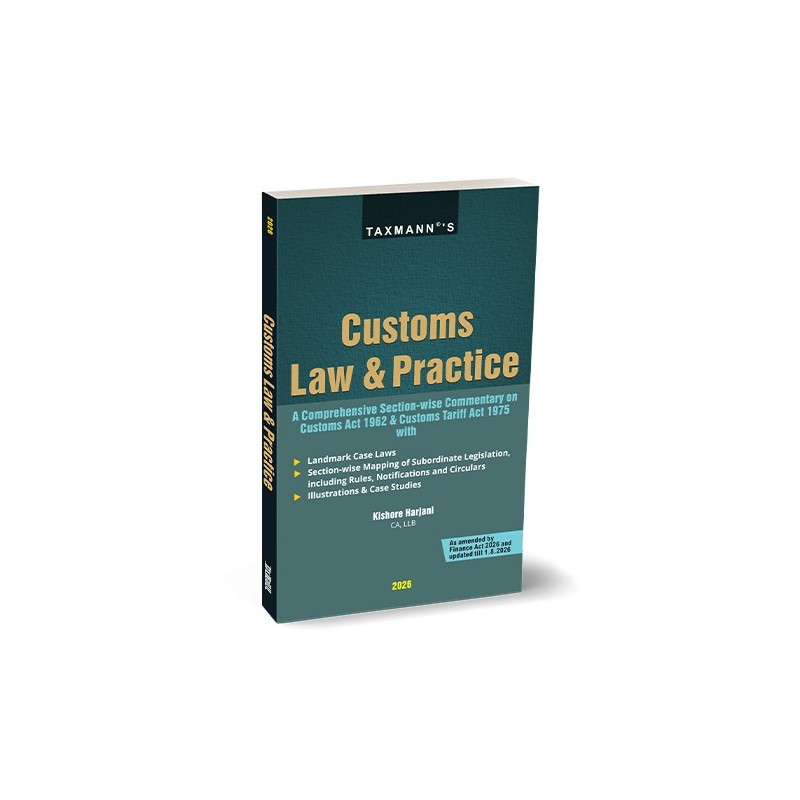
Taxmann Customs Law & Practice By Kishore Harjani Edition August 2026
Customs Law & Practice is conceived as a practical, research-oriented and citation-friendly single-volume commentary on India's customs law. It brings together the Customs Act 1962 and the Customs Tariff Act 1975 in a structured, section-wise format, so that the practitioner does not have to move between multiple books, notifications, circulars, rules and case-law sources to understand the law applicable to a particular provision.
The underlying philosophy of the publication is simple: the bare statute provides the text of the law, whereas effective professional practice requires much more. The commentary therefore places the statutory provision alongside its amendment history, detailed analysis, judicial interpretation, subordinate legislation, departmental circulars and practical illustrations wherever computation, timing, classification or characterisation can materially affect the outcome. The result is a consolidated reference work designed to move seamlessly from the text of the law to its practical application.
The publication is equally relevant to professionals seeking a quick answer and to researchers who need to trace an issue comprehensively. Its consistent presentation makes it easy to locate the statutory provision, understand its legislative history, identify the relevant rules and regulations, review the departmental position and examine the leading judicial authorities. The approach is particularly useful for advisory assignments, litigation, audits, investigations, assessments, refund and drawback matters, as well as day-to-day import and export compliance.
For litigators and counsel, the commentary is structured to facilitate drafting of replies, appeals, written submissions and legal opinions. For tax and trade professionals, it provides a consolidated bridge between the statutory framework and the subordinate legislation and administrative guidance that govern actual customs practice. For corporates and in-house teams, it serves as a dependable desk reference for identifying legal exposure and evaluating compliance positions. This book is intended for the following audience:
· Chartered Accountants, Cost Accountants and Company Secretaries — Useful for customs advisory, opinions, refund and drawback claims, audits, assessments and broader indirect-tax assignments
· Advocates and Litigation Counsel — A practical research aid for preparing replies, appeals, written submissions and arguments, supported by mapped case-law and analytical commentary
· Customs Brokers, Freight Forwarders, Custodians and Logistics Professionals — Helps navigate licensing, manifests, transhipment, custodial responsibilities, cargo facilities and other operational obligations
· Importers, Exporters and EXIM/Trade-Compliance Teams — Supports day-to-day customs clearances, origin claims, bonded operations, duty deferment, amendments and post-clearance compliance
· In-house Finance, Tax and Legal Teams — Provides an integrated reference for valuation, related-party transactions, AEO matters, provisional assessment, audit and investigation exposure
· Customs and Departmental Officers — A consolidated reference for understanding statutory powers, jurisdiction, adjudication and penal provisions alongside the operative administrative framework
· Academicians, Students and Researchers — A useful source for structured study and deeper research in customs law, indirect taxation and international trade
· Trade Policy and FTA Professionals — Brings together the relevant Rules of Origin and connects them with the broader customs framework
The Present Publication is the 2026 Edition, as amended by the Finance Act 2026 and updated till 1st August 2026. It is authored by Kishore Harjani, and is structured to provide a current and reliable statement of the law while retaining the historical trail necessary for understanding how the provisions have evolved. The book carries the following noteworthy features:
· [Comprehensive Section-wise Coverage] Detailed commentary on the Customs Act 1962 and the Customs Tariff Act 1975, including provisions that have been omitted, with appropriate reference to their earlier statutory position wherever relevant
· [Complete Amendment Trail] The legislative history of provisions is carefully tracked through amendments, insertions, substitutions, omissions and renumbering. Where historical wording is material, the earlier position is also retained so that the law applicable at a particular point in time can be reconstructed
· [Strong Judicial Perspective] Landmark judicial rulings and supporting decisions are brought together with the relevant propositions mapped to the provisions they interpret—making the case-law component practical rather than merely a list of authorities
· [The Statute-to-Rule Bridge] Relevant rules and regulations framed under statutory provisions are systematically mapped, allowing readers to move directly from the enabling provision to the delegated legislation that gives it practical effect
· [Circulars and Departmental Guidance] Relevant CBIC circulars and instructions are presented substantively, explaining the administrative position and its practical significance, with references for verification. In all, 325 distinct circulars, 182 notifications and 115 instructions are cited. Important instruments issued by other authorities are also brought together where they influence customs practice
· [Practical Illustrations] 138 worked illustrations are incorporated at provisions where calculations, timelines, procedural requirements or legal characterisation can change the result. These examples translate technical provisions into practical fact situations
· [Finance Act 2026 Guide] A dedicated opening section explains the customs-related amendments made by the Finance Act, 2026, including commencement and comparative treatment, making the latest legislative changes easier to understand
· [Rules of Origin] 18 separate Rules of Origin frameworks are consolidated, from the GSTP Rules of 1989 through to the India–UK CETA Rules 2026, enabling professionals dealing with preferential trade agreements and origin claims to access the applicable rules in a single reference
· [Rules, Regulations and Statutory Forms] Thirty-six sets of subordinate legislation are reproduced in an accessible arrangement, together with important forms, annexures and appendices, reducing the need to consult multiple external sources while working through the commentary
· [Customs Tariff with Interpretative Framework] The Customs Tariff Act commentary is supplemented by the General Rules for Interpretation, explanatory material, units and abbreviations and the Export Tariff, supported by examples and relevant authority
· [Additional Practical Materials] A dedicated compilation of common circulars and related administrative instruments issued by authorities such as RBI, CBDT, FSSAI and others is included where such material intersects with customs practice
The book is arranged in three broad divisions to create a logical progression from the principal statutes to the subordinate legislative framework, and—within the two commentary divisions—on a single presentation template that repeats without variation from the first section to the last.
· Three Integrated Divisions
o Division One | Customs Act 1962 — The Arrangement of Sections, then the full text of the Act with detailed section-wise notes under every provision, closing with supporting finding aids
o Division Two | Customs Tariff Act 1975 — The Arrangement of Sections and the text with section notes, followed by the General Rules for Interpretation, the explanatory notes and the Export Tariff
o Division Three | Rules & Regulations — Thirty-six sets of subordinate legislation in a consolidated format, each with its arrangement of rules, forms and annexures
· A Consistent Template Throughout the Commentary — Each statutory provision follows a uniform presentation designed to make research faster and more intuitive
o Statutory Text — The provision as currently in force, under its marginal heading
o Amendment Trail — The full record of substitutions, insertions, omissions and renumbering, with the superseded text retained where it is material
o Analytical Commentary — Depending on the provision, this brings together section notes, landmark rulings, relevant rules and regulations, departmental circulars and practical illustrations. The architecture allows the reader to understand not only what the provision says, but also how it operates in practice
· Illustration Architecture
o Each set of illustrations walks through a provision's full practical life cycle rather than sampling it. Under Section 129E, for instance, the sequence runs: pre-deposit at the first appellate stage; pre-deposit at the Tribunal stage; cumulative computation across both; the statutory monetary cap; the transitional saving for matters already pending; and recovery of the deposit on success—six numbered fact patterns on a single page, covering the question end to end
With its combination of statutory text, legislative history, analytical commentary, case law, subordinate legislation, departmental guidance and practical illustrations, Customs Law & Practice is designed to serve as a comprehensive professional companion for anyone working with Indian customs law. For professionals who require more than the bare text of the law, this edition offers a structured route from provision to proposition, from proposition to authority, and from authority to practical application.