- -10%
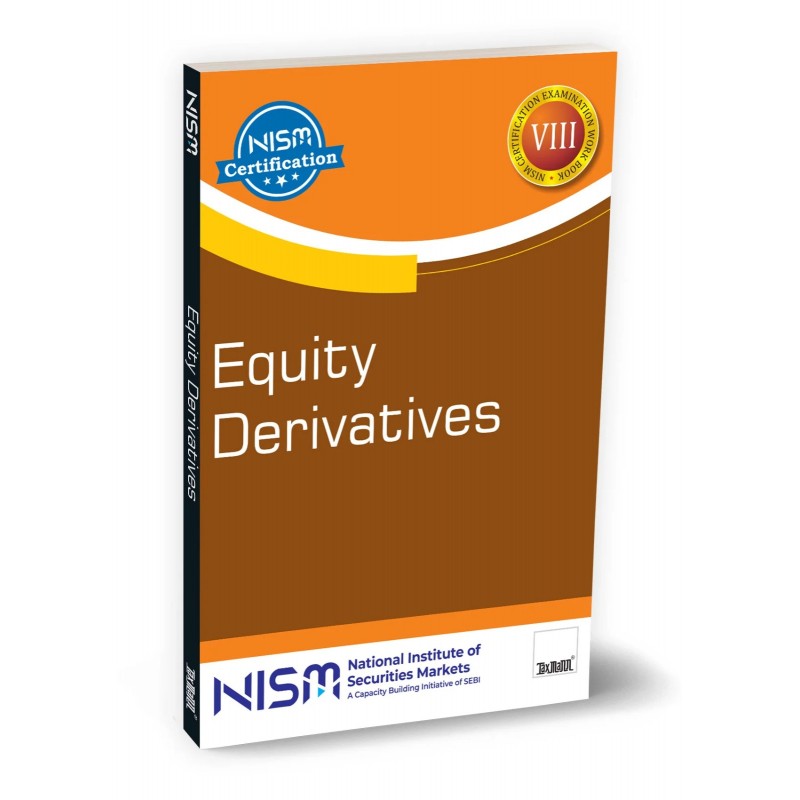
Equity Derivatives National Institute of Securities Markets Edition 2026
Equity Derivatives is a complete, self-contained textbook on the Indian equity derivatives market, written by the National Institute of Securities Markets (NISM) and published by Taxmann. The book covers the basics of equity derivatives, trading strategies using equity futures and equity options, clearing, settlement and risk management, and the regulatory environment in which the equity derivatives markets operate in India. Across ten chapters it builds from the ground up—what a derivative is and how these markets evolved, how a stock index is constructed and maintained, how futures and options contracts are specified, priced and settled, how a dozen distinct option strategies are assembled and what each pays off, how orders are matched and margins computed on an Indian exchange, and finally how the whole edifice is governed, accounted for, taxed and policed.
Its distinguishing quality is method. Concepts are never left abstract. Contract specifications are dissected against live NSE and BSE quotes. The four index-weighting methodologies are computed side by side from a single data set, so the reader can see precisely how the choice of method changes the answer. Every hedge is run through both a rising and a falling market, demonstrating that the effective price is locked either way. Each option strategy arrives with a strike-and-premium table, a payoff computed at successive spot levels, an identified break-even, and a chart—and the strategies are taught as extensions of one another, a collar as an extension of the covered call, a butterfly as a short straddle with its tails capped. The book is candid about the limits of the page, too: it tells the reader that the best way to understand the trading mechanism is to watch a live screen, and that horizontal and diagonal spreads simply cannot be drawn as payoff diagrams.
This March 2026 version is written against SEBI’s recent overhaul of the equity derivatives framework, with footnoted circular references running to February 2026: the expiry-day rationalisation under which NSE has adopted Tuesday and BSE Thursday, the rise in minimum contract value to ₹15 lakh, the delta-adjusted Future Equivalent Open Interest formulation, the tightened algorithmic trading rules, the phased Cyber Security & Cyber Resilience Framework, STT rates drawn from the Union Budget 2026-27, and a margin change that takes effect only on 5th May 2026. Because each regulatory statement is footnoted to its source circular number and date, the book doubles as a reference whose every position can be independently checked.
The Present Publication is the March 2026 Workbook Version, developed by NISM Certification Team with subject matter expert Dr. Aparna Bhat; reviewed by the Examination Committee comprising stock exchange representatives and industry experts. It is published exclusively by Taxmann, with the following noteworthy features:
The coverage of the book is as follows:
Every chapter is built on the same internal skeleton, so a reader who learns to navigate one can navigate all ten.
National Institute of Securities Markets : The National Institute of Securities Markets (NISM) is an educational institution established in 2006 by the Securities and Exchange Board of India (SEBI), the regulator of India’s securities markets. Its creation followed the Union Finance Minister’s 2005–06 Budget announcement, which called for an institution dedicated to teaching, training, and conducting research in the securities markets. Guided by its vision to ‘lead, catalyse, and deliver educational initiatives that enhance the quality of securities markets,’ NISM offers a spectrum of capacity-building programs, ranging from basic financial literacy workshops to full-time postgraduate courses. Six Schools of Excellence drive its mission: the School for Certification of Intermediaries, the School for Securities Education, the School for Investor Education and Financial Literacy, the School for Regulatory Studies and Supervision, the School for Corporate Governance, and the School for Securities Information and Research. These Schools collaborate to professionalise the securities markets further.