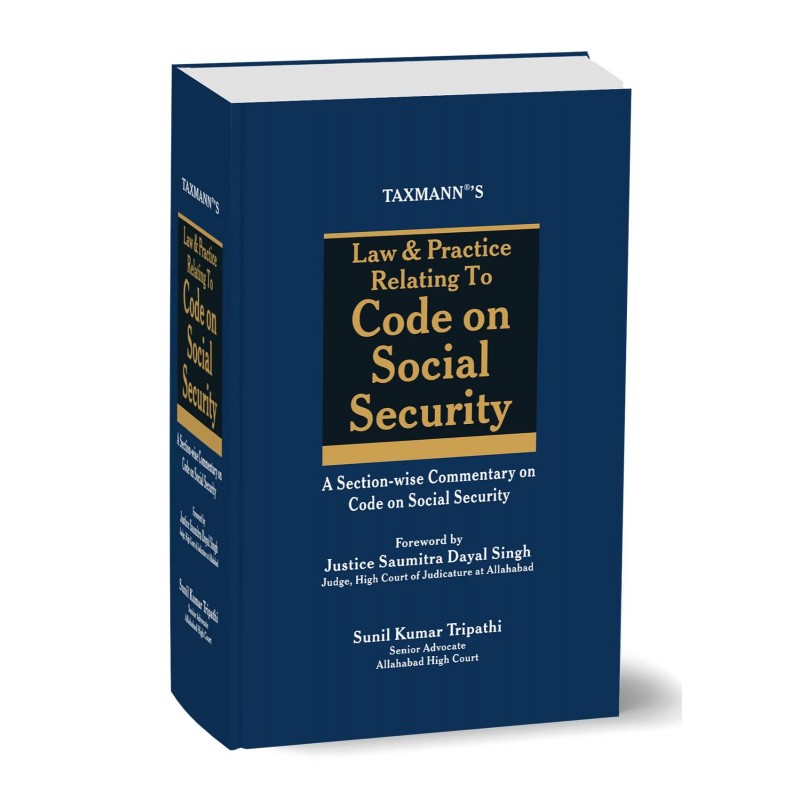
Law & Practice Relating to Code on Social Security Edition 2026
Law & Practice Relating to Code on Social Security Edition 2026
Description
Law & Practice Relating to Code on Social Security is the flagship commentary on the new labour codes—a section-wise treatment of all 164 sections, seven Schedules and the allied 2026 Rules and Schemes, written by a Senior Advocate with nearly five decades at the labour bar.
Its organising idea is comparison. The Code subsumes nine of India’s most heavily litigated welfare statutes, and with enforcement from 21-11-2025, a vast body of accrued rights and part-heard litigation still runs on the repealed Acts. So, for every provision that has a predecessor, this book prints the Code’s text and the old text side by side in a two-column table, section by section—letting the reader see at once what has been carried over, what has been reworded, what has been dropped, and what is new. Where a provision has no ancestor, the book says so expressly. Nine Act-wise concordance tables run the same mapping in reverse, so a practitioner holding a 1952 or 1948 authority can find where it now lives.
Around that spine sits a consistent analytical apparatus: a boxed roadmap at the head of every section, a bulleted digest under Provisions in a Nutshell, and decimal-numbered Comments carrying the case law—with a 30-page List of Cases and a 49-page Subject Index both keyed to paragraph numbers rather than pages, so a query resolves to the exact discussion.
The Present Publication is the 1st Edition, updated till 20th July 2026. It is authored by Sunil Kumar Tripathi, with the following noteworthy features:
- [The Comparative Study—The Book’s Defining Feature] Under the heading ‘Comparative Study of Provisions of Code on Social Security, 2020 & Old Labour Laws,’ every provision is placed in a two-column table against the provision it replaces. Where one Code section absorbs several old ones, all are set out in sequence—section 133 is compared against nine provisions drawn from seven different repealed Acts. Where nothing precedes it, the book records the fact expressly. Even the Schedules get this treatment
- [Nine Act-wise Concordance Tables] They map each repealed statute into the Code section by section, with blank entries marking old provisions that have no counterpart—the single most useful page-turn for anyone carrying forward a pending matter. A master table runs the mapping the other way
- [206 Pages on the Definitions Alone] Section 2’s 91 definitions are treated clause by clause—each with its own Overview box, comparative table, Section Notes and Comments. Definitions are the battleground of coverage litigation, and this is the depth the subject warrants
- [An ‘Overview of Section’ Box for Every Provision] A boxed roadmap listing each discussion point against its paragraph number, so a 2,000-page volume can be entered at exactly the right paragraph
- [Section Notes: ‘Provisions in a Nutshell’] A crisp bulleted digest of every section, with summary tables built by the author where the statute is hard to hold in the head: a four-row compensation matrix under section 76 supported by nine explanatory Notes, and a table under section 133 setting each offence against its punishment and its compoundability
- [Paragraph-numbered Analytical Comments] Decimal-numbered paragraphs opening with a Prelude and an Analysis of Section, then working through each practical theme separately, with the authority footnoted on the page
- [Deep Judicial Support] A 30-page List of Cases keyed to paragraph numbers, running from foundational Supreme Court authority to High Court decisions of 2026, with parallel citations across the standard labour reporters
- [Legislative Intent, Quoted] Where a question is contested, the author reproduces the Ministry of Labour’s clarifications to the 9th Report of the Standing Committee on Labour verbatim, so the reader sees the source rather than a gloss on it
- [Interpretive Scholarship Where It Matters] The treatment of repeal and savings draws on Halsbury’s Laws of England, Maxwell on the Interpretation of Statutes and Crawford on Statutory Construction; definitions are tested against P. Ramanatha Aiyar’s Concise Law Dictionary and The Law Lexicon
- [Rules Printed with the Section] The applicable rule of the Social Security (Central) Rules 2026 sits immediately below the parent section, with its Form named, so statute, machinery and paperwork are read as one
- [Alert to Collateral Change] Cross-references track the replacement of the IPC and CrPC by the Bharatiya Nyaya Sanhita and Bharatiya Nagarik Suraksha Sanhita 2023, and align registers and returns with the Code on Wages 2019 and the OSH Code 2020, so one unified compliance set serves all the Codes
- [Six Appendices] The complete allied subordinate legislation, the text of other Acts the Code refers to, and 43 notifications
- [Subject Index] Indexed by section heading with paragraph-level references
This is what distinguishes this commentary. Every section—and every definition, and every Schedule—is worked through the same template, of up to six layers, applied consistently across all 164 sections:
- Bare Text of the Provision, in full, with enforcement footnotes recording the exact date each provision came into force—essential while the Code is being switched on in tranches—and cross-references to the allied statutes carried in Appendix 5
- Relevant Rules, printed immediately below, with the operative Form named
- Overview of Section — A boxed roadmap listing the Comparative Study, the Section Notes and every numbered Comment, each against its paragraph number
- Comparative Study — The corresponding provisions, then the side-by-side table. Where there is no predecessor, this layer is replaced by an express statement to that effect
- Section Notes — ‘Provisions in a nutshell,’ then sub-headed bullets on each operative limb, with the author’s own summary tables and any Standing Committee material
- Comments — The analytical core, in decimal-numbered paragraphs, opening with a Prelude and an Analysis of Section and then taking each practical theme in turn
What that yields in practice can be seen at section 125, the assessment provision—eighteen pages for a single section. Bare text with enforcement footnote, then the Overview box, then a comparative table against section 7A of the EPF Act and section 45A of the ESI Act, then the Section Notes, and then fifteen numbered Comments moving from Prelude and Analysis of Section through limitation, enquiry timelines, extension, pending enquiries, powers in enquiry, nature of enquiry, ex parte proceedings and restoration—closing with two consolidated case-law paragraphs that gather the authorities on best-judgment assessment, speaking orders, natural justice, impleadment, and the functional-integrality and managerial-control tests for clubbing establishments.
Because the List of Cases and the Subject Index are both keyed to paragraph numbers, the book can be entered from either end: from a known authority to the passage that applies it, or from a practical question to the paragraph that answers it.
About the Author
Mr Sunil Kumar Tripathi is a Senior Advocate and one of India’s leading authorities on labour and industrial law, with nearly five decades at the Bar. A graduate in Law (LL.B.) of Banaras Hindu University (1976), he enrolled with the Bar Council of Uttar Pradesh in 1977 and practised before Labour Authorities, Labour Courts and Industrial Tribunals across the country. Since 2001 he has appeared before the Allahabad High Court.