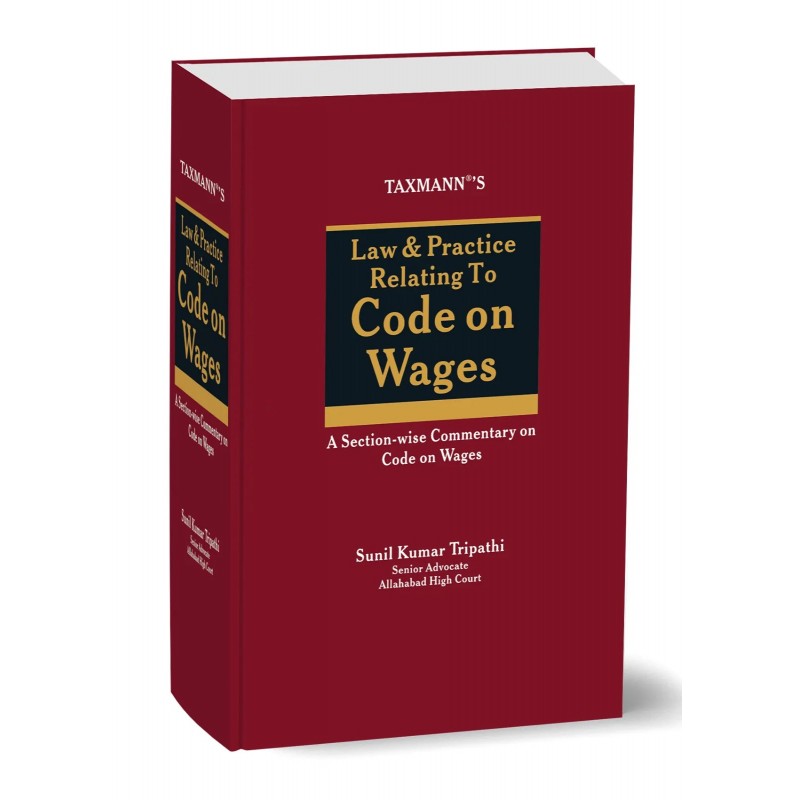
Law & Practice Relating to Code on Wages Edition August 2026
Law & Practice Relating to Code on Wages Edition August 2026
Description
Law & Practice Relating to Code on Wages is a section-wise commentary on the Code on Wages 2019, the Code by which Parliament has subsumed and repealed the Payment of Wages Act 1936, the Minimum Wages Act 1948, the Payment of Bonus Act 1965 and the Equal Remuneration Act 1976.
Three characteristics distinguish the work.
It states the law after enforcement and after the Rules. This volume is written after the Code came into force on 21st November 2025 and after the Wages (Central) Rules 2026 were notified on 8th May 2026. The law is stated as on 20th July 2026, and the commentary already considers the earliest judicial pronouncements upon the transition, delivered in 2026 by four High Courts and by the Supreme Court.
Its organising method is comparison, applied provision by provision. Under a standing heading, each unit sets the text of the Code beside the full text of the provision or provisions it has replaced, in a two-column table prefaced by an express statement of corresponding provisions. Where a provision has no antecedent, the commentary records that fact: thirteen are noted as having no corresponding section in the repealed enactments, four of them designated New Section in the concordance tables. For the reader required to determine how much of nearly nine decades of accumulated authority survives re-enactment, this apparatus is the principal aid the work affords.
It is arranged as ninety-five self-contained commentary units rather than sixty-nine. Each of the Code’s 69 sections receives its own treatment, and Section 2 is further divided into 26 separate mini-commentaries, one for every defined term from accounting year to worker. All ninety-five units carry a boxed Overview and analytical Comments; ninety-four further carry a comparative table and Section Notes.
The commentary extends to 625 decimal-numbered paragraphs, numbered continuously and without omission across all sixty-nine sections, so that any proposition may be cited with precision. It is supported by a List of Cases of 344 entries and by more than 430 case citations in the footnotes.
The Present Publication is the 1st Edition, updated till 20th July 2026. It is authored by Sunil Kumar Tripathi, with the following noteworthy features:
- [Ninety-five Self-contained Commentary Units] All 69 sections, together with all 26 terms defined in Section 2, each furnished with its own Overview box and Comments; ninety-four additionally carry a comparative table and Section Notes
- [A Two-column Comparative Table in Almost Every Unit] The text of the Code set against the full text of the superseded provision or provisions, prefaced by an express statement of corresponding provisions identifying every predecessor section. Section 26, for example, is mapped to six sections of the Payment of Bonus Act 1965, and Section 45 to provisions of all four repealed enactments
- [Express Identification of New and of Omitted Provisions] Four provisions are designated New Section in the concordance tables, and thirteen in all are recorded in the commentary as having no antecedent. The introductory tables disclose equally what the Code has not carried forward, including scheduled employment, the definitions of adolescent, adult and child, the power to add to the Schedule, the correction of errors, and several heads of deduction
- [Five Bidirectional Concordance Tables] From the Code to the repealed enactments, and separately from the Equal Remuneration Act 1976, the Minimum Wages Act 1948, the Payment of Bonus Act 1965 and the Payment of Wages Act 1936 to the Code, so that the reader is directed to the corresponding provision from whichever enactment he approaches
- [The Earliest Judicial Consideration of the Transition] The commentary upon repeal and savings examines six decisions of 2026 upon what survives the repeal—Tech Mahindra Ltd. v. Union of India (Bom. HC), United Labour Federation v. Union of India (Mad. HC), N.A. Sebastian v. Union of India (Del. HC), Glastronix LLP v. Glastronix Karmika Sangha (Karn. HC), Salem Mandala Manuneddhi Amaipuchara Mattrum Kattumana Thozhirchanga M v. Government of Tamil Nadu (Mad. HC) and Union of India v. Heavy Vehicles Factory Employees’ Union (SC)—each considered against the relevant paragraph
- [A Full Interpretive and Constitutional Apparatus] Eight opening paragraphs furnish the interpretive tools before the definitions are approached: the office of a definition clause, restrictive as against extensive definitions, provisos, the distinction between proviso, exception and saving clause, explanations, schedules, transitional provisions, and the expression ‘unless the context otherwise requires’. Section 62 adds ten paragraphs upon delegated legislation and Section 69 eleven upon repeal and savings
- [The Central Rules Placed at the Point of Use] Nine inline Relevant Rules blocks reproduce the operative rule immediately beneath the section it implements: Rules 3 and 4 under Section 6; Rules 5 and 6 under Section 13; Rule 8 under Section 14; Rules 19 and 20 under Section 23; Rules 24 to 26 under Section 32; Rules 27 and 28 under Section 36; Rules 29 to 44 under Section 42; Rules 46 and 47 under Section 44; and Rules 48, 51 and 52 under Section 50
- [Dates of Enforcement Recorded on the Face of the Text] Seventy-seven footnotes record the date upon which each provision came into force: seventy-three referable to the general date of enforcement and four to the earlier commencement of the provisions relating to the Advisory Board
- [Overview Boxes as a Navigational Layer] Each unit opens with a boxed map of its contents, listing the comparative study, the section notes, the FAQs and every numbered Comment with its paragraph reference, so that the volume serves for rapid consultation as readily as for continuous reading
- [Cross-Code Treatment Where the Definitions Require It] Because the Code adopts terms from enactments themselves subsumed elsewhere, the commentary traces each borrowed definition into the Occupational Safety, Health and Working Conditions Code 2020, the Industrial Relations Code 2020 and the Code on Social Security 2020, including one term the Code employs but does not define, upon which the author advances his own suggested resolution
- [The Central Government’s Clarifications, Reproduced at the Relevant Sections] Nine blocks carry the Government’s clarifications, Q1 to Q12, against the sections to which they relate, together with the Government’s own worked illustration of the fifty per cent allowance rule, which demonstrates numerically how an excess allowance is added back and what figure then governs statutory calculation
- [Forty-nine Summaries and Nineteen Worked Examples] Each provision is preceded by a bulleted statement of its requirements, and nineteen worked examples address the provisions of greatest computational difficulty, among them substituted rest days, the divisor governing a rest-day wage, the deadline applicable to each species of wage period, the ceiling upon fines and the period for their recovery, and the order in which set-on and set-off from earlier accounting years fall to be applied
- [A Ten-year Set-on and Set-off Computation, Reproduced and Explained] Appendix A to the Central Rules is set out in full and then traced year by year, including years of loss
- [Annexures for Practical Use] The Wages (Central) Rules 2026 complete with all nine Forms; extracts from eleven further enactments referred to in the Code, with notes bridging the Indian Penal Code, the Code of Criminal Procedure and the Income-tax Act to their successors of 2023 and 2025; and twelve notifications
- [Three Modes of Access] A List of Cases of 344 entries across fourteen pages, a Subject Index of eighteen pages, and the section-wise arrangement itself, so that the work may be approached from the authority, from the subject or from the statute
The work follows the architecture of the Code, from Chapter I to Chapter IX and from Section 1 to Section 69, and applies a uniform seven-layer treatment to each of its ninety-five units:
- Layer 1 — Bare Statutory Text, footnoted with the date upon which the provision was enforced
- Layer 2 — Relevant Rules, reproduced immediately beneath the section wherever the Central Rules supply its machinery
- Layer 3 — Overview of Section, a boxed map of the contents that follow, with paragraph references
- Layer 4 — Comparative Study, comprising the statement of corresponding provisions and the two-column table against the repealed law
- Layer 5 — Section Notes, opening with the provision stated in summary, followed by thematic headings dividing it into its operative conditions and exceptions
- Layer 6 — FAQs, being the Government’s clarifications reproduced verbatim where issued
- Layer 7 — Comments, decimal-numbered paragraphs each under an italicised heading, opening with a Prelude explaining what the provision has replaced and why it was altered, and proceeding to the concept and its background, the judicial tests with authority in numbered footnotes, worked examples where the provision is arithmetical, and the position under the Central Rules
- Every authority cited in a footnote appears also in the List of Cases against its paragraph number
About the Author
Mr Sunil Kumar Tripathi is a Senior Advocate and one of India’s leading authorities on labour and industrial law, with nearly five decades at the Bar. A graduate in Law (LL.B.) of Banaras Hindu University (1976), he enrolled with the Bar Council of Uttar Pradesh in 1977 and practised before Labour Authorities, Labour Courts and Industrial Tribunals across the country. Since 2001 he has appeared before the Allahabad High Court.