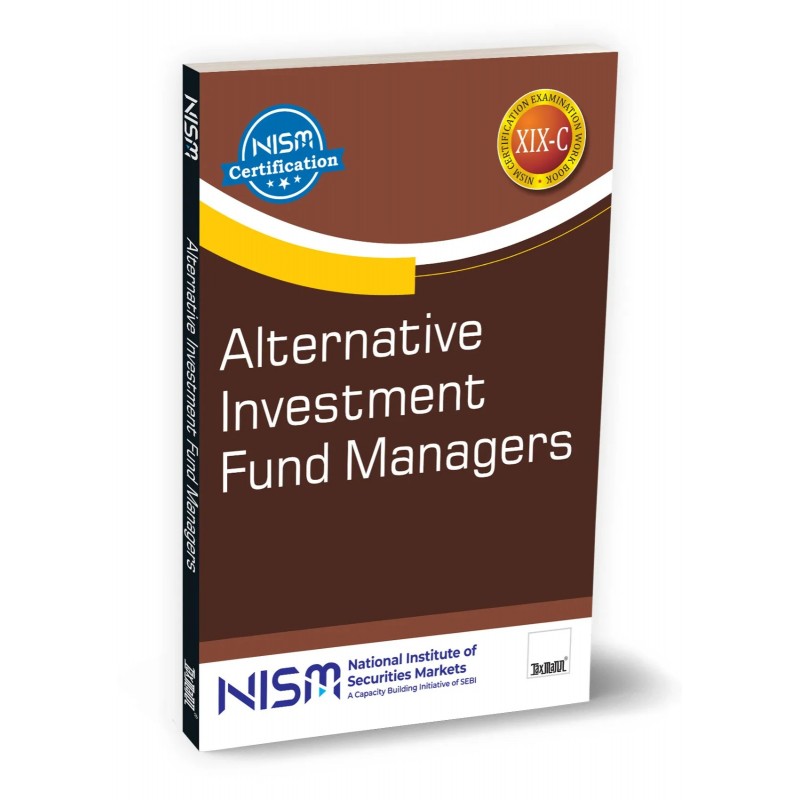
Alternative Investment Fund Managers Edition September 2026
Alternative Investment Fund Managers Edition September 2026
Description
Alternative Investment Fund Manager is a complete working treatment of Alternative Investment Funds in India, covering how an AIF is structured, priced, governed, valued, monitored, taxed, wound up and regulated. Published by Taxmann as the official NISM workbook, it serves equally as a desk reference for anyone who manages, advises, services or invests in an AIF.
The distinguishing feature is that the subject is computed, not merely described. Fee waterfalls, IRR and PME, NAV determination and tax liability are all worked through with figures, and every regulatory proposition is footnoted to the amendment or circular it comes from. It is also the prescribed study material for the NISM-Series-XIX-C: Alternative Investment Fund Managers Certification Examination, the certification SEBI has notified for the key investment team of an AIF Manager.
The Present Publication is the March 2026 Workbook Version. It is developed in collaboration with the Certification Team of NISM, Archit Lohia, Pratap Giri and Dr Rachana Baid and reviewed by Biharilal Deora and Taxmann’s Editorial Board. It is published exclusively by Taxmann, with the following noteworthy features:
- [Complete Coverage in One Volume] Portfolio theory to statutory detail, written so that a commercial term introduced in one chapter is computed in another and traced to its regulatory source in a third
- [Full Life-Cycle Fund Case] An eight-year close-ended fund worked in twelve steps: cash flows, gross and net fund IRR, the J-curve, hurdle rate distribution, the distribution waterfall, ROI metrics and investor-level net IRR
- [48 Worked Examples and Illustrations] Including NAV and Series NAV computation for a Category III AIF, index construction under three weighting methods, and three fully worked taxation examples at fund and unitholder level
- [Three Practitioner Annexures] A fund-level and investor-level risk factor template, a fund due diligence questionnaire, and the Investor Charter for AIFs, each drafted for direct use
- [Comparative Analysis in 21 Tables] Setting the three AIF categories, Category III against PMS and mutual funds, and domestic, offshore, parallel and unified structures side by side
- [Amended & Updated] Circular references running to 4 March 2026, covering the pro-rata and pari-passu framework, the dissolution period, the liquidation scheme and the specific due diligence obligations
- [Built-in Study Apparatus] Learning Objectives opening every chapter, self-assessment questions closing every chapter, and a glossary of private equity and venture capital terms
The coverage of the book is as follows:
- Investment Foundations (Chapters 1 to 5)
- The AIF Product and its Ecosystem (Chapters 6 to 8)
- Fund Economics and Benchmarking (Chapters 9 and 10)
- Strategy, Governance and Documentation (Chapters 11 to 13)
- Valuation, Monitoring and Exit (Chapters 14 and 15)
- Taxation and Regulation (Chapters 16 and 17)
The structure of the book is as follows:
- Cumulative Rather Than Modular — Waterfall mechanics introduced in Chapter 7 are computed in Chapter 9; the PPM introduced in Chapter 7 is documented and audited in Chapter 13; valuation in Chapter 14 feeds into the reporting obligations in Chapter 15
- A Fixed Chapter Template — Incorporates a Learning Objectives opening, self-assessment questions at the close, and headings numbered to three levels for targeted revision
- Weighted Towards Practice — Fee Structure, Fund Performance, and Regulatory Framework run to 87 pages each; the five theoretical chapters together occupy 80
- Three Annexures — They are placed at the end of the chapters they support, and there is a closing glossary
About the Author
The National Institute of Securities Markets (NISM) is an educational institution established in 2006 by the Securities and Exchange Board of India (SEBI), the regulator of India’s securities markets. Its creation followed the Union Finance Minister’s 2005–06 Budget announcement, which called for an institution dedicated to teaching, training, and conducting research in the securities markets.